
Pull to refresh
Logo
California requires data centers to pay for grid and water costs

California requires data centers to pay for grid and water costs

Rule Changes

Seven new laws shift power infrastructure costs from households to AI facilities

Today: Newsom signs seven data center bills

Overview

Updated 1 hour ago

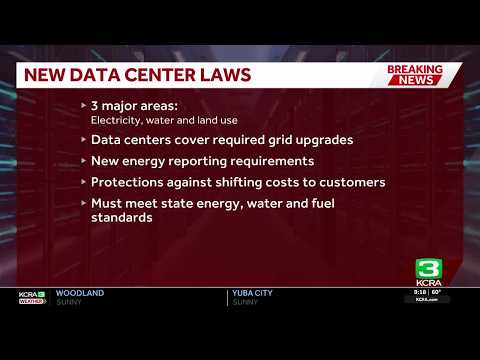
California Governor Gavin Newsom signed seven bills on Monday that force data center operators to pay for the power grid upgrades their facilities require. The laws also require operators to disclose projected water use, energy efficiency, and drought plans before local governments can approve new projects.

The package is a sharp reversal for the governor, who vetoed a water disclosure bill last year amid pressure from the tech industry. Now the California Public Utilities Commission must create a separate electricity rate classification for heavy data processing facilities so their energy use shows up on corporate bills, not household ones.

Three of the laws shift electric infrastructure costs away from residential customers and toward data center operators. Three more mandate disclosures of water and resource use. A seventh makes data centers ineligible for blanket exemptions from the state-mandated environmental review process.

Why it matters

If data centers absorb grid and water costs California previously spread across all ratepayers, the economics of AI infrastructure shift nationwide.

Questions about this story

Free account needed to ask — your question is kept and asked for you right after sign-up. Answers are public.

No questions yet — be the first to ask.

Key Indicators

7
Bills signed into law
The legislative package covering grid costs, water disclosure, and environmental review.
30-8
Senate vote on SB 887
Environmental review bill passed the state Senate 30-8, Assembly 59-11.
Jan 1, 2028
CPUC rate deadline
Utility commission must establish new data center tariffs and interconnection rules by this date.
28-10
Senate vote on SB 886
Rate design bill passed the upper house 28-10 before Newsom signed it.

Voices

Curated perspectives — historical figures and your fellow readers.

Ever wondered what historical figures would say about today's headlines?

Sign up to generate historical perspectives on this story.

People Involved

Organizations Involved

Timeline

September 2025 September 2026

4 events Latest: Today
Tap a bar to jump to that date
  1. Newsom signs seven data center bills

    Today Law

    Governor signed the package shifting grid costs to data centers, requiring water disclosure, and blocking environmental review exemptions.

  2. Assembly clears AB 2469 water disclosure bill

    Legislation

    Lawmakers barred local approval of data centers unless developers disclose water plans and pay for infrastructure costs.

  3. State Senate passes water transparency measure 30-9

    Legislation

    Senators approved the bill requiring data center operators to report water sources and use under penalty of perjury.

  4. Newsom vetoes water disclosure bill

    Policy

    Governor vetoed Papan's nearly identical water disclosure measure over concerns it would stifle AI growth.

Scenarios

1

Data center development slows in California as costs rise

Likely Resolves by End of 2027

Discussed by: Industry analysts and utility observers cited in KQED and Network World coverage

With operators now bearing transmission upgrade, generation, and wildfire mitigation costs, new facilities become significantly more expensive to build in California. Developers redirect capital to states with cheaper power and looser rules, such as Texas, despite its own permit moratorium. Existing projects already in the pipeline continue, but the state's share of new AI infrastructure shrinks.

2

Data center industry or utilities sue to block the rules

Possible Resolves by Q1 2028

Discussed by: Legal analysis in Lawyer Monthly and MLex coverage

Utilities or data center operators challenge the rate design requirements and environmental review restrictions in court. The lawsuit claims the CPUC rate classification oversteps state authority or that environmental requirements conflict with federal interconnection rules. Courts stay parts of the package while litigation proceeds, delaying the January 2028 deadline.

3

CPUC rate design works as intended; other states adopt similar rules

Possible Resolves by Q2 2028

Discussed by: Mark Toney of TURN and Senator Steve Padilla's office

The CPUC establishes cost-allocated tariffs by the January 2028 deadline, and data center costs appear on corporate bills rather than residential ones. Environmental review and water disclosure requirements go into effect without disruption. Other states facing data center strain use California's framework as a model, replicating the rate design and disclosure provisions.

Historical Context

2 moments from history that rhyme with this story — and how they unfolded.

May 2000 - September 2001

California electricity crisis (2000-2001)

After partial deregulation in 1996, California utilities faced wholesale power prices that spiked from $25 to over $1,400 per megawatt-hour. Enron traders exploited the market design, and the state experienced rolling blackouts. Pacific Gas & Electric declared bankruptcy. Ratepayers absorbed billions in costs through surcharges and long-term contracts the state signed at peak prices.

Then

The state spent roughly $40 billion on emergency power purchases, and the crisis triggered rolling blackouts across the state.

Now

California's electricity market remains partially deregulated, and the crisis poisoned public trust in shifting energy costs onto ratepayers.

Why this matters now

The new data center laws answer the same question posed in 2000: who pays when a small group of highly concentrated users drives grid costs? California regulators and consumer groups carry direct institutional memory of ratepayers absorbing costs that were pushed off corporate balance sheets.

2018 - 2025

Virginia data center boom and local backlash (2018-2025)

Northern Virginia became the world's largest data center market, hosting roughly 70 percent of global internet traffic at peak. Local utilities approved massive transmission upgrades, and ratepayer advocates warned that residential customers were subsidizing grid improvements for facilities owned by Amazon and other tech giants. Dominion Energy's rate filings showed residential customers covered a share of upgrade costs.

Then

Virginia data center construction continued, but ratepayer watchdogs documented cost-shifting onto households and environmental groups challenged projects on water and land use grounds.

Now

Virginia utilities and lawmakers began revisiting cost allocation, and the state became a cautionary example for other regions facing data center surges.

Why this matters now

California's package directly responds to the Virginia pattern of ratepayers subsidizing data center grid upgrades. The new laws are designed to prevent that cost-shifting from taking root in California.

Sources

(9)