

Pull to refresh
Logo
Red Hat discloses critical Quay flaws exposing private container images

Red Hat discloses critical Quay flaws exposing private container images

Built World

Two bugs in the registry's key server and robot-account search let attackers read, overwrite, or poison images across tenants.

Overview

Updated 1 hour ago

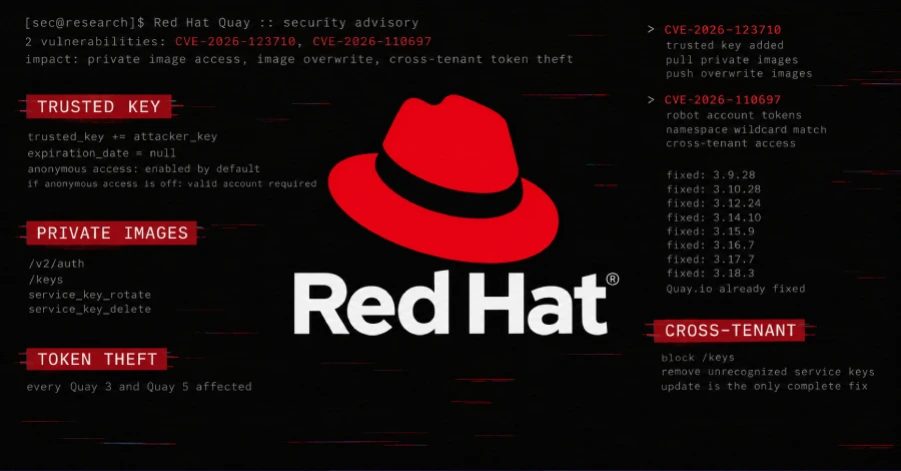
Red Hat disclosed two flaws in Quay, its container image registry, on November 16. One lets an unauthenticated attacker install a signing key that Quay trusts for every repository. The other lets any user who can create a namespace steal another tenant's robot-account tokens.

Quay sits between developers and production: it stores the images that servers pull and run. An attacker who can overwrite an image can plant code that reaches every system that later pulls it. Red Hat rates the flaws 9.8 and 9.9 out of 10.

Why it matters

If your organization runs Quay, an attacker who reaches it can read your private images and replace them before your next deployment.

Questions about this story

Free account needed to ask — your question is kept and asked for you right after sign-up. Answers are public.

No questions yet — be the first to ask.

Key Indicators

9.8
CVSS score, CVE-2026-123710
The signing-key flaw is rated critical under CVSS version 3.1.
9.9
CVSS score, CVE-2026-110697
The robot-account search flaw is rated slightly higher than the signing-key flaw.
8
Quay release branches with fixes
Red Hat shipped patches for versions 3.9.28 through 3.18.3.
0.66%
EPSS 30-day exploitation forecast
The model estimates a low but nonzero chance of exploitation in the next 30 days.

Voices

Curated perspectives — historical figures and your fellow readers.

Sign up to generate historical perspectives on this story.

People Involved

Organizations Involved

Timeline

3 events Latest: Yesterday
  1. Red Hat discloses two critical Quay flaws

    Latest Disclosure

    CVE-2026-123710 and CVE-2026-110697 affect every Quay 3 and Quay 5 version.

  2. Fixed Quay releases ship for eight branches

    Patch

    Versions 3.9.28 through 3.18.3 close both flaws; Red Hat says Quay.io is already fixed.

  3. Red Hat publishes Quay key-flaw remediation steps

    Advisory

    Guidance tells administrators to block the /keys endpoint and audit for signing keys with no expiry.

Scenarios

1

Exposed Quay registries patch before mass exploitation

Likely Resolves by Feb 28, 2027

Discussed by: Red Hat, which calls updating the only complete fix

Red Hat shipped fixed releases for eight branches and says Quay.io is already patched. The remaining risk is self-hosted registries that untrusted clients can reach, including internal ones. If administrators apply the updates and audit for unknown signing keys, the window closes.

2

Attackers exploit the Quay signing-key flaw in the wild

Possible Resolves by May 31, 2027

Discussed by: EPSS forecast and security press

The flaw needs only network access to a Quay registry and, with anonymous access on by default, no account. A public proof-of-concept or scanning campaign would raise the odds. The EPSS model puts 30-day exploitation probability at 0.66%, which is low but not zero.

3

Stolen robot tokens poison an OpenShift CI/CD pipeline

Possible Resolves by May 31, 2027

Discussed by: Red Hat's CVE-2026-110697 statement

An attacker creates a namespace with an underscore that collides with a victim's namespace, lists the victim's robot accounts, and uses their decrypted tokens to push a malicious image. In OpenShift, that image can enter a CI/CD pipeline. The attack needs no elevated privileges and no action from the victim.

Historical Context

2 moments from history that rhyme with this story — and how they unfolded.

December 2020

SolarWinds Orion supply-chain attack (2020)

Attackers linked to Russia's SVR compromised SolarWinds' build system and shipped a backdoored Orion update to about 18,000 customers, including U.S. government agencies.

Then

SolarWinds disclosed the breach in December 2020. Agencies disconnected Orion and scrambled to find compromised systems.

Now

The attack pushed software bills of materials and build-system security into federal procurement rules.

Why this matters now

Quay is a distribution chokepoint like Orion's update server. Trust in the registry is trust in every image it serves.

January 2021

Codecov Bash Uploader compromise (2021)

An attacker modified Codecov's Bash Uploader script, which customers ran in CI pipelines, to send environment variables to an external server.

Then

Codecov disclosed the breach in April 2021 and told customers to rotate credentials.

Now

The incident showed that CI/CD tooling can leak secrets without touching production systems.

Why this matters now

The Quay robot-token flaw targets the same layer: credentials that pipelines use to pull and push images.

Sources

(5)