
Pull to refresh
Logo
Kaiser trial finds digital reminders raise statin refills modestly

Kaiser trial finds digital reminders raise statin refills modestly

New Capabilities

A 20,604-patient randomized test of portal messages, texts and emails. Even in the best arm, about 85% of patients still did not refill.

Overview

Updated 56 minutes ago

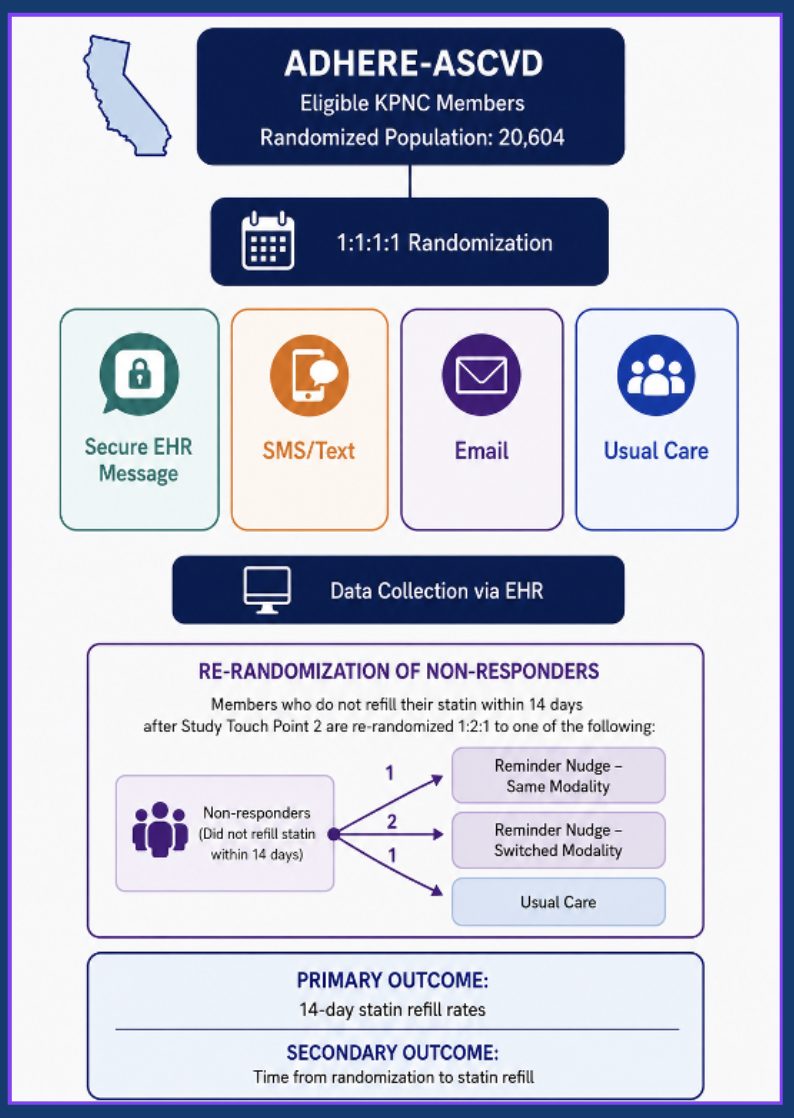
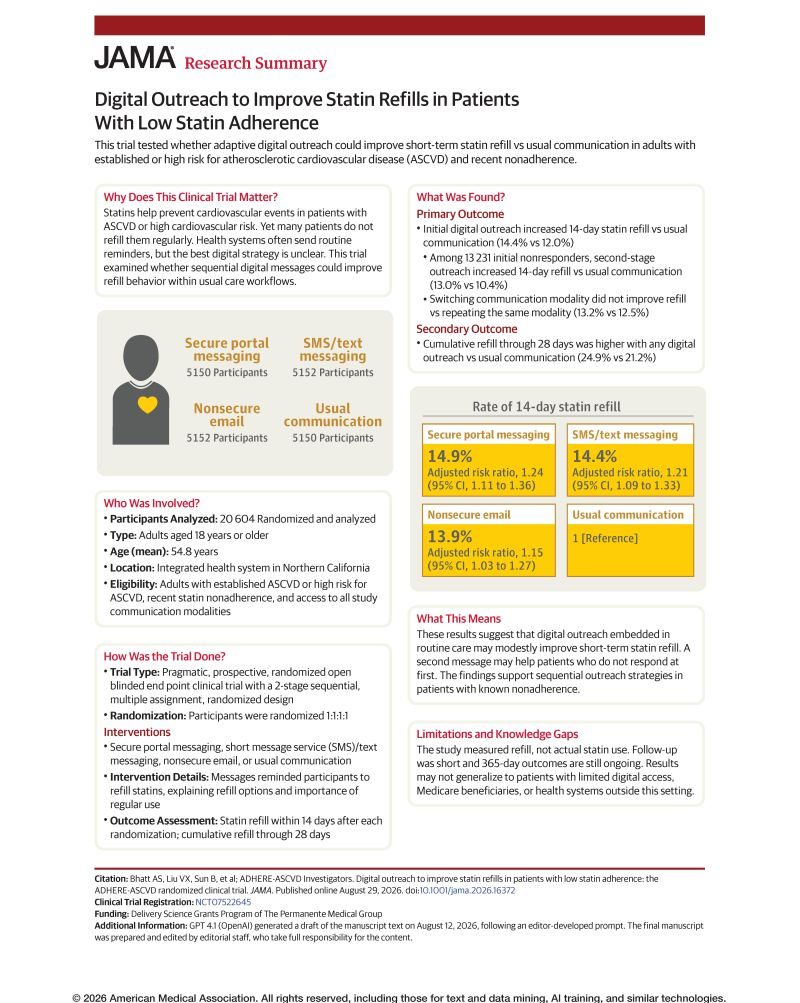
About one in five patients in a large Northern California health system had stopped refilling their statins. Kaiser Permanente sent 20,604 of them a secure portal message, a text, a nonsecure email, or nothing beyond usual communication, then counted who refilled.

Refills within 14 days rose from 12.0% with usual communication to 14.4% with a digital message. A second message to people who ignored the first added roughly 2.5 more points, while switching to a different channel added nothing beyond repeating the same one. Even in the best case, about 85% of patients still did not refill.

Why it matters

Health systems can send these messages tomorrow for almost nothing. The trial shows the ceiling is low: most nonadherent patients need more than a reminder.

Questions about this story

Free account needed to ask — your question is kept and asked for you right after sign-up. Answers are public.

No questions yet — be the first to ask.

Key Indicators

20,604
Patients randomized
Adults with established atherosclerotic cardiovascular disease or high risk of it, and a recent statin refill gap.
14.4%
Refilled within 14 days after a digital message
Pooled result across portal, text and email arms in the first randomization.
12.0%
Refilled within 14 days with usual communication
The comparison arm, which received no study outreach.
13,231
Initial nonresponders randomized a second time
Patients who had not refilled after the first message entered a second stage of the trial.
24.9%
Cumulative refill through 28 days, any digital outreach
Includes both the first and second outreach stages.
21.2%
Cumulative refill through 28 days, usual communication
The 28-day comparison figure for the no-outreach arm.
15.3%
Share with established cardiovascular disease
The rest had high cardiovascular risk without a prior event.

Voices

Curated perspectives — historical figures and your fellow readers.

Sign up to generate historical perspectives on this story.

People Involved

Organizations Involved

Timeline

August 2026 November 2026

2 events Latest: Yesterday
  1. Study appears in JAMA's November 3 print issue

    Latest Publication

    The randomized clinical trial runs in the journal's current issue, roughly two months after online release.

  2. Trial published online and presented at ESC

    Publication

    JAMA published ADHERE-ASCVD online as the results were presented at the European Society of Cardiology congress.

Scenarios

1

One-year data show the refill gain fades

Uncertain Resolves by End of 2027

Discussed by: The trial authors, who noted that follow-up beyond 28 days is still running and that the study measured refills rather than pills taken.

The 28-day result is a short window, and a refill is not the same as a filled pill bottle that gets used. If the 365-day analysis shows the two arms converging, the case for outreach becomes a case for a one-time nudge rather than an adherence program. That would push health systems toward pairing messages with cost relief, pharmacist follow-up, or side-effect counseling.

2

Kaiser Permanente makes sequential outreach standard practice

Possible Resolves by Q2 2027

Discussed by: Bhatt and the trial authors, who argue the findings support embedding adaptive outreach in population health programs.

The cheapest path from evidence to practice runs through the health system that generated it. A second message to nonresponders costs almost nothing and produced a measurable gain, so the operational question is whether Kaiser Permanente writes that sequence into routine statin management. Adoption there would give other integrated systems a working template and a set of real-world numbers.

3

A new trial targets the patients reminders cannot reach

Possible Resolves by End of 2027

Discussed by: Roeters van Lennep, who argued at ESC that the 85% who did not refill need deeper engagement, including strategies aimed at patients who actively decline statins.

The trial's own numbers point past itself. Most patients ignored every message, and the discussant's distinction between patients who cannot take a statin and patients who will not suggests the next test should attack cost, side-effect expectations, or trust rather than message delivery. A registered trial testing one of those levers would mark the field's move from reminders to persuasion.

Historical Context

3 moments from history that rhyme with this story — and how they unfolded.

Mid-2000s

Sequential multiple assignment randomized trials (mid-2000s)

Statisticians including Susan Murphy developed the sequential multiple assignment randomized trial, or SMART, to compare sequences of treatment decisions rather than one fixed treatment. Patients who fail a first-line option are randomized again, which mirrors how clinicians actually adjust care. Early uses were in mental health and addiction treatment.

Then

The design spread through psychiatry, behavioral health and later oncology as a way to test adaptive care.

Now

It gave researchers a formal method for asking whether a second intervention helps the people who did not respond to the first.

Why this matters now

ADHERE-ASCVD borrows that design wholesale. Patients who ignored the first message were randomized a second time, which is how the trial could test a sequence of reminders instead of a single one.

2000s-2010s

Reminder trials for medication adherence (2000s-2010s)

Hundreds of randomized trials tested text messages, automated calls and mailed reminders for drugs ranging from statins to HIV antivirals. Most were small, short and single-site, and many could measure only whether a prescription was filled, not whether the medicine was taken. Effects were usually small and often faded once the messages stopped.

Then

Health systems adopted reminders anyway, because the cost per message was trivial next to the drugs themselves.

Now

A consistent pattern emerged: reminders help people who meant to refill and forgot, and do little for people who decided to stop.

Why this matters now

This trial is the largest clean test of that pattern in statins, and it lands on the same answer: a real but small gain, concentrated among patients already inclined to act.

2010

Behavioral insights units in government (2010)

The United Kingdom set up a small team to test cheap behavioral tweaks in public services, starting with letters telling tax delinquents that most of their neighbors had already paid. The approach later moved into appointment attendance, benefit take-up and preventive care messaging.

Then

Some letters moved response rates by a few percentage points at negligible cost, which was enough to justify scaling them.

Now

The model spread to other governments and into health systems, which now run their own randomized tests of patient messaging.

Why this matters now

ADHERE-ASCVD applies the same bet to cardiovascular prevention, and produces the same order of result: a few points, cheaply, from a message most patients ignore.

Sources

(8)