

Pull to refresh
Logo
Watchman trial finds single-drug regimens match dual therapy after heart implant

Watchman trial finds single-drug regimens match dual therapy after heart implant

New Capabilities

The SIMPLAAFY results give Boston Scientific's device a path to simpler blood-thinner routines, with 12-month data still to come

Overview

Updated 1 hour ago

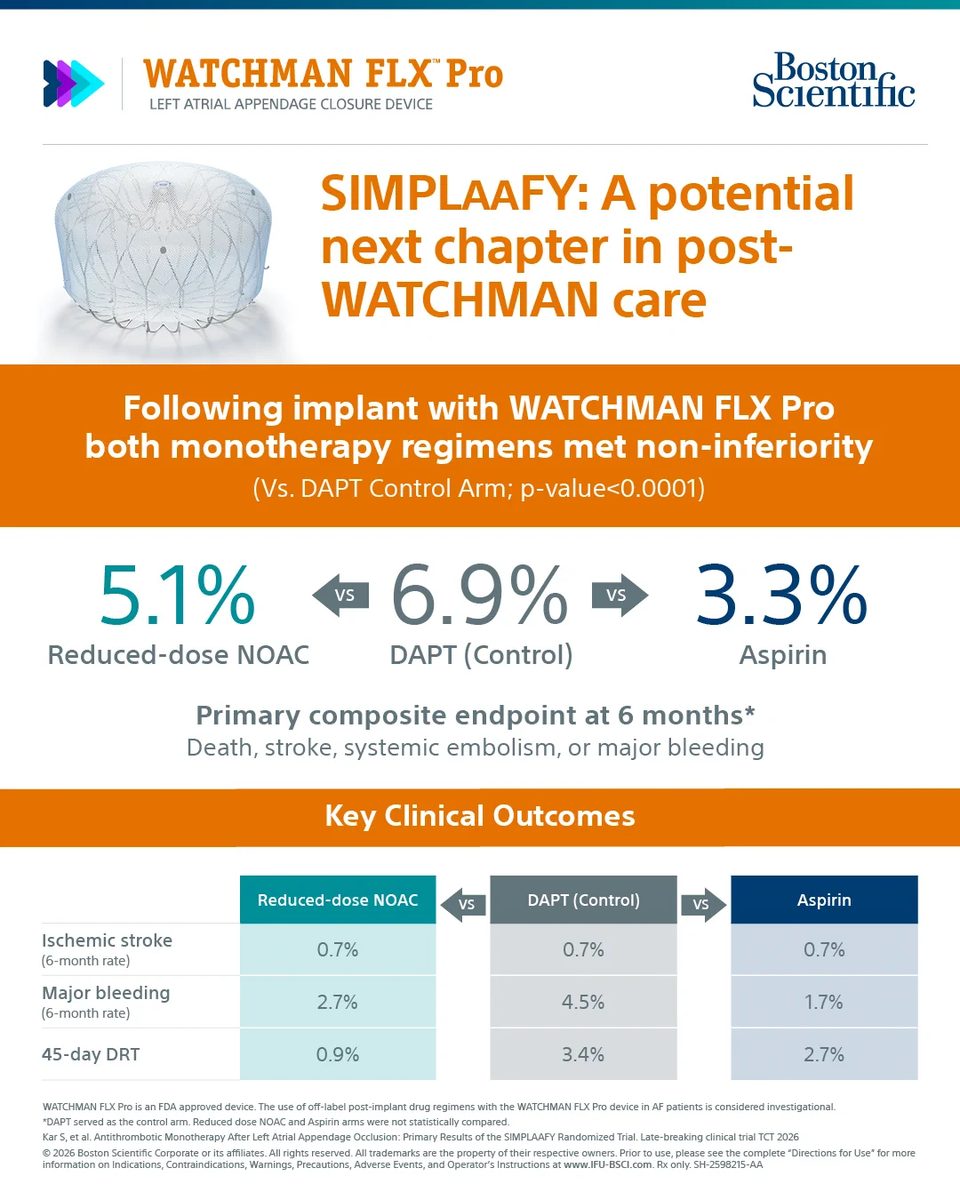
Patients who receive the Watchman device to seal off the left atrial appendage usually leave the hospital on two antiplatelet drugs at once. The SIMPLAAFY trial, reported November 2 at the Transcatheter Cardiovascular Therapeutics meeting in San Diego and published in JAMA, tested whether one drug would do. Across 1,857 patients at 87 US sites, both a reduced-dose oral anticoagulant and aspirin alone matched dual antiplatelet therapy on death, stroke, systemic embolism and major bleeding at six months.

The bleeding numbers are the ones that will travel. Major bleeding was 4.5% on dual therapy, 2.7% on the reduced-dose anticoagulant and 1.7% on aspirin alone. Ischemic stroke was 0.7% in every arm. Device-related thrombus, a clot forming on the implant itself, was 3.4% on dual therapy, 0.9% on the anticoagulant and 2.7% on aspirin.

Why it matters

Dropping to a single drug cut major bleeding from 4.5% to 1.7% in the trial, without a rise in ischemic stroke.

Questions about this story

Free account needed to ask — your question is kept and asked for you right after sign-up. Answers are public.

No questions yet — be the first to ask.

Key Indicators

1,857
Patients randomized
Enrolled across 87 US investigational sites between October 2024 and December 2025.
6.9%
Primary endpoint, dual antiplatelet therapy
Death, stroke, systemic embolism or major bleeding at six months.
5.1%
Primary endpoint, reduced-dose anticoagulant
Risk ratio 0.75 against dual therapy; noninferiority met.
3.3%
Primary endpoint, aspirin alone
Risk ratio 0.49 against dual therapy; noninferiority met.
0.7%
Ischemic stroke, all three arms
Identical rate across dual therapy, reduced-dose anticoagulant and aspirin.
13%
Discontinuation, dual therapy arm
Against 3% on the reduced-dose anticoagulant and 2% on aspirin alone.

Voices

Curated perspectives — historical figures and your fellow readers.

Sign up to generate historical perspectives on this story.

People Involved

Organizations Involved

Timeline

October 2024 November 2026

4 events Latest: Yesterday
Tap a bar to jump to that date
  1. Results presented at TCT and published in JAMA

    Latest Results

    Both monotherapy arms beat dual antiplatelet therapy on noninferiority, with less bleeding.

  2. Final six-month follow-up completed

    Trial

    Last patient reaches the six-month primary endpoint window.

  3. Enrollment closes at 1,857 patients

    Trial

    Final patient randomized; six-month follow-up continues into 2026.

  4. SIMPLAAFY begins randomizing patients

    Trial

    Enrollment opens at 87 US investigational sites, running through December 2025.

Scenarios

1

Cardiology guidelines name monotherapy as an acceptable post-implant regimen

Possible Resolves by End of 2027

Discussed by: TCT 2026 discussants and the JAMA authors, who wrote that routine dual antiplatelet therapy is not supported by the results

The trial's noninferiority findings and lower bleeding rates give guideline committees a randomized basis to soften the default recommendation. The JAMA discussion already sketches how clinicians might choose between the two monotherapies: signs of sluggish flow in the left atrium favor the reduced-dose anticoagulant, prior bleeding favors aspirin. A formal guideline update would make that choice standard rather than discretionary.

2

Twelve-month data show late clots or leaks that undercut the six-month result

Unlikely Resolves by Nov 2, 2027

Discussed by: The JAMA authors, who flagged that only six months of follow-up is reported and that imaging was assessed only at 45 days

The trial's device-related thrombus rates were exploratory and not adjusted for multiple comparisons. Aspirin's 2.7% rate sat between dual therapy's 3.4% and the anticoagulant's 0.9%, which leaves room for a late signal. The prespecified 12-month follow-up will show whether delayed peridevice leak or later-forming thrombus changes the picture.

3

Results stay confined to the Watchman FLX Pro and do not transfer to other devices

Possible Resolves by Q2 2028

Discussed by: Kar at TCT and the JAMA authors, both of whom noted the findings may not apply to devices with different surfaces or geometries

The trial studied one device with a fluoropolymer coating designed to speed healing. The authors wrote that the coating's contribution to the monotherapy outcomes is unknown. If other left atrial appendage closure devices do not replicate the result, monotherapy becomes a device-specific practice rather than a field-wide shift.

Historical Context

3 moments from history that rhyme with this story — and how they unfolded.

Before 2026

NCDR registry analysis leads to DAPT approval (before 2026)

An analysis of the mandated National Cardiovascular Data Registry Left Atrial Appendage Occlusion Registry found similar bleeding and device-related thrombus risk when comparing dual antiplatelet therapy with warfarin or oral anticoagulants after closure. That finding supported regulatory approval of dual antiplatelet therapy as a post-procedure regimen.

Then

Dual antiplatelet therapy became an accepted alternative for patients who should avoid anticoagulation.

Now

It became the comparator arm in later randomized trials, including SIMPLAAFY.

Why this matters now

SIMPLAAFY tested the regimen that registry data had legitimized, and found it carried the heaviest bleeding burden of the three options.

2026

ANDES trial (reported 2026)

The ANDES trial compared two months of direct oral anticoagulant therapy with two months of dual antiplatelet therapy after left atrial appendage closure, with most patients then switching to a single antiplatelet drug. The anticoagulant arm had less bleeding but a higher rate of device-related thrombus.

Then

The thrombus signal complicated the bleeding advantage and drew questions about whether it was a real effect or noise in a small trial.

Now

It set up SIMPLAAFY as the larger test of whether monotherapy could hold up.

Why this matters now

SIMPLAAFY's much larger sample gives a more precise read on the trade-off ANDES first raised.

Before 2026

HEAL-LAA postmarket study of the Watchman FLX Pro

The first prospective postmarket study of the Watchman FLX Pro found 82.7% complete seal at 45 days and favorable clinical outcomes through 12 months.

Then

Established a baseline seal rate for the coated device.

Now

Left open whether the coating changes how much antithrombotic therapy patients need.

Why this matters now

SIMPLAAFY's authors say the coating's role in the monotherapy results is unknown, which limits how far the findings travel.

Sources

(5)