

Pull to refresh
Logo
Federal labor board rejects NIH bid to strip its fellows' union

Federal labor board rejects NIH bid to strip its fellows' union

Rule Changes

A regional FLRA ruling keeps a first-of-its-kind contract covering roughly 5,000 early-career NIH researchers in place

Overview

Updated 1 hour ago

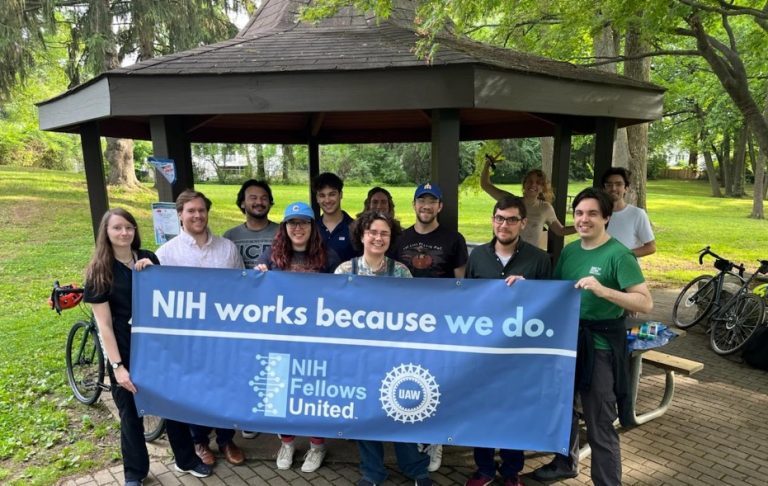
Roughly 5,000 postdocs, graduate students and postbaccalaureate researchers work in NIH's own labs on term-limited appointments. In December 2023 they voted 97.8% to unionize, and in December 2024 they ratified a contract covering pay, leave and harassment protections. On March 2, 2026, NIH told the union it should 'never have been certified' and asked a federal labor board to remove the fellows from the bargaining unit.

On October 29, 2026, the regional office of the Federal Labor Relations Authority (FLRA), which oversees labor relations for federal employees, rejected that petition. The ruling keeps the contract in force. The question the case turned on — whether people who hold training appointments are 'employees' with a right to bargain — is the same one that has shaped graduate-student union fights at universities for a decade.

Why it matters

If training status can void a ratified contract, no federal research trainee's bargaining rights are settled — and roughly 5,000 NIH labs' working conditions hang on the answer.

Questions about this story

Free account needed to ask — your question is kept and asked for you right after sign-up. Answers are public.

No questions yet — be the first to ask.

Key Indicators

5,000
Fellows in the bargaining unit
Approximate number of early-career researchers NIH's union represents nationwide.
97.8%
Union election yes vote
Share of voting fellows who backed UAW representation in December 2023.
98.3%
Contract ratification vote
Share of voting fellows who approved the first contract in December 2024.
2027
Contract term runs through
The agreement NIH moved to undo was set to run through 2027.

Voices

Curated perspectives — historical figures and your fellow readers.

Sign up to generate historical perspectives on this story.

People Involved

Organizations Involved

Timeline

December 2023 October 2026

6 events Latest: 2 days ago
Tap a bar to jump to that date
  1. FLRA hearing on the petition

    Hearing

    NIH's Lori Conlan testifies that fellows 'are not employees.'

  2. NIH withdraws recognition of the union

    Statement

    An email to union leaders says the bargaining unit 'should never have been certified.'

  3. First contract ratified

    Agreement

    98.3% of members approve a contract covering pay, leave, health and safety, and grievances.

  4. NIH fellows vote to unionize

    Election

    97.8% of voting fellows back UAW representation; the FLRA certifies the unit on December 15.

Scenarios

1

NIH drops the challenge and the contract runs to 2027

Possible Resolves by Q1 2027

Discussed by: NIH Fellows United, which publicly called on the agency to stop pursuing the petition

The agency accepts the regional ruling, stops litigating, and administers the contract through its 2027 expiration. Fellows keep the pay, leave and grievance provisions while attention shifts to negotiating a successor agreement.

2

NIH appeals to the full FLRA Authority

Uncertain Resolves by Q2 2027

Discussed by: Labor-relations lawyers tracking the case, including McGuireWoods

NIH asks the FLRA's members in Washington to review the regional decision. That would put the employee-versus-trainee question before the full Authority, with the contract's status potentially in question during review.

3

NIH tries again after the contract expires

Possible Resolves by Q2 2028

Discussed by: Union leaders, who say they are preparing for 'what comes next'

Rather than appeal, the agency waits out the agreement and challenges the unit at the next certification cycle, when a change in circumstances is easier to argue. That would reopen the trainee question with a fresh record and a new contract at stake.

Historical Context

3 moments from history that rhyme with this story — and how they unfolded.

August 2016

Columbia University graduate union decision (2016)

The National Labor Relations Board reversed a 2004 precedent and held that graduate students at private universities who work as teaching and research assistants are employees with a right to unionize. Organizing spread across campuses in the years that followed.

Then

Graduate workers at several private universities voted to unionize.

Now

The employee question stayed contested, and the board revisited it under later administrations.

Why this matters now

The same employee-versus-student argument NIH made about its fellows is the argument that has decided graduate union cases at universities.

September 2019

NLRB proposed student-employee rule (2019)

During the first Trump administration, the labor board proposed a rule stating that students who work for their universities are not employees. The rule was never put into effect.

Then

The proposal signaled a shift in federal posture but changed no existing bargaining relationships.

Now

The underlying question remained open, leaving agencies and universities to argue it case by case.

Why this matters now

It shows how often the trainee question has been raised and abandoned at the federal level, the same pattern NIH itself followed in 2023.

2023

NIH's own 2023 reversal

Before the union vote, NIH signaled it would oppose certification on the grounds that its trainees were not employees. The agency then backed away, allowed the election, and negotiated a contract it later ratified with the union.

Then

Fellows won the first union certification for scientific trainees in the federal government.

Now

The agency's later reversal of that position became the basis for the 2026 dispute.

Why this matters now

It explains why the FLRA found NIH's petition procedurally weak: nothing about the unit had changed since the agency itself accepted it.

Sources

(7)