
Pull to refresh
Logo
CERN finds strong evidence of quantum entanglement in Z bosons from Higgs decays

CERN finds strong evidence of quantum entanglement in Z bosons from Higgs decays

New Capabilities

ATLAS and CMS measure the effect at 4.7 sigma, just below the discovery threshold

Today: ATLAS and CMS announce strong evidence of Z boson entanglement

Overview

Updated 1 hour ago

Physicists at CERN have found strong evidence that Z bosons, the particles that carry the weak nuclear force, become quantum entangled when produced in Higgs boson decays. The result, based on proton collisions at 13 trillion electron volts, shows that Einstein's "spooky action at a distance" persists at the most extreme energies ever tested in a laboratory.

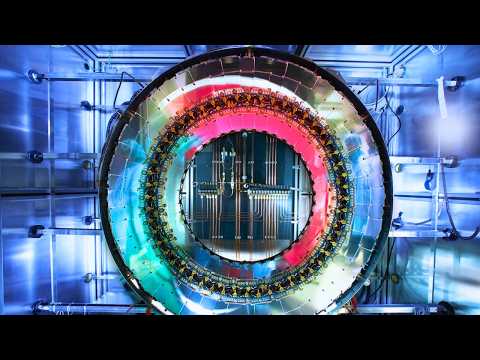
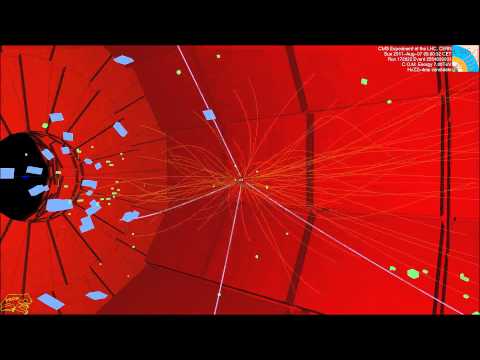
Researchers with the ATLAS and CMS experiments reconstructed the spins of Z bosons from the electrons and muons those particles decay into. The spin correlations matched what quantum theory predicts for entangled pairs—and what classical physics would not allow. The statistical significance is 4.7 sigma, just below the 5-sigma bar particle physicists use for a formal discovery.

A Higgs boson weighs 125 gigaelectron volts, and a Z boson weighs 91. Two ordinary Z bosons would weigh 182, too heavy for the Higgs to produce, so at least one Z in each event is a virtual, off-shell particle. That makes this result a test of how quantum effects survive in short-lived, heavy particles—and a new technique for probing the Higgs boson itself.

Why it matters

Confirms quantum entanglement survives at collider energies, giving physicists a new probe of the Higgs boson and potential clues to physics beyond the Standard Model.

Questions about this story

Free account needed to ask — your question is kept and asked for you right after sign-up. Answers are public.

No questions yet — be the first to ask.

Key Indicators

4.7σ
Statistical significance of entanglement evidence
Strong evidence, but below the 5σ threshold required for a formal discovery.
~400
Higgs-to-four-lepton events analyzed
Rare decay signature collected across LHC runs 2 and 3 by ATLAS and CMS.
13 TeV
Proton collision energy
The highest design energy of the Large Hadron Collider.

Voices

Curated perspectives — historical figures and your fellow readers.

Ever wondered what historical figures would say about today's headlines?

Sign up to generate historical perspectives on this story.

People Involved

Organizations Involved

Timeline

July 2012 September 2026

3 events Latest: Today
  1. ATLAS and CMS announce strong evidence of Z boson entanglement

    Today Announcement

    The result confirms spooky action at a distance at 13 TeV collision energies.

  2. Z boson entanglement study published in Physical Review Letters

    Publication

    The paper reports 4.7-sigma evidence for quantum entanglement between Z bosons from Higgs decays.

  3. Higgs boson discovery announced at CERN

    Discovery

    ATLAS and CMS report a new particle consistent with the Standard Model Higgs boson.

Scenarios

1

Z boson entanglement crosses 5 sigma, declared a discovery

Possible Resolves by End of 2030

Discussed by: ATLAS and CMS collaboration physicists; CERN's statement on high-luminosity opportunities

As LHC Run 3 and later the high-luminosity upgrade accumulate more Higgs-to-four-lepton events, the statistical significance of the entanglement measurement grows. If it reaches 5 sigma, the collaborations will call it an observation, matching the top quark entanglement milestone from 2024.

2

Entanglement signal fades as dataset grows

Unlikely Resolves by End of 2030

Discussed by: Coverage in ScienceAlert, which notes the analysis rests on roughly 400 rare events

If systematic uncertainties in reconstructing off-shell Z bosons are larger than estimated, the significance could dip below 4.7 sigma as more data arrives. A weaker signal would not falsify quantum mechanics—it would mean the measurement itself was not clean enough.

3

Entanglement observables become a standard probe at the LHC

Likely Resolves by End of 2032

Discussed by: phys.org coverage of quantum information techniques crossing into particle physics

Researchers borrow tools from quantum information science to analyze collider data, using entanglement as an observable to test the Higgs boson's couplings and hunt for deviations from the Standard Model. This unfolds as a program rather than a single measurement, with more particle species and production channels added over time.

Historical Context

3 moments from history that rhyme with this story — and how they unfolded.

1972-1982

Bell test experiments (1972-1982)

John Clauser ran the first test of Bell's inequality with entangled photons in 1972. Alain Aspect repeated it with cleaner setups in 1981-82, closing loopholes and confirming that quantum correlations cannot be explained by hidden variables. Einstein had called the effect 'spooky action at a distance.'

Then

Aspect's results settled the decades-long debate in favor of quantum mechanics.

Now

The work underpinned quantum cryptography, quantum computing, and earned Clauser, Aspect, and Anton Zeilinger the 2022 Nobel Prize in Physics.

Why this matters now

The same phenomenon the Z boson result now confirms, but tested at tabletop scale with photons rather than in particle decays at 13 TeV.

July 2012

Higgs boson discovery (2012)

ATLAS and CMS announced the discovery of a new particle with mass around 125 gigaelectron volts, consistent with the Standard Model Higgs boson, completing the particle set predicted by theory.

Then

Confirmed the mechanism by which particles acquire mass; earned François Englert and Peter Higgs the 2013 Nobel Prize.

Now

Turned the LHC toward precision study of the Higgs, including its decays and quantum properties.

Why this matters now

The Z bosons in this new measurement come from Higgs decays, making entanglement a fresh probe of the discovery particle's own properties.

September 2024

Top quark entanglement at the LHC (2024)

The CMS collaboration at the LHC reported observation of quantum entanglement between top quark pairs produced in proton collisions. It was the first entanglement measurement at a particle collider.

Then

Demonstrated that quantum information techniques work in the messy environment of collider physics.

Now

Established a template for measuring entanglement at high energies, which the Z boson result extends.

Why this matters now

The top quark is a fermion; the Z boson carries a force. Confirming the effect in Z bosons from Higgs decays extends the approach to a new particle class and into the Higgs sector.

Sources

(6)