



Pull to refresh
Logo
Bethe strings, predicted in 1931, created in ultracold cesium gas

Bethe strings, predicted in 1931, created in ultracold cesium gas

New Capabilities

Innsbruck team binds atoms in one-dimensional tubes without chemical bonds; earlier sightings came in magnetic solids

3 days ago: Innsbruck announces the result

Overview

Updated 1 hour ago

A quantum state predicted in 1931 now exists in a laboratory. Physicists in Innsbruck cooled cesium atoms near absolute zero, squeezed them into thousands of one-dimensional tubes, and watched them bind into clusters called Bethe strings.

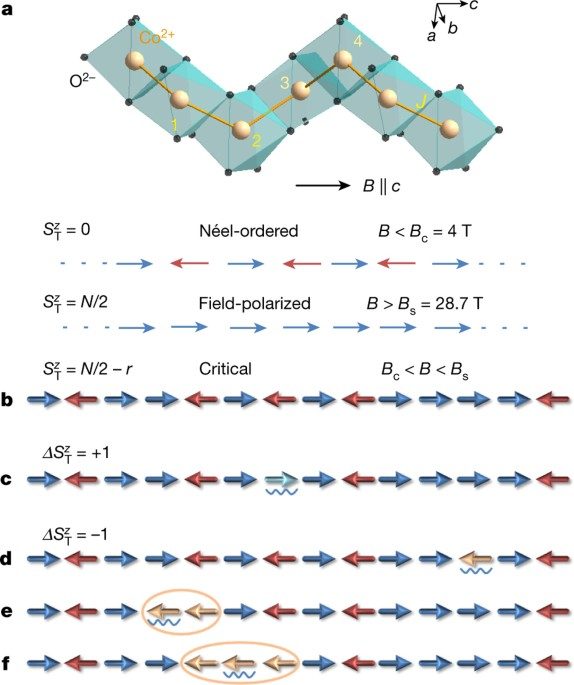
The binding needs no chemical bonds. The atoms hold together through their interactions alone, in clusters six or more particles wide, and the strings survive collisions intact. Earlier sightings came in magnetic solids; this is the first time they have been built in a gas where researchers control the geometry and interaction strength.

Why it matters

Bethe strings give physicists a knob-controlled laboratory system to test quantum many-body theory, the mathematics behind superconductors and other complex materials.

Questions about this story

Free account needed to ask — your question is kept and asked for you right after sign-up. Answers are public.

No questions yet — be the first to ask.

Key Indicators

95
Years from Hans Bethe's 1931 prediction to laboratory creation
The prediction stood for nearly a century before being realized in an ultracold gas.
~4,000
One-dimensional tubes confining the cesium gas
A two-dimensional optical lattice sliced the cloud into thousands of independent tubes.
6+
Atoms in the largest Bethe string clusters
Bound groups of six or more particles formed without conventional chemical bonds.
10–35
Cooling temperature of cesium atoms, in nanokelvin
Atoms were held within a few billionths of a degree of absolute zero.

Voices

Curated perspectives — historical figures and your fellow readers.

Ever wondered what historical figures would say about today's headlines?

Sign up to generate historical perspectives on this story.

People Involved

Organizations Involved

Timeline

1931 October 2026

3 events Latest: 3 days ago
  1. Innsbruck announces the result

    Latest Announcement

    The University of Innsbruck publicizes the discovery, and ScienceDaily and other outlets report it as a 1931 prediction coming to life.

  2. Bethe string experiment published

    Publication

    Innsbruck, Amsterdam, and Munich teams report creating Bethe strings in ultracold cesium gas in Nature Communications.

  3. Bethe predicts one-dimensional bound states

    Theoretical Prediction

    Hans Bethe publishes the Bethe ansatz, showing particles in one dimension can lock into collective bound states now called Bethe strings.

Scenarios

1

Innsbruck extends Bethe string experiments to new regimes

Likely Resolves by End of 2027

Discussed by: The Innsbruck team, which says the platform enables controlled study of string formation and interaction

The group continues with the cesium setup, probing how strings form, collide, and respond as interaction strength and particle density change. The paper's generalized hydrodynamics simulations give a baseline to test against, so follow-up results would likely appear in the same or related journals.

2

Independent labs build Bethe strings in other atomic gases

Possible Resolves by Q2 2028

Discussed by: The ultracold-atom community, since the method uses standard tools: optical lattices and Feshbach resonances

Other groups could reproduce the result with different species, such as lithium or potassium, because the technique is adaptable to any Bose gas with tuneable interactions. Independent confirmation would strengthen the claim that the strings are real and robust beyond one atomic species.

3

Indirect detection draws scrutiny or replication trouble

Possible Resolves by End of 2028

Discussed by: Commentators noting the evidence is an energy gap and momentum width, not direct imaging of individual strings

The detection is inferential, backed by theory rather than pictures of strings. A competing group could argue the data admit alternative explanations, or a replication attempt could fail. Such a challenge would push the Innsbruck team toward more direct probes, such as single-string imaging.

Historical Context

3 moments from history that rhyme with this story — and how they unfolded.

1924–1995

Bose-Einstein condensation (1924–1995)

Einstein predicted in 1924-25 that cooling a gas of bosons near absolute zero would collapse its atoms into a single quantum state. In 1995, Eric Cornell and Carl Wieman at JILA created the first Bose-Einstein condensate in rubidium, and Wolfgang Ketterle did the same with sodium at MIT. The three shared the 2001 Nobel Prize.

Then

The 1995 creations launched an entire field of ultracold-atom physics.

Now

BECs became workhorse tools for quantum simulation, precision measurement, and atom interferometry.

Why this matters now

Both stories show a theoretical prediction taking decades to confirm with ultracold atomic gases, then turning prediction into laboratory tools.

1916–2015

Gravitational wave detection (1916–2015)

Einstein's general relativity predicted gravitational waves in 1916. In September 2015, the Laser Interferometer Gravitational-Wave Observatory (LIGO) detected ripples from two merging black holes, confirming the prediction a century later.

Then

The detection opened a new way to observe the universe, by listening to gravity rather than light.

Now

Gravitational-wave astronomy became a routine observing mode, with dozens of events catalogued.

Why this matters now

A theory published decades earlier was confirmed only when experimental technology caught up, the same pattern as Bethe strings.

1964–2012

Higgs boson discovery (1964–2012)

Peter Higgs and others predicted a particle that gives other particles mass in 1964. In July 2012, the Large Hadron Collider at CERN detected a particle matching the Higgs boson's predicted properties, completing the Standard Model of particle physics.

Then

The discovery confirmed the mechanism of mass generation and earned the 2013 Nobel Prize for Higgs and François Englert.

Now

It showed that predictions from abstract theory could be verified precisely, guiding where to build and look.

Why this matters now

A half-century-old theoretical prediction, confirmed only after instruments grew powerful enough to test it.

Sources

(5)