
Pull to refresh
Logo
CERN finds gluons behaving strangely deep inside atomic nuclei

CERN finds gluons behaving strangely deep inside atomic nuclei

New Capabilities

ALICE experiment's high-resolution measurement favors gluon saturation over conventional nuclear shadowing

Yesterday: ScienceDaily and major outlets report the finding

Overview

Updated 1 hour ago

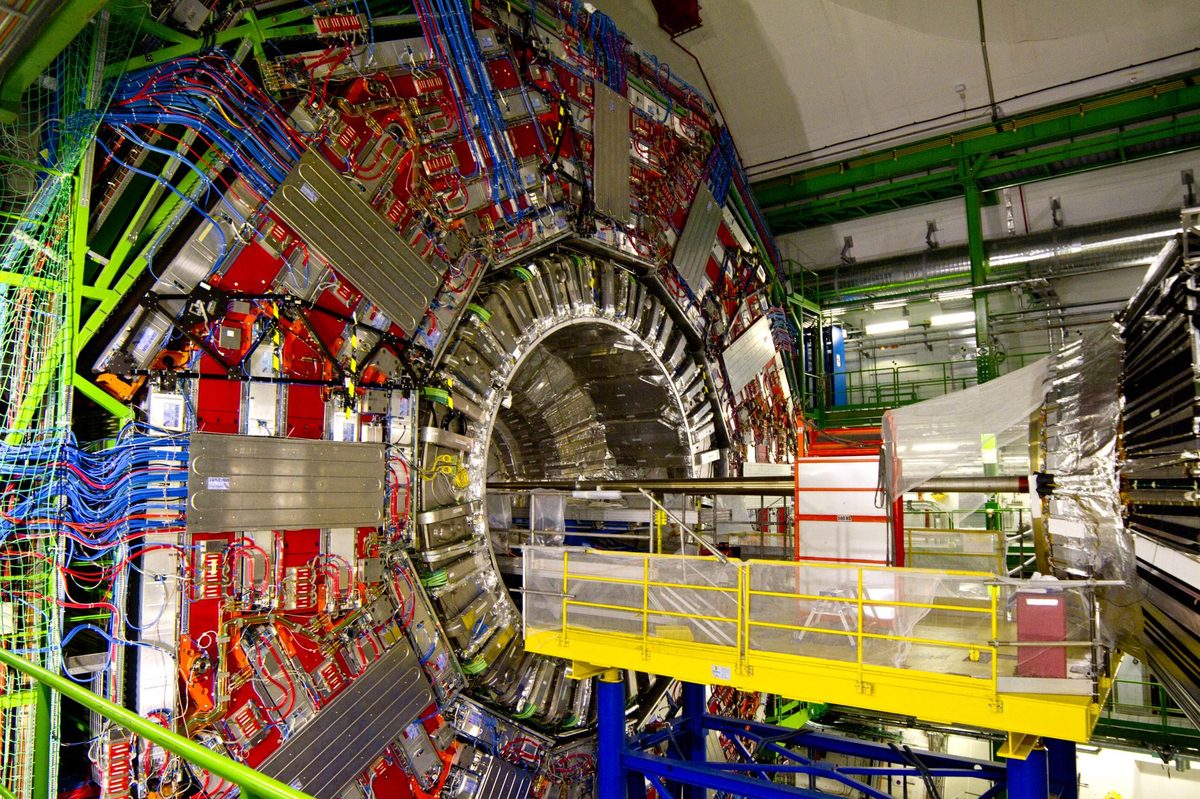
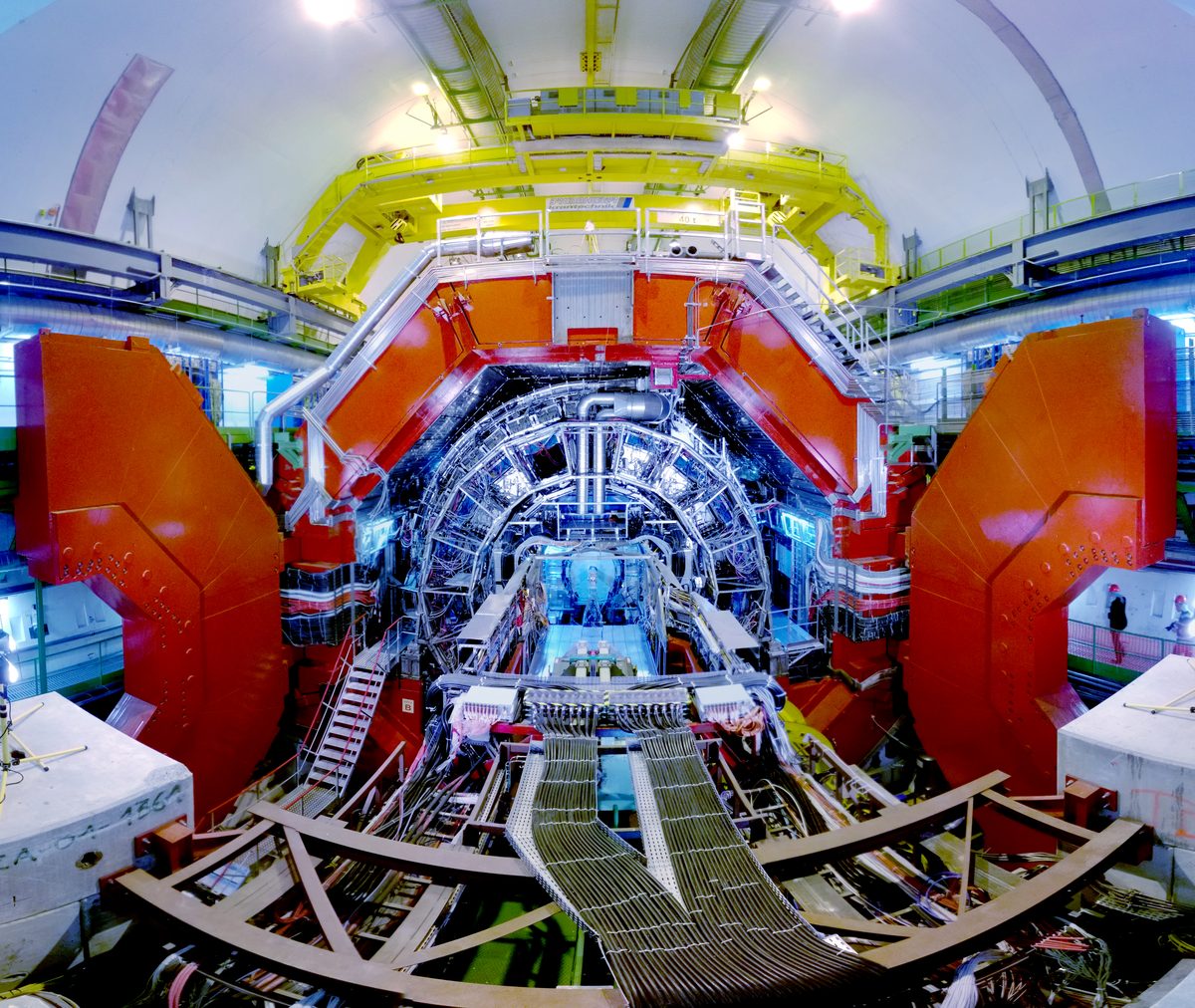
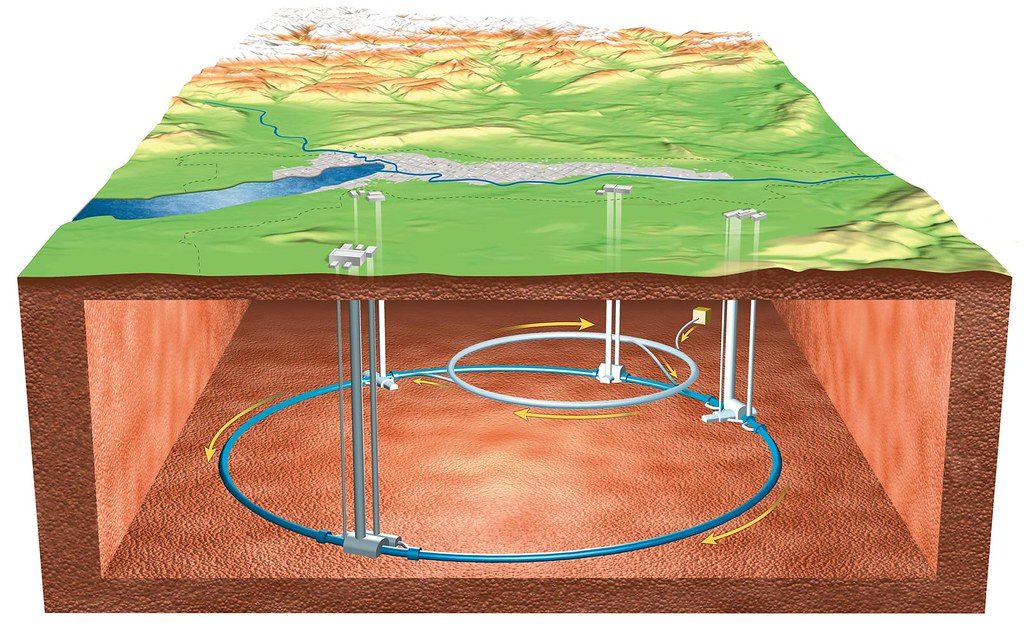
Physicists at CERN have found a new way to peer inside atomic nuclei, zooming in on structures about one-quarter the size of a proton. Using the ALICE experiment at the Large Hadron Collider, they measured production of a particle called J/ψ (pronounced "JAY-sigh") at unprecedentedly fine resolutions—and saw something that challenges a decades-old explanation.

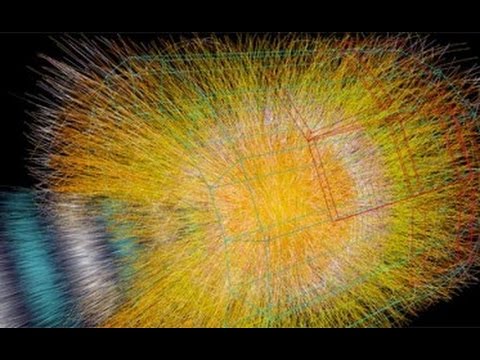
At the smallest scales, J/ψ production dropped significantly, a suppression that conventional "nuclear shadowing" can't fully explain. The data instead match a prediction called gluon saturation, where gluons pack so densely inside nuclei that they begin interacting strongly with one another. If confirmed, it would mark a major step in understanding the strong force that binds 99% of visible matter.

Why it matters

Gluons make up nearly all visible matter in the universe; understanding how they organize inside nuclei could explain how matter gets its mass and structure.

Questions about this story

Free account needed to ask — your question is kept and asked for you right after sign-up. Answers are public.

No questions yet — be the first to ask.

Key Indicators

Statistical significance of J/ψ suppression at smallest scales
About three standard deviations — suggestive but not yet the five-sigma gold standard for particle physics discovery.
0.2 femtometers
Finest spatial resolution achieved
Structures about one-quarter the size of a proton, probed by varying momentum transfer.
20–633 GeV
Photon-nucleus energy range measured
Incoherent J/ψ production measured across this wide energy band during LHC Run 2.
Run 2
LHC data-taking period used
Data collected from 2015–2018 when lead nuclei passed close without directly colliding.

Voices

Curated perspectives — historical figures and your fellow readers.

Ever wondered what historical figures would say about today's headlines?

Sign up to generate historical perspectives on this story.

People Involved

Organizations Involved

Timeline

June 2015 September 2026

4 events Latest: Yesterday
Tap a bar to jump to that date
  1. ScienceDaily and major outlets report the finding

    Latest Coverage

    News of the gluon saturation evidence spreads across physics and science media.

  2. ALICE publishes first multidimensional gluon measurement

    Publication

    Physical Review Letters reports incoherent J/ψ production across energy and momentum transfer, showing suppression inconsistent with nuclear shadowing alone.

  3. LHC Run 2 concludes after three years of data collection

    Operations

    ALICE accumulates the ultra-peripheral collision dataset later analyzed for this result.

  4. LHC Run 2 begins with lead-lead collisions

    Operations

    Data-taking period begins that would later be used for the gluon measurement.

Scenarios

1

Gluon saturation confirmed at 5-sigma significance

Possible Resolves by End of 2028

Discussed by: Tapia Takaki and the ALICE collaboration; physics community following the preprint

ALICE and other LHC experiments (including Run 3 data now being collected) accumulate more statistics. The suppression pattern sharpens past the five-sigma threshold, the gold standard for discovery claims in particle physics. This would establish gluon saturation as an observed phenomenon, not just a theoretical prediction.

2

Nuclear shadowing revision accommodates new data

Possible Resolves by End of 2028

Discussed by: Theoretical physicists who developed shadowing models

Refined shadowing models — updated to include spatial fluctuations, energy dependence, or other effects the earlier frameworks omitted — reproduce the measured suppression pattern. The data get absorbed into an expanded version of the older framework, and gluon saturation remains unproven.

3

Electron-Ion Collider becomes the decisive test

Likely Resolves by End of 2035

Discussed by: Brookhaven National Laboratory and the US Department of Energy

The Electron-Ion Collider (EIC) under construction at Brookhaven, scheduled for the 2030s, is specifically designed to map gluon distributions with far higher precision than the LHC can achieve. Its first results could settle whether gluon saturation truly occurs or whether shadowing-like effects explain everything.

Historical Context

2 moments from history that rhyme with this story — and how they unfolded.

1992–2007

HERA deep inelastic scattering (1992–2007)

The HERA accelerator at DESY in Hamburg collided electrons and protons, producing the first detailed measurements of gluon distributions inside protons. It revealed how gluons carry about half the proton's momentum and how their density grows sharply at small values of Bjorken-x.

Then

HERA data established the standard framework for parton distribution functions used in all subsequent collider analyses.

Now

The observed rapid gluon growth at small x raised the question of whether gluon densities eventually saturate — exactly the question ALICE's new measurement now probes inside nuclei.

Why this matters now

HERA measured gluons inside single protons. ALICE now measures them inside entire nuclei at even finer resolution, directly testing whether the same growth patterns lead to saturation when gluons are packed into nuclear volumes.

July 2012

Discovery of the Higgs boson (2012)

CERN announced discovery of a new particle consistent with the long-predicted Higgs boson, completing the Standard Model of particle physics. Two experiments — ATLAS and CMS — independently observed it with 5-sigma significance from LHC proton-proton collision data.

Then

François Englert and Peter Higgs won the 2013 Nobel Prize in Physics. The discovery confirmed the mechanism by which elementary particles acquire mass.

Now

It marked the Standard Model's completion but also exposed its gaps — dark matter, neutrino masses, and the strong force's confinement remain unexplained, driving the search for physics beyond the Standard Model.

Why this matters now

Like the Higgs discovery, this gluon measurement comes from an LHC experiment testing a foundational prediction of quantum field theory. Both required advances in detector technology and analysis techniques to probe territory no experiment had reached before.

Sources

(7)