
Logo
Daily Brief
Following
Why
EU and Mercosur Sign World's Largest Free Trade Agreement After 26 Years

EU and Mercosur Sign World's Largest Free Trade Agreement After 26 Years

A quarter-century of failed negotiations ends with a deal covering 700 million consumers

Overview

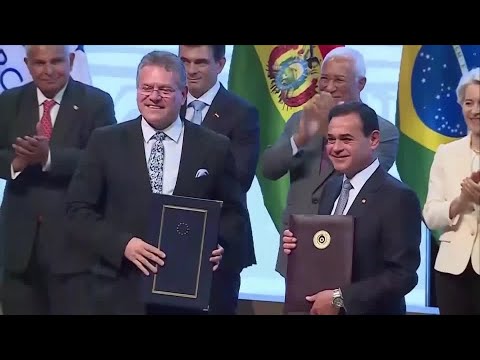
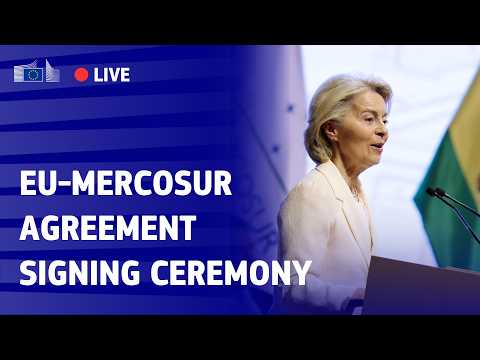
Negotiations between the EU and Mercosur began in 1999. Twenty-six years later, on January 17, 2026, representatives signed a comprehensive free trade agreement in Asunción, Paraguay—the same city where Mercosur itself was founded in 1991. The deal eliminates tariffs on more than 90% of bilateral trade and creates the world's largest free trade zone, covering over 700 million consumers and roughly a quarter of global GDP.

The agreement still requires European Parliament consent and ratification by Mercosur member legislatures. France, Ireland, Austria, Poland, and Hungary voted against in the EU Council, and European farmers are mobilizing opposition. The European Parliament vote is expected by April or May 2026. If ratified, the deal would reshape transatlantic commerce and mark a significant EU pivot toward Latin America amid rising U.S. tariffs and growing Chinese influence in the region.

Key Indicators

700M+
Consumers in combined market
The EU-Mercosur zone covers more people than the US, China, or any other free trade area.
90%
Tariffs eliminated
More than 90% of bilateral trade will become tariff-free, phased in over 10-15 years.
€4B
Annual EU savings
European Commission estimate of customs duties saved annually by EU companies.
21-5
EU Council vote
Council approved signature with Austria, France, Hungary, Ireland, and Poland voting against.

People Involved

Ursula von der Leyen
President of the European Commission (Led EU delegation at signing ceremony)
Javier Milei
Javier Milei
President of Argentina (Signed agreement, plans to submit to Congress for ratification)
Luiz Inácio Lula da Silva
President of Brazil (Supports agreement but did not attend signing ceremony)
Maroš Šefčovič
Maroš Šefčovič
EU Trade Commissioner (Leading European Parliament lobbying effort)
Emmanuel Macron
Emmanuel Macron
President of France (Opposes the agreement)

Organizations Involved

Mercosur
Mercosur
Regional Trade Bloc
Status: Party to the agreement

South American customs union comprising Argentina, Brazil, Paraguay, Uruguay, and Bolivia.

European Commission
European Commission
EU Executive Body
Status: Negotiated and signed agreement on EU's behalf

The EU's executive branch, responsible for proposing legislation and negotiating trade agreements.

COPA-COGECA
COPA-COGECA
Agricultural Trade Union
Status: Opposes the agreement

European farmers' union representing 23 million farmers across the EU.

European Parliament
European Parliament
EU Legislative Body
Status: Must consent to agreement before it takes effect

The EU's directly elected legislative body, whose consent is required for trade agreement ratification.

Timeline

  1. Agreement Signed in Asunción

    Signing

    EU and Mercosur leaders sign the comprehensive partnership agreement at a ceremony in Paraguay's capital, creating the world's largest free trade zone.

  2. EU Council Approves Signature

    Vote

    EU member states vote 21-5 to authorize signing. Austria, France, Hungary, Ireland, and Poland vote against; Belgium abstains.

  3. Final Agreement Announced

    Milestone

    Von der Leyen announces conclusion of negotiations at Mercosur summit in Montevideo. Signing delayed to early 2026 at Italy's request.

  4. Scholz and Milei Signal Support

    Diplomatic

    German Chancellor Scholz and Argentine President Milei meet in Berlin, both expressing support for concluding the deal.

  5. Amazon Fires Spark Backlash

    Opposition

    Record Amazon deforestation under Brazil's Bolsonaro government prompts EU members to threaten withdrawal from the deal.

  6. Agreement in Principle Reached

    Milestone

    At the G20 Osaka summit, negotiators announce agreement in principle after 20 years of talks.

  7. Third Relaunch

    Negotiation

    EU and Mercosur exchange new market access offers and intensify negotiations.

  8. Second Stall

    Stall

    Progress slows amid disagreements on beef quotas and environmental standards. Talks suspended again.

  9. Negotiations Resume

    Negotiation

    Talks restart at the VI EU-Latin America Summit after six-year hiatus.

  10. First Breakdown

    Stall

    Negotiations stall over agricultural market access and industrial tariffs. Talks suspended indefinitely.

  11. EU-Mercosur Negotiations Launch

    Negotiation

    The EU and Mercosur launch formal negotiations for a comprehensive association agreement in Rio de Janeiro.

  12. Mercosur Founded in Asunción

    Formation

    Argentina, Brazil, Paraguay, and Uruguay sign the Treaty of Asunción, creating Mercosur as a regional customs union.

Scenarios

1

European Parliament Ratifies Deal by Mid-2026

Discussed by: European Commission officials, German MEP Bernd Lange (trade committee chair), Atlantic Council analysts

The EPP and S&D parliamentary groups, which together hold a majority, vote in favor. French and Irish opposition proves insufficient to block consent. The agreement enters into provisional force by end of 2026, with full implementation phased over 10-15 years. EU automakers and Mercosur agricultural exporters begin benefiting from tariff reductions immediately.

2

Parliament Delays or Blocks Ratification

Discussed by: French government officials, COPA-COGECA, Greenpeace EU, Stop EU-Mercosur coalition

Farmer protests escalate across Europe as the 2027 French election approaches. MEPs from agricultural regions defect from their party lines. The Parliament either delays the consent vote indefinitely or rejects the agreement outright, sending negotiators back to the table. The deal joins a growing list of stalled EU trade agreements.

3

ECJ Rules Deal Incompatible with EU Treaties

Discussed by: Patriots for Europe parliamentary group, ECR group, environmental NGOs

The European Parliament votes to seek an ECJ opinion on the agreement's compatibility with EU law, particularly regarding environmental provisions and the EU Deforestation Regulation. The court process delays ratification by 12-18 months. If the ECJ identifies incompatibilities, the deal requires renegotiation.

4

Mercosur Member Fails to Ratify

Discussed by: Brazilian economists, opposition lawmakers in Mercosur countries

While ratification is broadly expected in South America, domestic opposition—particularly from Brazilian industrialists who fear European competition—delays or blocks legislative approval in one or more Mercosur countries. The agreement cannot enter into force without all four founding members ratifying.

Historical Context

NAFTA Renegotiation to USMCA (2017-2020)

August 2017 - July 2020

What Happened

President Trump demanded renegotiation of the 1994 North American Free Trade Agreement, threatening U.S. withdrawal. After 14 months of contentious talks marked by tariff threats and stalemates, the U.S., Mexico, and Canada signed the USMCA in November 2018. Congressional approval followed in January 2020.

Outcome

Short Term

The new agreement raised automotive content requirements to 75% and introduced a 16-year sunset clause with mandatory six-year reviews.

Long Term

The USMCA demonstrated that even established trade agreements can be fundamentally renegotiated under political pressure. The 2026 mandatory review is now expected to trigger another round of negotiations.

Why It's Relevant Today

Both cases involve decades-old trade frameworks being reshaped by changing political dynamics. The EU-Mercosur deal shows how protectionist pressures can paradoxically accelerate trade agreements—the EU pursued Mercosur partly to diversify away from Trump-era U.S. tariffs.

EU-Canada CETA Negotiations (2009-2017)

May 2009 - September 2017

What Happened

The EU and Canada negotiated a comprehensive trade agreement over five years, concluding in August 2014. Ratification then stalled when Belgium's Wallonia region threatened to veto the deal over investor-state dispute provisions. Last-minute concessions allowed provisional application in September 2017.

Outcome

Short Term

The near-collapse over a regional veto exposed vulnerabilities in EU trade policy ratification.

Long Term

CETA established the template for 'new generation' EU trade agreements with chapters on investment, services, and sustainable development. It remains only provisionally applied—10 EU member states have still not completed national ratification.

Why It's Relevant Today

CETA's ratification struggles foreshadow the challenges facing EU-Mercosur. The same countries that blocked or delayed CETA—France, Belgium, Ireland—are now opposing Mercosur. The Commission's decision to split the agreement into trade and non-trade pillars was designed to avoid the CETA ratification trap.

EU-UK Trade and Cooperation Agreement (2020)

March - December 2020

What Happened

The EU and UK negotiated a post-Brexit trade agreement in just 10 months, reaching a deal on December 24, 2020—one week before the transition period expired. The compressed timeline forced rapid compromises on fishing rights, level playing field provisions, and Northern Ireland arrangements.

Outcome

Short Term

The TCA prevented tariffs on UK-EU trade but introduced significant non-tariff barriers. It entered into provisional force on January 1, 2021.

Long Term

The rushed agreement left numerous issues unresolved, requiring ongoing negotiations on financial services, data adequacy, and the Northern Ireland protocol. A mandatory review is due in 2026.

Why It's Relevant Today

The contrast is instructive: EU-UK took 10 months under deadline pressure; EU-Mercosur took 26 years with no hard deadline. The difference illustrates how political will—or its absence—determines negotiation timelines more than technical complexity.

15 Sources: