


Pull to refresh
Logo
FDA clears NeuroXT's NEXT-Cue for Alzheimer's risk prediction

FDA clears NeuroXT's NEXT-Cue for Alzheimer's risk prediction

New Capabilities

A Seoul device maker wins Class II clearance for software that estimates five-year progression from mild cognitive impairment

Overview

Updated 53 minutes ago

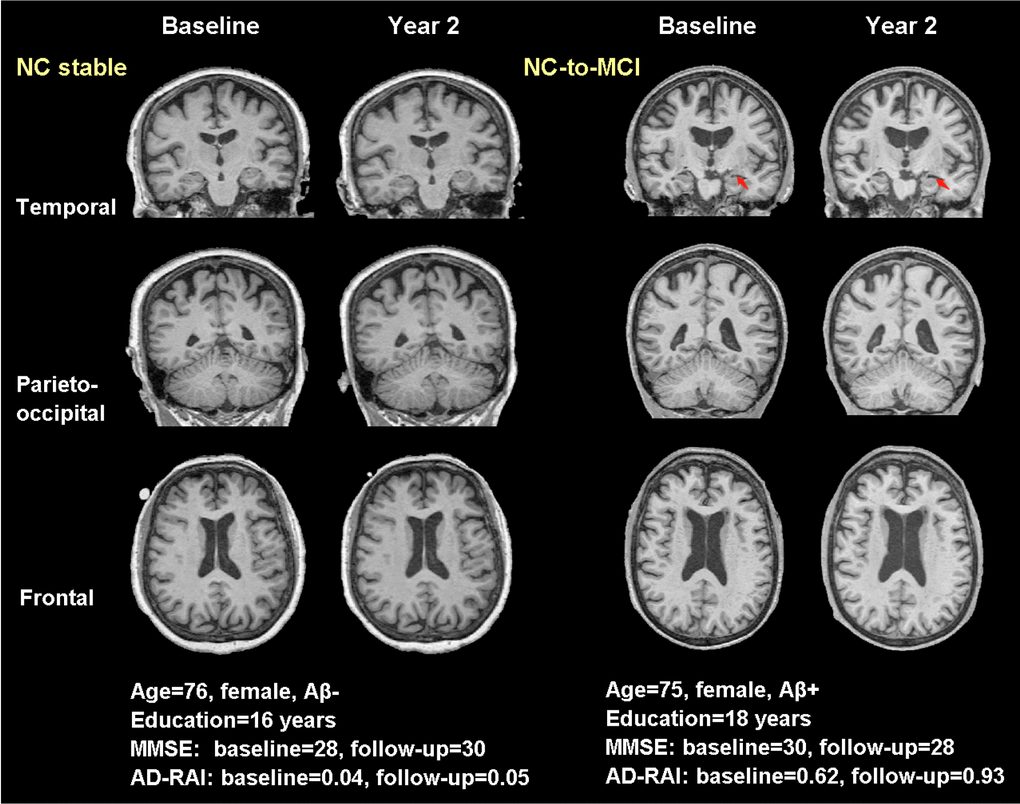
For years, software that reads a brain scan has been cleared to report what is visible now: a bleed, a lesion, a narrowed vessel. NEXT-Cue is cleared to report something else — how likely a patient already diagnosed with mild cognitive impairment is to develop Alzheimer's dementia within five years.

The Food and Drug Administration granted NeuroXT, a Seoul-based device maker, 510(k) clearance on Oct. 8, 2026. The device sits in a Class II category written specifically for prognostic software in mild cognitive impairment, defined at 21 CFR 882.1454. Its output is adjunctive: supplementary information for a clinician, not a diagnosis.

That boundary carries the commercial and clinical stakes. Anti-amyloid treatments work best in early disease, so a tool that flags likely progression could shape who gets monitored, scanned, or referred for treatment planning.

Why it matters

If prognostic AI becomes routine, Alzheimer's care shifts from diagnosis to triage: who gets monitored, scanned, or treated early.

Questions about this story

Free account needed to ask — your question is kept and asked for you right after sign-up. Answers are public.

No questions yet — be the first to ask.

Key Indicators

129
FDA review time
Days from receipt of the application on June 1, 2026 to the decision on Oct. 8, 2026.
5 years
Prediction window
The period over which the software estimates progression to Alzheimer's dementia.
3
Data sources combined
Brain MRI images, demographic information, and cognitive assessment results.

Voices

Curated perspectives — historical figures and your fellow readers.

Sign up to generate historical perspectives on this story.

People Involved

Organizations Involved

Timeline

2024 October 2026

7 events Latest: Yesterday
Tap a bar to jump to that date
  1. Company targets U.S. hospital partners, early-2027 Korean launch

    Latest Company

    NeuroXT restates plans to build clinical use cases in the U.S. before selling at home.

  2. NeuroXT announces clearance

    Company

    The company says it will pursue U.S. hospital partnerships and is seeking Korean approval.

  3. FDA grants substantial equivalence

    Regulatory

    The agency clears NEXT-Cue as a Class II device for prognostic assessment in mild cognitive impairment.

  4. FDA clarifies radiology AI exemption

    Regulatory

    A final order narrows which AI radiology tools need a full 510(k) submission.

  5. FDA receives 510(k) K261805

    Regulatory

    NeuroXT files a Traditional 510(k) for NEXT-Cue under product code QWT.

  6. Follow-on research agreement signed

    Research

    NeuroXT and Beth Israel Deaconess extend their collaboration to patients who have received Alzheimer's treatment.

  7. NeuroXT starts U.S. biomarker research

    Research

    The company begins MRI-based Alzheimer's imaging research with Beth Israel Deaconess Medical Center in Boston.

Scenarios

1

NeuroXT wins Korean approval and launches NEXT-Cue at home

Likely Resolves by Q1 2027

Discussed by: NeuroXT's own announcement; Korean trade press coverage

The company said it is pursuing a license from Korea's Ministry of Food and Drug Safety and aims to begin domestic sales in early 2027. Approval would make Korea the second market and the company's first home-market launch.

2

A named U.S. health system signs a NEXT-Cue pilot

Possible Resolves by Q2 2027

Discussed by: NeuroXT management statements; U.S. trade coverage

NeuroXT says it plans to establish clinical use cases at leading U.S. institutions. A public announcement from a named hospital or health system would be the first evidence that clearance converts into clinical use. Without one, the clearance remains a regulatory milestone.

3

Independent validation of NEXT-Cue's predictions is published

Uncertain Resolves by End of 2027

Discussed by: Korean trade press commentary on the need for external validation

Prognostic software has to be checked against what actually happened to patients, not against the data it learned from. That requires a cohort outside the development set and follow-up over the prediction window. A peer-reviewed study meeting that bar would give clinicians and buyers something the clearance itself does not.

Historical Context

2 moments from history that rhyme with this story — and how they unfolded.

April 2018

IDx-DR becomes the first autonomous AI diagnostic cleared in the U.S. (2018)

The FDA allowed marketing of IDx-DR, software that analyzes retinal photographs and returns a screening result for diabetic retinopathy without a clinician reading the image first. It was the first device of its kind the agency permitted.

Then

The clearance showed that software alone could issue a clinical finding, opening a path for AI screening in primary care.

Now

It became the reference point for later AI devices that asked regulators to trust an algorithm's output rather than assist a human reader.

Why this matters now

NEXT-Cue asks the FDA to trust software with a forecast rather than a finding, one step further from what a clinician can directly observe.

2023–2026

Anti-amyloid Alzheimer's treatments shift attention to early detection (2023–2026)

A new class of antibody treatments that clear amyloid plaques from the brain reached the U.S. market. They work best in patients at the mild stage of the disease, which made identifying likely progressors more clinically useful.

Then

Clinics needed ways to sort mild cognitive impairment patients by risk, and imaging and biomarker testing volumes rose.

Now

The value of a prognosis tool depends on whether it changes monitoring or referral decisions, which remains unproven for most such software.

Why this matters now

NEXT-Cue's commercial case rests on that shift: without treatments that reward early identification, a five-year forecast has less to act on.

Sources

(10)