
Pull to refresh
Logo
FMCSA opens comment on Saia's plan to train permit holders on double trailers

FMCSA opens comment on Saia's plan to train permit holders on double trailers

Rule Changes

A five-year exemption request would let about 300 learner's permit holders a year pull doubles under supervision before earning the endorsement

Overview

Updated 54 minutes ago

A driver holding only a commercial learner's permit can already operate an 80,000-pound tractor-trailer on a public road, provided a licensed instructor rides along. Federal rules stop at the second trailer: permit holders cannot pull doubles until they hold a full commercial driver's license (CDL) with a doubles/triples endorsement, and states are barred from issuing that endorsement to a permit.

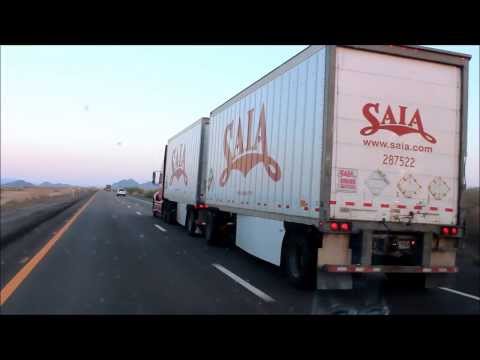
Saia LTL Freight wants a five-year exemption to train about 300 permit holders a year in double-trailer rigs under direct supervision. The Federal Motor Carrier Safety Administration (FMCSA) published the request on November 18, 2026, with comments open through December 18. The agency has not decided.

Why it matters

The change would let a national freight carrier put permit holders behind doubles before they finish licensing, a training order other fleets could copy.

Questions about this story

Free account needed to ask — your question is kept and asked for you right after sign-up. Answers are public.

No questions yet — be the first to ask.

Key Indicators

300
Trainees per year under Saia's request
The company estimates the exemption would cover about 300 permit holders annually.
19
Training vehicles in Saia's fleet
Saia's application limits the program to roughly 19 training rigs.
80,000 lbs
Maximum gross vehicle weight for training
Saia proposes to restrict training to vehicles at or below this weight.
0
States allowed to issue a doubles endorsement to a permit holder
Federal rules prohibit state licensing agencies from issuing the T endorsement on a learner's permit.
18
Comments opposing UPS's similar 2022 request
FMCSA received 18 objections to the UPS doubles-training exemption and granted it anyway.

Voices

Curated perspectives — historical figures and your fellow readers.

Sign up to generate historical perspectives on this story.

Organizations Involved

Timeline

September 2022 November 2026

3 events Latest: Yesterday
  1. FMCSA opens comment on Saia's doubles-training request

    Latest Regulatory

    The notice seeks comment through December 18 on a five-year exemption covering about 300 trainees a year.

  2. PAM Transport requests unsupervised permit-holder driving

    Regulatory

    A separate docket would cover 500 to 700 permit holders a year who already passed the skills test.

  3. FMCSA grants UPS a doubles-training exemption

    Regulatory

    The five-year exemption let UPS train permit holders in twin 28-foot trailers despite 18 opposing comments.

Scenarios

1

FMCSA grants Saia a five-year doubles-training exemption

Likely Resolves by End of 2027

Discussed by: FreightFiles and Big Rig Report, both of which point to the 2022 UPS grant as the template

FMCSA reviews the comment docket, weighs Saia's safeguards against the compliance baseline, and publishes a grant with terms: direct supervision by a T-endorsed instructor, a company knowledge test, yard proficiency checks, and an 80,000-pound weight cap. This is the path the agency took with UPS, which drew organized opposition and still won approval.

2

FMCSA narrows the exemption before approving it

Possible Resolves by End of 2027

Discussed by: Industry trade coverage, which notes the agency has attached conditions to past training exemptions

The agency grants relief but trims it: a shorter term than five years, a smaller trainee or vehicle count, added reporting on crashes and citations, or a requirement that trainees complete a set number of single-trailer miles first. Safety advocates who objected to the UPS request on experience grounds would likely push for exactly these limits.

3

FMCSA denies Saia's request outright

Unlikely Resolves by End of 2027

Discussed by: Commenters who opposed the 2022 UPS exemption on the grounds that new drivers need single-trailer experience first

The agency concludes that doubles training cannot be made equivalent to compliance before a driver holds a CDL with the endorsement, or that Saia's safeguards are thinner than the ones it accepted from UPS. A denial would leave the current sequence intact: earn the CDL, pass the doubles knowledge test, then train on doubles.

Historical Context

2 moments from history that rhyme with this story — and how they unfolded.

September 2022

UPS twin 28-foot trailer training exemption (2022)

UPS asked FMCSA for five years of relief so permit holders could train with twin 28-foot trailers rather than waiting for a full CDL and the doubles endorsement. The agency logged 18 public comments in opposition, including one arguing that new drivers need experience before handling doubles.

Then

FMCSA granted the exemption, reasoning that the rules require only a knowledge test for the doubles endorsement, not a skills test.

Now

The grant became the template for carrier-specific doubles training and is the precedent Saia's application is measured against.

Why this matters now

Saia is asking for essentially the same relief UPS received, which is why a grant is the likeliest outcome rather than a novel policy question.

October 2026

PAM Transport's no-instructor request (2026)

PAM Transport filed a separate exemption request, docketed as FMCSA-2026-3466, seeking to let 500 to 700 permit holders a year who already passed the CDL skills test drive without a CDL holder in the front seat. FMCSA published the notice on October 27, 2026.

Then

The comment window ran 30 days; no decision has been reported.

Now

Undecided. It sits alongside Saia's request as one of two pending moves to expand what permit holders can legally do.

Why this matters now

Both dockets test the same boundary, but they pull in opposite directions: Saia adds a supervisor, PAM removes one. FMCSA's reasoning in each will shape how far carriers can restructure driver training.

Sources

(6)