Anchor

AI-designed IPF drug enters Phase III trial, a first for generative AI
New CapabilitiesRentosertib targets TNIK, a kinase AI linked to fibrosis; 52-week readout to come
Yesterday: Insilico announces Phase III initiationNew here? Follow stories to track developments over time. Create a free account to get updates when stories you care about change.
Overview
Updated YesterdayInsilico Medicine dosed the first patient this week in a Phase III trial of Rentosertib, a drug for the progressive lung disease idiopathic pulmonary fibrosis. It's the first medicine with both an AI-identified target and an AI-designed molecule to reach this stage of testing.
The 320-patient, 52-week study runs at 47 hospitals across China and compares Rentosertib against placebo on the rate of lung-function decline. The outcome will test the core claim of AI drug discovery: that generative models can find treatments faster and cheaper than traditional chemistry.
Rentosertib inhibits TNIK, a kinase no one had previously tied to fibrosis. Insilico's PandaOmics platform flagged the target by scoring genes with multi-omics data from fibrotic tissue — a target class not previously associated with the disease.
Why it matters
If Rentosertib succeeds, it validates that generative AI can discover viable medicines — a claim the industry has made for years without proof.
Questions about this story
Free account needed to ask — your question is kept and asked for you right after sign-up. Answers are public.
No questions yet — be the first to ask.
Key Indicators
320
Patients enrolled in Phase III trial
Across 47 centers in China, randomized to Rentosertib or placebo for 52 weeks.
52
Weeks of treatment in study
Primary endpoint measures the annual rate of decline in forced vital capacity.
+98.4 mL
Phase IIa FVC change, 60 mg arm
Mean forced vital capacity change at 12 weeks versus -20.3 mL for placebo.
47
Clinical trial sites
Hospitals across China recruiting for GENESIS-IPF-3.
Related Media

Insilico Medicine Doses First Patient in GENESIS-IPF-3, the World's First Phase III Trial of

First AI-designed drug, Rentosertib, officially named by USAN | News | Drug Target Review
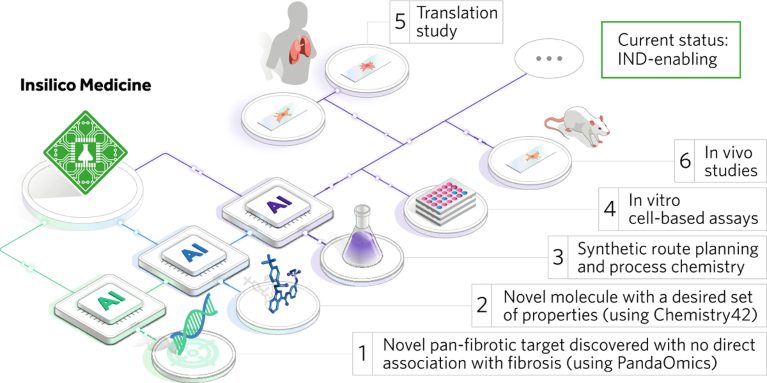
Insilico: linking target discovery and generative chemistry AI platforms for a drug discovery breakthrough | Biopharma Dealmakers

2 views
4:36
The world's first AI-discovered drug just entered Phase 3 trials
Medpharm Global

157 views
18:09
AI Generated Drug Slows Aging? What Rentosertib Really ...
Binary Verse AI

261 views
14:12
Rentosertib talk with Fedor Galkin, PhD, and Alex Zhavoronkov ...
Insilico Medicine
Images from Openverse under Creative Commons licenses. Videos from YouTube.
Voices
Curated perspectives — historical figures and your fellow readers.
Play
Exploring all sides of a story is often best achieved with Play.
Most of these play right now — no account needed. Sign up to save scores, keep a streak, and unlock Debate and Predict.
Log in
Sign Up
Higher or Lower
A number from this story, against one from elsewhere in the news — guess which is bigger, then keep the chain going. 5 rounds, 3 strikes; a miss costs a strike and resets your streak.
Example
Anchor
EU tariff revenue
$52B
Big for this kind of number
Mystery
Pentagon AI contract
?
Round 1
Streak: 0
Mystery
?
Keyboard: ↓/L lower · ↑/H higher
0 pts
Best streak: 0 · Rounds: 0
0 points — sign up to put that on the leaderboard.
Now try on this story
Connections
Sixteen names from the news. Find the four hidden groups of four. Four mistakes max.
Loading today's puzzle…
0/4 groups
Mistakes
Sign up to keep a daily streak — a new puzzle lands every day.
Now try on this story
Exit debate?
Your progress in this debate will be lost.
How it works
- 1 Two AI personas square off on this story.
- 2 You predict who'll win each round — correct picks earn XP.
- 3 One crossfire question is yours to fire. Pick it carefully.
Couldn't generate a topic
Select Your Champions
Choose one persona for each side of the debate
DEBATE TOPIC
Choose personas with different perspectives for a more dynamic debate.
SIDE A (PRO)
Select debater for this side:
No debate personas available right now.
SIDE B (CON)
Select debater for this side:
No debate personas available right now.
VS
Get ready to make your prediction...
Round of
Claim
Evidence
Stakes
Crossfire Answer
Closing Statement
Claim
Evidence
Stakes
Crossfire Answer
Closing Statement
Your Crossfire Question
Generating arguments...
Who's Got This Round?
Make your prediction before the referee scores
The referee scores both sides on
Correct predictions earn +20 XP
· Press 1 or 2 to pick
Evidence
40%
Logic
30%
Detail
20%
Style
10%
Round Results
Your Pick
Not this time
(%)
Overall Score
/10
Your Pick
Not this time
(%)
Overall Score
/10
Set the Crossfire
Pick the question both personas must answer in the final round
Crafting crossfire questions...
Choosing a question earns +10 XP crossfire bonus
🏆
Total XP Earned
Cred Change
Predictions
Debate Oracle! You called every round!
Sharp Instincts! You know your debaters!
The Coin Flip Strategist! Perfectly balanced!
The Contrarian! Bold predictions!
Inverse Genius! Try betting the opposite next time!
XP Breakdown
Base completion
+20 XP
Rounds played ( rounds x 5 XP)
+ XP
Correct predictions ( correct x 20 XP)
+ XP
Crossfire bonus
+10 XP
Accuracy
%
Prediction History
Round
You picked:
✓
✗
Now try on this story
Keep debating to level up your credibility and unlock achievements
People Involved
ZX
Zuojun Xu
Leading Principal Investigator, GENESIS-IPF-3
Professor at Peking Union Medical College Hospital, Chinese Academy of Medical Sciences
Nanshan Zhong
Co-Leading Principal Investigator, GENESIS-IPF-3
Academician, Chinese Academy of Engineering
Chang Chen
Co-Leading Principal Investigator, GENESIS-IPF-3
President, Shanghai Pulmonary Hospital
Organizations Involved
Insilico Medicine
Clinical-stage biotechnology company
Developer of Rentosertib; sponsor of GENESIS-IPF-3
A generative-AI-powered biotech that identified TNIK as a fibrosis target through its PandaOmics platform.
Peking Union Medical College Hospital
Teaching hospital
Lead site for GENESIS-IPF-3
The hospital where the first Phase III patient was dosed, under the direction of Leading PI Zuojun Xu.
Timeline
February 2023 September 2026
6 events
Latest: Yesterday
Tap a bar to jump to that date
-
Insilico announces Phase III initiation
Latest AnnouncementCompany confirms Rentosertib is the first generative-AI-driven drug to enter Phase III testing.
-
First patient dosed in Phase III
Clinical TrialPeking Union Medical College Hospital doses first GENESIS-IPF-3 patient; Shanghai Pulmonary Hospital enrolls its first the same day.
-
CDE clears IND for inhaled formulation
RegulatoryChina approves a Phase I study of inhaled Rentosertib in healthy volunteers and IPF patients.
-
Phase IIa results published in Nature Medicine
Publication71 patients showed +98.4 mL FVC change at 12 weeks in the 60 mg arm versus -20.3 mL placebo.
-
China CDE grants Breakthrough Therapy Designation
RegulatoryChina's Center for Drug Evaluation fast-tracks Rentosertib for IPF.
-
FDA grants Orphan Drug Designation
RegulatoryUS Food and Drug Administration designates Rentosertib as an orphan drug for IPF.
Historical Context
3 moments from history that rhyme with this story — and how they unfolded.
2000s–2014
Nintedanib's path to IPF approval (2014)
Boehringer Ingelheim's nintedanib (Ofev) became the second approved IPF drug in 2014, after years of failed candidates in a disease where trials have one of the highest failure rates in drug development.
Then
Nintedanib and pirfenidone became the standard of care, slowing FVC decline without reversing fibrosis.
Now
They set the regulatory precedent: FVC decline rate is the accepted endpoint for IPF trials, which is exactly what GENESIS-IPF-3 measures.
Why this matters now
IPF's brutal trial history is why Rentosertib's Phase III readout carries so much weight — positive Phase II signals have failed here before.
November 2020
AlphaFold 2 (2020)
DeepMind's AlphaFold 2 won the CASP14 protein-folding competition, predicting protein structures with accuracy near experimental methods. The problem had stood unsolved for 50 years.
Then
AlphaFold's predictions were released openly, and the database now covers hundreds of millions of proteins used by researchers worldwide.
Now
It established AI as a legitimate tool for fundamental biology, not just a laboratory curiosity.
Why this matters now
AlphaFold proved AI could predict biology; Rentosertib tests whether AI can deliver a marketable medicine. Both are 'firsts' for AI in their respective domains.
1990s–2010s
Computational drug discovery's unfulfilled promise (1990s–2010s)
Computer-aided drug design methods like molecular docking promised in the 1990s to speed drug discovery. They improved efficiency at the margins but produced few breakthrough drugs.
Then
In silico methods became standard tools, but the industry's core pipeline remained chemistry-driven.
Now
The gap between promise and delivery left the field skeptical of computational claims, a skepticism now aimed at generative AI.
Why this matters now
Rentosertib is the first genuine late-stage test of whether AI delivers where earlier computational waves fell short.
Sources
(10)Related Stories
Insilico Medicine releases AI models that beat dedicated drug-discovery software
New Capabilities
Updated 7 days ago
Multi-node PI3K inhibition reaches clinical testing
New Capabilities
Updated May 29
AI transforms cancer drug development from trial-and-error to targeted selection
New Capabilities
Updated May 27
China approves first AI-assisted Class 1 innovative drug Mprosevir
New Capabilities
Updated 4 days ago
Drug Farm advances first potential therapy for rare ROSAH syndrome
New Capabilities
Updated Jul 14
Chest X-ray AI that drafts radiology reports wins FDA breakthrough designation
New Capabilities
Updated 5 days ago