

Pull to refresh
Logo
AI agent team designs a lung-cancer drug in Stanford's virtual biotech

AI agent team designs a lung-cancer drug in Stanford's virtual biotech

New Capabilities

37,000 automated scientists matched an approach human drugmakers later pursued

3 days ago: Science publishes Virtual Biotech paper

Overview

Updated 1 hour ago

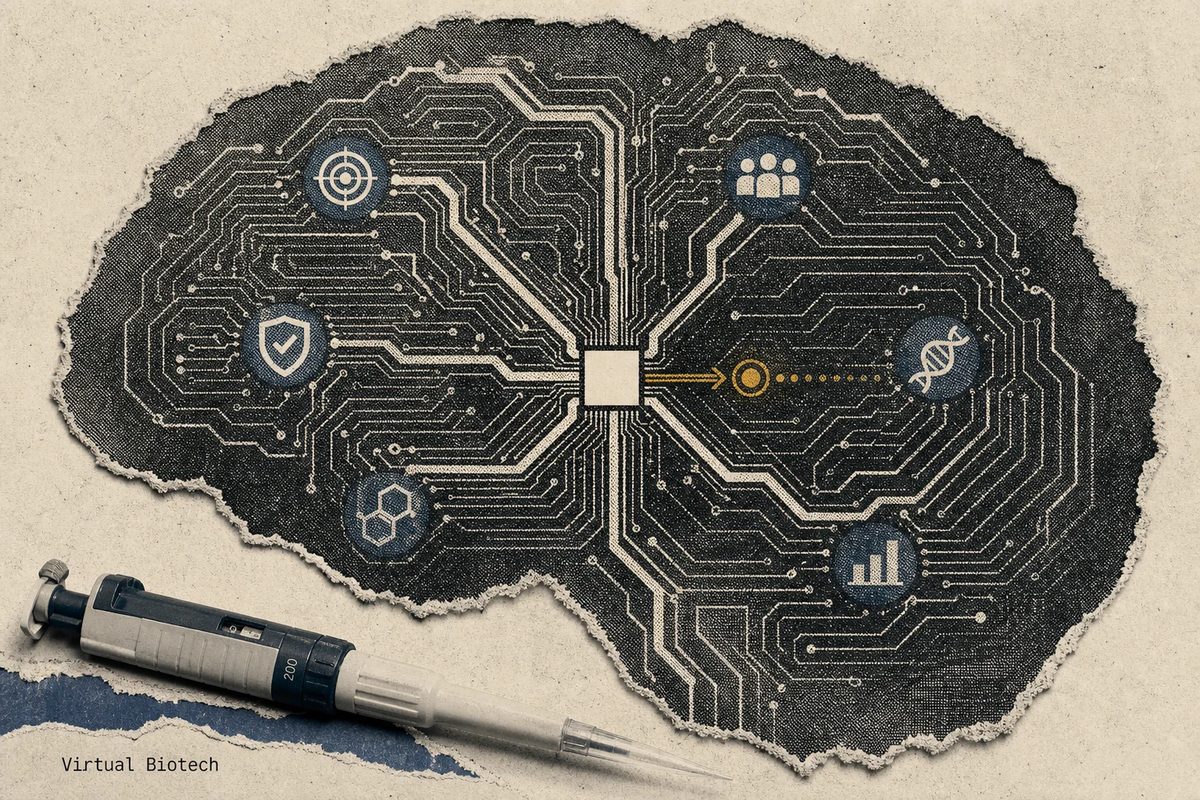
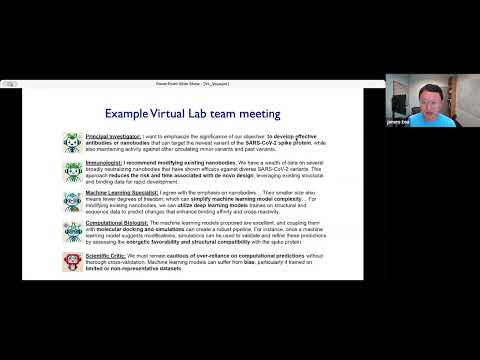
Stanford researchers built a drug-discovery operation with no lab benches, no payroll, and 37,000 employees—each one an AI agent. The virtual biotech analyzed more than 55,000 clinical trials and designed a lung-cancer treatment that mirrors an approach a human pharmaceutical company independently developed months later.

Most drug candidates fail in clinical trials, and each failure costs years and hundreds of millions of dollars. If agent teams can reliably predict which targets will work, the economics of medicine change for the entire industry.

Why it matters

Drug discovery fails 90% of the time and costs billions. Agent teams may find safer, more effective targets in days instead of years.

Questions about this story

Free account needed to ask — your question is kept and asked for you right after sign-up. Answers are public.

No questions yet — be the first to ask.

Key Indicators

37,000+
AI scientist agents deployed
Specialized agents reporting to a virtual chief scientific officer, split across four divisions covering target validation, safety, delivery, and trial review.
55,984
Clinical trials analyzed
Agents assigned one per trial, working through registries, papers, and press releases in about six hours.
48%
Higher odds of reaching market for cell-specific targets
Drugs targeting switch-like, cell-type-specific genes also saw 32% fewer adverse events across dozens of conditions.
32%
Fewer adverse events for cell-specific targets
Compared with drugs acting on broad-spectrum targets, in trials across cancers, brain, heart, kidney, and lung conditions.

Voices

Curated perspectives — historical figures and your fellow readers.

Ever wondered what historical figures would say about today's headlines?

Sign up to generate historical perspectives on this story.

People Involved

Organizations Involved

Timeline

January 2025 September 2026

4 events Latest: 3 days ago
Tap a bar to jump to that date
  1. Science publishes Virtual Biotech paper

    Latest Publication

    Zou and Zhang report the 37,000-agent system, its analysis of 55,984 trials, and the B7-H3 lung-cancer design, published in Science.

  2. Pharma company independently matches AI design

    Validation

    Daiichi Sankyo and Merck develop the same B7-H3 antibody-drug conjugate strategy the agents proposed, using pre-January 2025 data.

  3. Virtual lab launches at Stanford

    Launch

    James Zou's virtual lab begins coordinating AI scientist agents at Stanford Medicine during 2025.

  4. FDA breakthrough designation for ifinatamab deruxtecan

    Regulatory

    The B7-H3 ADC receives a breakthrough therapy designation after showing effectiveness in a human study.

Scenarios

1

FDA approves ifinatamab deruxtecan for small cell lung cancer

Possible Resolves by End of 2026

Discussed by: Nature, Stanford Medicine release, AllSci coverage

The B7-H3 antibody-drug conjugate is under FDA Priority Review for previously treated extensive-stage small cell lung cancer, with a PDUFA date of October 10, 2026. Approval would validate the exact strategy the virtual biotech's agents proposed, giving the platform its first real-world confirmation outside computational results.

2

Virtual biotech targets validated in wet labs

Uncertain Resolves by Q2 2028

Discussed by: James Zou, Stanford Medicine release

Zou's team plans to move the platform's new candidate targets into real laboratories for prospective testing. Success means at least one AI-proposed target passes experimental validation in a peer-reviewed study, showing the computational hypotheses hold up outside the model.

3

Pharma industry adopts multi-agent drug discovery platforms

Possible Resolves by Jan 1, 2028

Discussed by: Paper authors, Harrison Zhang; industry analysts

The paper argues agentic systems shift drug discovery from isolated AI tools to coordinated reasoning across biological scales. Broad adoption would appear as major pharmaceutical companies announcing partnerships to deploy similar multi-agent platforms for target discovery and trial design.

Historical Context

3 moments from history that rhyme with this story — and how they unfolded.

1990–2003

Human Genome Project (1990–2003)

An international consortium coordinated massive computational and laboratory effort to sequence all 3 billion base pairs of human DNA, completing in 2003, two years early.

Then

The completed genome enabled a wave of genetic medicine, diagnostics, and targeted therapies.

Now

It demonstrated that large-scale coordinated computational work could transform biomedical research and drug development.

Why this matters now

The virtual biotech extends the same idea: not coordinating machines and labs, but coordinating reasoning agents to generate therapeutic hypotheses at scale.

2013–2016

IBM Watson for Oncology (2013–2016)

IBM marketed Watson as an AI that could recommend cancer treatments, deploying it at hospitals in the U.S., China, and India. It struggled with training-data quality and physician trust.

Then

Hospitals reported Watson making unsafe or nonsensical recommendations; partnerships dissolved by 2020.

Now

The program's collapse became a cautionary tale about overpromising AI in medicine and skipping clinical validation.

Why this matters now

The virtual biotech will be judged by whether its targets work in patients, not by computational elegance—Watson's failure shows the risk of skipping that step.

November 2020

AlphaFold's protein structure breakthrough (2020)

DeepMind's AlphaFold predicted protein structures from amino acid sequences, a problem biologists had worked on for decades. The system's accuracy stunned the field at the CASP14 competition.

Then

Within months, researchers were using AlphaFold structures routinely; experimentalists confirmed many predictions.

Now

AlphaFold became a standard research tool, but its predictions still required experimental confirmation before they guided patient care.

Why this matters now

Like AlphaFold, the virtual biotech produces computational hypotheses that must pass real-world biological testing before they matter in medicine.

Sources

(7)