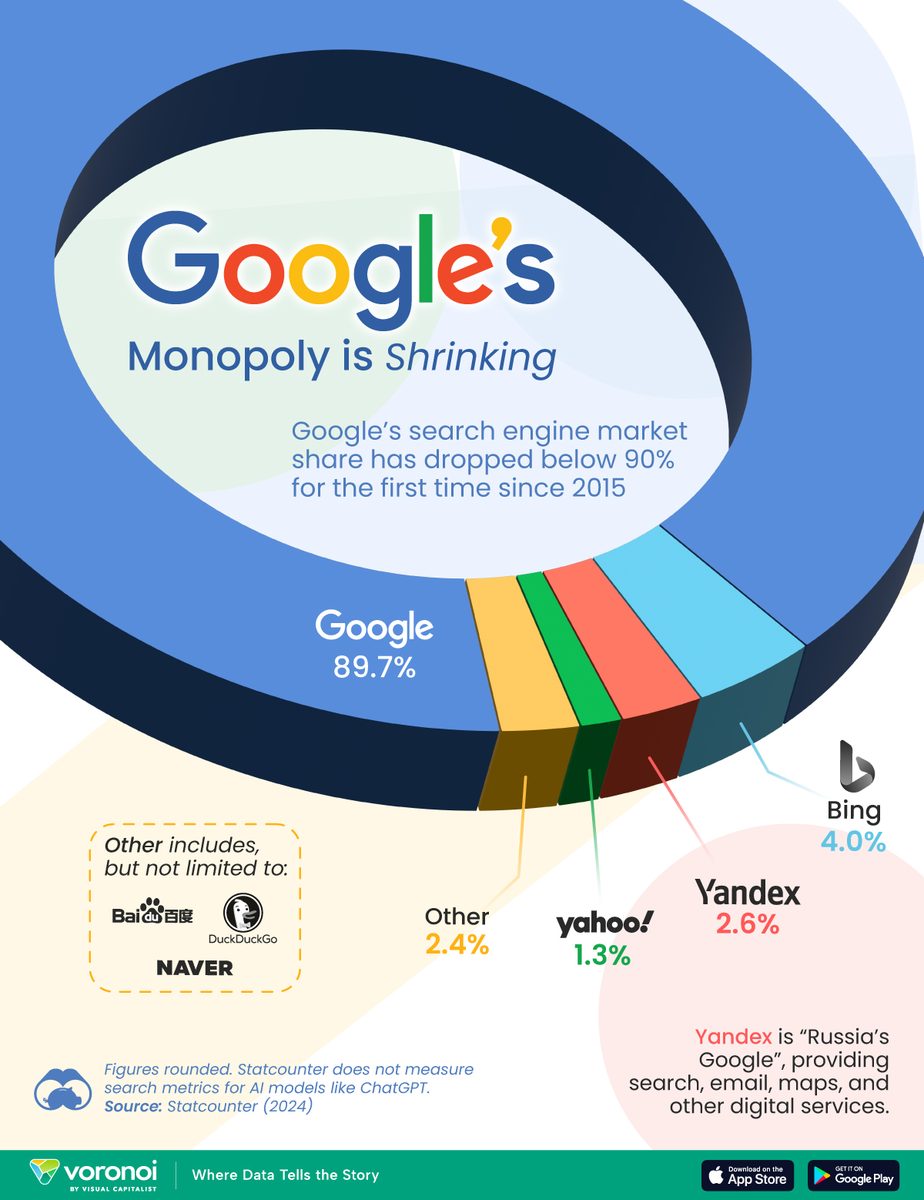
Google has paid Apple roughly $20 billion per year to be the default search engine on iPhones and Safari. In August 2024, a federal judge ruled this arrangement—and similar deals with Samsung and others—constituted an illegal monopoly. Now both sides are appealing: the Department of Justice wants Google broken up, while Google wants the entire case thrown out.
The stakes extend beyond search. As AI chatbots like ChatGPT and Perplexity replace traditional search, whoever controls the default AI assistant on billions of devices may inherit Google's dominance. The court ordered data sharing with competitors, a ban on exclusive default deals, and six years of oversight.
Questions about this story
Free account needed to ask — your question is kept and asked for you right after sign-up. Answers are public.
No questions yet — be the first to ask.
Key Indicators
$20B
Annual default payments
What Google pays Apple each year to remain the default search engine on Safari and iPhones
90%
Google search market share
Google's share of global search queries, down slightly from historic highs but still dominant
6 years
Oversight period
Duration of court-ordered Technical Committee monitoring of Google's compliance
38
States in coalition
Bipartisan group of state attorneys general pursuing harsher remedies on appeal
15 events
Latest: February 3rd, 2026 · 8 months ago
Showing 8 of 15
JK to step
Tap a bar to jump to that date
Jump to
February 2026
DOJ and States File Cross-Appeal
LatestLegal
Department of Justice and 35 state attorneys general file appeal seeking Chrome divestiture and complete ban on default search payments.
January 2026
Google Challenges Data Sharing
Legal
Google files separate appeal specifically challenging six-year data-sharing mandate as government overreach.
Google Files Appeal
Legal
Google files notice of appeal challenging liability ruling, arguing search dominance reflects product quality rather than anticompetitive conduct.
December 2025
Final Remedies Order Issued
Ruling
Mehta finalizes remedies including Technical Committee appointment, data-sharing specifications, and 180-day implementation timeline.
September 2025
Judge Rejects Chrome Divestiture
Ruling
Mehta issues 230-page remedies opinion rejecting structural breakup but ordering data sharing with competitors, ban on exclusive default deals, and six-year oversight.
May 2025
Remedies Trial Concludes
Trial
Final arguments presented; Google warns proposed remedies would require diverting 1,000-2,000 employees from search development.
April 2025
Remedies Trial Opens
Trial
Three-week evidentiary hearing begins with testimony from Google CEO Sundar Pichai, search head Liz Reid, and executives from competitors including DuckDuckGo and OpenAI.
December 2024
Kanter Steps Down
Personnel
DOJ Antitrust Division chief Jonathan Kanter announces resignation effective December 20, leaving case leadership in transition.
November 2024
DOJ Proposes Chrome Divestiture
Legal
Department of Justice files proposed remedies including forced sale of Chrome browser and potential Android divestiture, plus ban on default search payments.
August 2024
Google Found Liable for Illegal Monopoly
Ruling
Judge Mehta rules Google violated Section 2 of the Sherman Act by maintaining illegal monopoly in search and search advertising through exclusive default agreements.
May 2024
$20 Billion Payment Revealed
Disclosure
Court documents reveal Google paid Apple $20 billion in 2022 alone to maintain default search status on Safari and iOS devices.
September 2023
Liability Trial Begins
Trial
Ten-week trial opens in Washington D.C. with testimony from Google executives, Apple representatives, and search competitors.
January 2021
Cases Consolidated
Legal
District court consolidates DOJ and state cases for pretrial purposes under Judge Amit Mehta.
December 2020
38-State Coalition Joins Lawsuit
Legal
Colorado Attorney General Phil Weiser leads bipartisan coalition of 38 state attorneys general in filing separate lawsuit, later consolidated with DOJ case.
October 2020
DOJ Files Antitrust Lawsuit Against Google
Legal
The Department of Justice and 11 state attorneys general file complaint alleging Google illegally maintained search monopoly through exclusive default agreements with Apple, Samsung, and others.
Scenarios
1
D.C. Circuit Orders Chrome Sale, Reshaping Search Market
Possible
Discussed by: American Prospect, Public Knowledge, and antitrust scholars at American Enterprise Institute have analyzed this outcome
The appeals court reverses Mehta's structural remedy rejection, finding behavioral remedies insufficient to restore competition. Chrome divestiture creates an independent browser company that could partner with Bing, DuckDuckGo, or AI search startups. Default search deals become genuinely competitive auctions. This would reduce Google's search share by 10-15 percentage points over five years as competitors gain distribution.
2
Appeals Court Affirms Mehta, Remedies Proceed as Ordered
Likely
Discussed by: Legal analysts at Winston & Strawn and DLA Piper view this as the most probable outcome
The D.C. Circuit upholds both the liability finding and behavioral remedies while rejecting calls for divestiture. Google implements data sharing with approved competitors, exclusive default deals end, and the Technical Committee monitors compliance through 2031. Impact on Google's market share remains modest—perhaps 3-5 percentage points—as the company adapts within the behavioral constraints.
3
Google Wins Appeal, Liability Finding Overturned
Unlikely
Discussed by: International Center for Law & Economics and Information Technology and Innovation Foundation have outlined this possibility
The D.C. Circuit finds Judge Mehta erred in his market definition or monopoly analysis, overturning the liability finding entirely. Google escapes all remedies, default deals continue unchanged, and the case becomes a cautionary tale about antitrust enforcement limitations in fast-moving tech markets. The DOJ may seek Supreme Court review, extending uncertainty for years.
4
Supreme Court Takes Case, Creates New Antitrust Standards
Possible
Discussed by: Brookings Institution and Harvard Law Review have examined potential Supreme Court interest
Either party seeks certiorari after the D.C. Circuit rules; the Supreme Court agrees to hear the case given its significance for tech platform regulation. The Court establishes new standards for digital market antitrust analysis, potentially affecting ongoing cases against Apple, Amazon, and Meta. Final resolution extends to 2028 or beyond, while remedies remain stayed.
Historical Context
3 moments from history that rhyme with this story — and how they unfolded.
1 of 3
May 1998 - November 2001
United States v. Microsoft (1998-2001)
The DOJ and 20 states sued Microsoft for bundling Internet Explorer with Windows to crush Netscape Navigator. Judge Thomas Penfield Jackson found Microsoft liable and ordered the company broken into two pieces—one for Windows, one for applications. Microsoft controlled 95% of the PC operating system market.
Then
The D.C. Circuit upheld the liability finding but overturned the breakup order in 2001, finding Jackson had shown bias. A consent decree imposed behavioral remedies including API sharing requirements.
Now
Microsoft avoided structural breakup but was constrained during the critical 2001-2011 period when Google, Facebook, and mobile platforms emerged. Many analysts credit the antitrust pressure with preventing Microsoft from dominating web search and social media.
Why this matters now
The Microsoft case provides the closest template for Google's appeal. The D.C. Circuit's 2001 decision—affirming liability while rejecting divestiture—may influence how judges evaluate structural versus behavioral remedies for tech monopolies.
2 of 3
November 1974 - January 1984
AT&T Breakup (1974-1984)
The DOJ sued AT&T, which controlled 80% of U.S. telephone lines, over anticompetitive practices in equipment manufacturing and long-distance service. After eight years of litigation, AT&T agreed to divest its 22 local operating companies, creating seven independent 'Baby Bells' while retaining long-distance service and Bell Labs.
Then
The January 1984 divestiture reduced AT&T's book value by 70%. Local phone service remained regulated monopolies while long-distance became competitive.
Now
Competition in long-distance drove prices down dramatically. Sprint and MCI emerged as viable competitors. The Baby Bells later reconsolidated through mergers, with Verizon and AT&T (reformed from SBC) now dominant.
Why this matters now
AT&T remains the only successful structural breakup of a major technology monopoly. DOJ's Chrome divestiture proposal echoes this approach, though Judge Mehta rejected it as too complex given Chrome's integration with Google's systems.
3 of 3
November 2010 - June 2017
EU Google Shopping Case (2017)
The European Commission fined Google €2.42 billion for favoring its own shopping comparison service in search results over competitors like Foundem and Kelkoo. The Commission found Google abused its search dominance to direct traffic to Google Shopping.
Then
Google paid the fine and implemented a remedy allowing competing shopping services to bid for placement in search results.
Now
Critics argue the remedy was ineffective—Google Shopping retained dominant market share while competitors saw minimal benefit from the auction system. The EU has since pursued additional Google cases involving Android and advertising.
Why this matters now
The EU case illustrates the challenge of behavioral remedies against platform monopolies. The DOJ's appeal argues Mehta's data-sharing remedy risks similar ineffectiveness without structural changes like Chrome divestiture.