
Pull to refresh
Logo
Coca-Cola bottler wins approval to demolish vacant Grand Rapids building for truck parking

Coca-Cola bottler wins approval to demolish vacant Grand Rapids building for truck parking

Built World Grand Rapids, MI local

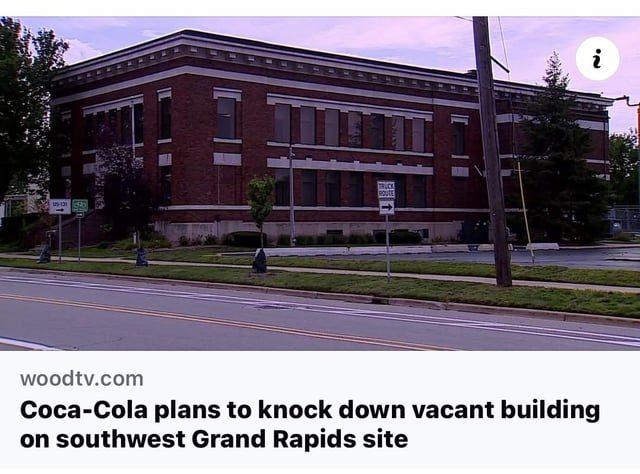
Reyes Coca-Cola Bottling will replace a long-vacant 7,100-square-foot office with 23 truck-trailer spaces on Butterworth Street SW.

Yesterday: Reddit post surfaces demolition plan

Overview

Updated 4 hours ago

A vacant two-story brick office building on Grand Rapids' southwest side is coming down. Reyes Coca-Cola Bottling won a 5-2 planning commission vote Aug. 13 to demolish the structure at 1208 Butterworth St. SW and pave the lot for truck parking.

The building has sat empty for years despite the company's 'all efforts to use and/or lease' it. The vote trades one of the area's older brick buildings for parking — a swap r/grandrapids residents are arguing about.

Why it matters

One of the southwest side's few remaining brick office buildings becomes asphalt if this demolition proceeds — trading the neighborhood's industrial history for truck parking.

Questions about this story

Free account needed to ask — your question is kept and asked for you right after sign-up. Answers are public.

No questions yet — be the first to ask.

Key Indicators

5-2
Commission vote to approve the demolition
Approved Aug. 13 with a condition for a landscape feature at the corner.
23
Truck-trailer parking spaces to be added
Raises site capacity from 84 to 107 parking spots.
220
Employees at the Butterworth bottling plant
The workforce the company cites when arguing it needs more truck parking for safety.
7,100 sq ft
Size of the building slated for demolition
Two-story brick office structure at 1208 Butterworth St., vacant for years.

Voices

Curated perspectives — historical figures and your fellow readers.

Ever wondered what historical figures would say about today's headlines?

Sign up to generate historical perspectives on this story.

Play

Exploring all sides of a story is often best achieved with Play.

Most of these play right now — no account needed. Sign up to save scores, keep a streak, and unlock Debate and Predict. Log in Sign Up
Predict 3 ways this could play out. Back the one you believe — contrarian picks score more when a scenario has a resolution date. Log in to play

People Involved

Organizations Involved

Timeline

August 2026 September 2026

3 events Latest: Yesterday
  1. Reddit post surfaces demolition plan

    Latest Public Attention

    A r/grandrapids post brings the demolition to wider attention, sparking neighborhood debate over the brick building's fate.

  2. Photo documents deteriorating building

    Documentation

    A photo captures the 1208 Butterworth St. SW building showing visible cracks and loose brick, as described by company representative Eric Mark.

  3. Planning commission approves demolition 5-2

    Decision

    Grand Rapids Planning Commission approves Reyes Coca-Cola's special land use request to demolish the vacant building, adding a landscape condition at the corner.

Historical Context

2 moments from history that rhyme with this story — and how they unfolded.

2018–2024

Michigan Central Station's rescue (2018)

Detroit's Michigan Central Station, a 1913 Beaux-Arts train depot, sat vacant and decaying from 1988 onward. As demolition talk surfaced, Ford Motor Company bought the building in 2018 and spent roughly $740 million restoring it, reopening it in 2024 as a mobility campus.

Then

The landmark was saved from the wrecking ball and became a symbol of Detroit's resurgence.

Now

Set a template for corporate-funded adaptive reuse of abandoned buildings — but only for structures with iconic status and deep-pocketed buyers.

Why this matters now

The Butterworth building has neither landmark status nor a billionaire patron. It shows the opposite end of the preservation spectrum, where a modest vacant building gets torn down for parking instead of restored.

Late 1990s–2000s

Grand Rapids' furniture warehouse conversions (1990s–2000s)

Grand Rapids, once known as Furniture City, saw its old factory and warehouse districts along the Grand River converted into residential lofts, offices, and galleries starting in the late 1990s. Developers adapted the brick-and-timber buildings rather than razing them.

Then

Preserved a large stock of industrial architecture and anchored the city's downtown revitalization.

Now

Gave Grand Rapids a reputation for adaptive reuse that now sits in tension with the demolition of smaller, less-anchored buildings like 1208 Butterworth.

Why this matters now

The city has repeatedly found new uses for its brick industrial heritage — but the economics only work for buildings with scale and location demand. This small corner office lacks both.

Sources

(2)