

Pull to refresh
Logo
Grand Rapids launches new clinic to restore suspended driver's licenses

Grand Rapids launches new clinic to restore suspended driver's licenses

Rule Changes Grand Rapids, MI local

Michigan's Road to Restoration program expands locally, helping residents clear traffic barriers to driving

Today: New Grand Rapids program offers restoration path

Overview

Updated 50 minutes ago

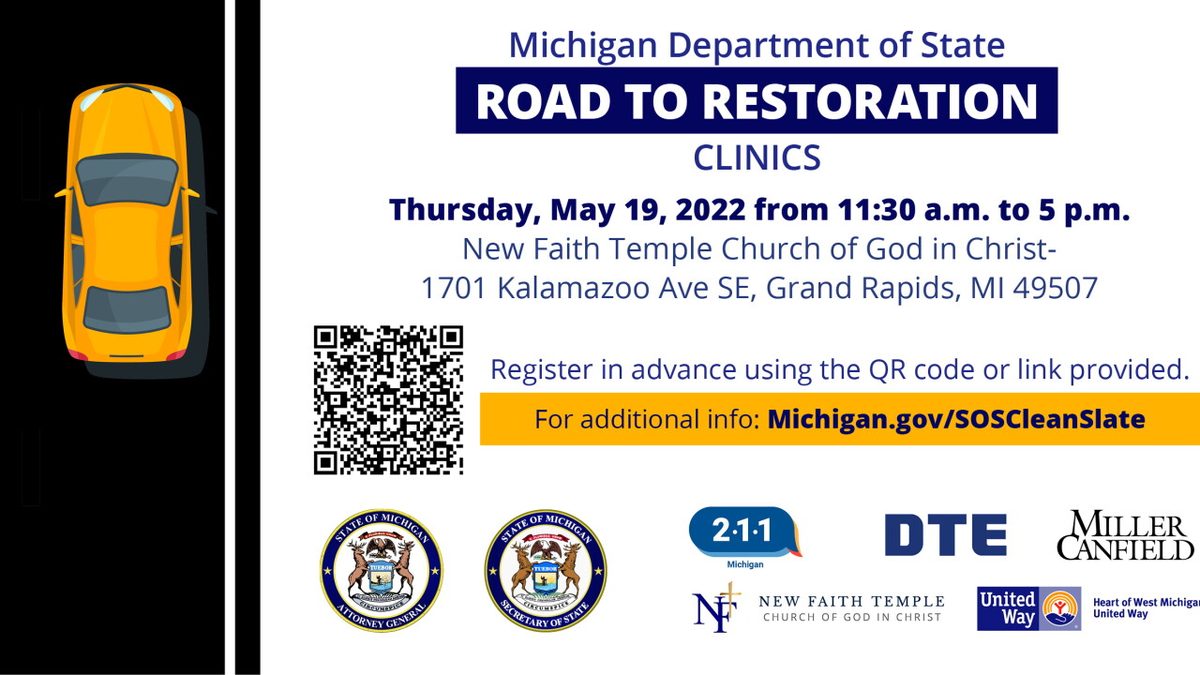
Grand Rapids residents with suspended licenses can now attend one-on-one clinics to clear up misdemeanor traffic offenses and unresolved court matters, part of Michigan's Road to Restoration program. The sessions, run by the Secretary of State's office with nonprofit and corporate partners, walk attendees through their driving records, identify barriers, and complete restoration steps on site.

The program exists because Michigan changed its license suspension rules in 2021. That year, the state stopped suspending licenses for unpaid fines or missed court appearances related to certain non-moving violations — a shift that affected more than 150,000 residents. But many of those people still need to navigate fees, warrants, and paperwork before the state will reinstate their driving privileges.

Why it matters

Without a license, Michigan workers can't reach jobs, childcare, or medical care in a state where public transit is sparse — and thousands remain stuck in the restoration process.

Questions about this story

Free account needed to ask — your question is kept and asked for you right after sign-up. Answers are public.

No questions yet — be the first to ask.

Key Indicators

150,000+
Michigan residents affected by 2021 suspension law changes
Residents whose suspensions were lifted under the new non-moving violation legislation.
4,000+
Residents served at Road to Restoration clinics in 2022
18 clinics held in 11 Michigan cities including Grand Rapids.
25,000+
Licenses suspended for OWI offenses in 2022
Counted by Michigan State Police's Drunk Driving Audit; thousands more suspended for other reasons.

Voices

Curated perspectives — historical figures and your fellow readers.

Ever wondered what historical figures would say about today's headlines?

Sign up to generate historical perspectives on this story.

People Involved

Organizations Involved

Timeline

October 2021 September 2026

6 events Latest: Today
Tap a bar to jump to that date
  1. New Grand Rapids program offers restoration path

    Today Initiative

    Local program helps people with misdemeanor traffic offenses and unresolved court matters regain driving privileges through one-on-one clinics.

  2. Safe & Just Michigan releases report on restoration barriers

    Report

    Recommends ability-to-pay assessments before suspensions and changes to habitual offender rules, noting tens of thousands lose licenses annually.

  3. Second year of clinics announced

    Initiative

    Program relaunches with first clinic in Saginaw, additional sessions scheduled for Grand Rapids, Lansing, Detroit, and the Upper Peninsula.

  4. First year results: 4,000+ served

    Milestone

    18 clinics held in 11 cities including Grand Rapids, Detroit, Flint, and Lansing.

  5. Road to Restoration program launches

    Initiative

    Michigan Secretary of State partners with DTE Energy, Miller Canfield, Detroit Justice Center, and others to host clinics statewide.

Scenarios

1

Michigan legislature passes ability-to-pay assessment law

Possible Resolves by End of 2027

Discussed by: Safe & Just Michigan, House Democrats

Lawmakers adopt the recommendation requiring courts to assess a person's ability to pay before suspending a license for unpaid court debt. This would prevent future suspensions at the source and reduce the restoration caseload, supported by both advocacy groups and bipartisan business interests.

2

Grand Rapids program expands to cover all suspended drivers

Possible Resolves by Sep 15, 2027

Discussed by: WZZM 13, local officials

The local initiative grows beyond misdemeanor traffic offenses to include OWI-related hearings and habitual offender cases, doubling clinic capacity and serving hundreds more residents annually. This requires additional state funding and legal staff.

3

Funding gap forces clinic reductions

Unlikely Resolves by Q2 2027

Discussed by: Michigan 2-1-1, Detroit Justice Center

Private partners like DTE Energy scale back commitments as corporate budgets tighten, reducing clinic frequency and leaving more residents without in-person guidance. The program continues but serves fewer people, and wait times for appointments grow.

Historical Context

3 moments from history that rhyme with this story — and how they unfolded.

1984-1998

Federal highway funding and license revocation (1980s-1990s)

The federal government pressured states to revoke licenses for drug offenses and other violations as a condition of highway funding. States including Michigan adopted these policies, which expanded suspension rollbooks far beyond safety-related driving offenses.

Then

Thousands lost driving privileges for non-driving offenses, creating a cycle of fines and fees.

Now

By the 2010s, researchers documented that debt-based suspensions did not improve road safety but did push people into job loss and poverty.

Why this matters now

Michigan's 2021 reform is a direct reversal of this federal-era policy, and the Road to Restoration program is the cleanup mechanism for that legacy.

October 2015-March 2017

California amnesty program (2017)

California offered a 24-month amnesty window for drivers with suspended licenses due to unpaid court fines. The state also made installment payment plans available and stopped suspending licenses purely for failure to pay.

Then

More than 230,000 people regained driving privileges during the amnesty period.

Now

California's reform became a national model, and early data suggested no measurable increase in traffic collisions or violations.

Why this matters now

Michigan's approach extends California's logic but provides dedicated in-person clinics to help people clear remaining legal barriers, addressing a gap in the amnesty model where residents were on their own to navigate restoration.

June 2020-present

New Orleans continued restoration partnership (2020-present)

New Orleans launched a partnership with the nonprofit OARC to help residents restore driving privileges through city-run clinics. The city paired the program with data-sharing to identify eligible drivers automatically.

Then

Thousands of residents attended clinics, and the city reduced its suspended license caseload through proactive outreach.

Now

The clinic model became a template for other jurisdictions, including Michigan's Road to Restoration program.

Why this matters now

Michigan's Grand Rapids program follows this proven community-clinic model, bringing together legal experts and social services in a single location to reduce barriers.

Sources

(5)