

Pull to refresh
Logo
Harvey builds a shared fact record for litigation

Harvey builds a shared fact record for litigation

New Capabilities

The legal AI startup's fact graph links every extracted fact to its source line and updates as new documents arrive

Overview

Updated 1 hour ago

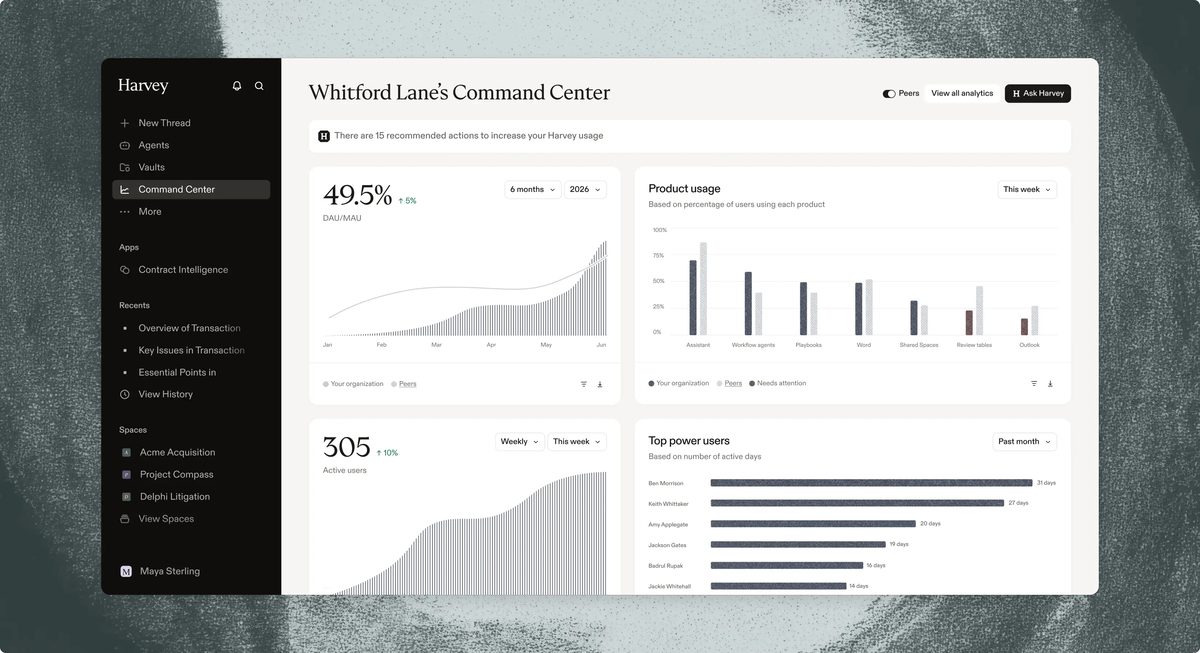
A long lawsuit generates millions of documents and a factual record that has to be rebuilt whenever a new lawyer joins the team. Harvey now sells a system that extracts facts from those documents, links each one to the exact line it came from, and keeps the record current as new files arrive.

The company showed the capability at its FORUM Chicago event and opened it to early access. Litigators are about one-third of Harvey's customers, which is why the firm built a dedicated product for them rather than another general-purpose chat window.

Why it matters

If a firm can trust a machine-built fact record, months of document review collapse into a query, and every draft inherits it.

Questions about this story

Free account needed to ask — your question is kept and asked for you right after sign-up. Answers are public.

No questions yet — be the first to ask.

Key Indicators

One-third
Share of Harvey's customers who are litigators
Harvey cites this as the reason for building a litigation-specific capability.
Millions
Documents the fact graph is built to scan per matter
Harvey's stated scale for a single matter's document set.
4
Harvey products carrying the Jus Mundi arbitration agent
Assistant, Agents, Vault and Workflows, per the partnership announcement.

Voices

Curated perspectives — historical figures and your fellow readers.

Sign up to generate historical perspectives on this story.

People Involved

Organizations Involved

Timeline

2 events Latest: Yesterday
  1. Jus Mundi arbitration agent placed inside Harvey

    Latest Partnership

    Arbitration research runs in Harvey's Assistant, Agents, Vault and Workflows.

  2. Harvey unveils fact graph at FORUM Chicago

    Product launch

    Company shows a shared, source-linked fact record for disputes and internal investigations.

Scenarios

1

Litigation teams make the fact record their working file

Possible Resolves by Q2 2027

Discussed by: Harvey and design partner Slaughter and May

Early-access firms feed new matters into the fact graph, and chronologies and witness outlines get drafted from the shared record instead of from scratch. Adoption would show up as named customers and case studies rather than waitlist announcements.

2

Extraction errors keep lawyers checking every link by hand

Possible Resolves by Q2 2027

Discussed by: Independent commentary on the early-access launch, including Hanging Context

The system's value depends on facts being pulled correctly and inconsistencies flagged often enough that lawyers stop ignoring the warnings. If error rates stay high, firms keep the manual record and use the tool only for first-pass review.

3

A rival ships a comparable matter record and closes the gap

Uncertain Resolves by End of 2027

Discussed by: Legal technology trade coverage

Fact extraction linked to sources is a software problem, not a proprietary dataset. Competitors selling document review or research tools could add a shared matter record, turning the fact graph into one feature among several rather than a reason to switch vendors.

Historical Context

2 moments from history that rhyme with this story — and how they unfolded.

1973-1975

Lexis and Westlaw go online (1973-1975)

Full-text legal research moved from printed indexes to terminals, letting lawyers search case law directly instead of paging through digests.

Then

Large firms adopted terminals slowly, and hourly billing for research time became a subject of client complaints.

Now

Search became the default way lawyers find authority, and the databases became the commercial core of the legal publishing industry.

Why this matters now

Search answered 'where is the case.' The fact graph attempts the harder question of what the documents in one matter collectively establish, which search never tried to hold.

February 2012

Da Silva Moore v. Proskauer (2012)

A federal magistrate judge in New York approved using predictive coding, a machine-learning method, to screen a large document set in an employment discrimination case over the objection of the opposing party.

Then

The ruling gave litigators a citable precedent for machine-assisted review of evidence.

Now

Technology-assisted review became routine in large document productions, with courts and parties arguing over transparency and validation.

Why this matters now

It set the terms of the argument now repeating: a machine can review the documents, but the process has to be defensible and auditable. Harvey's source-line linking is aimed at that requirement.

Sources

(6)