


Pull to refresh
Logo
Supio launches Case Communications for automated legal follow-up

Supio launches Case Communications for automated legal follow-up

New Capabilities

Agent autonomously contacts carriers, providers, and clients while attorneys stay in control

Yesterday: Supio launches Case Communications

Overview

Updated 1 hour ago

Plaintiff firms spend roughly two-thirds of their labor communicating with carriers, providers, and clients. Supio's Case Communications, launched October 2, lets an AI agent handle that work autonomously.

Built on Supio's FirmOS, Case Communications routes calls, texts, emails, and faxes into case files. The agent can chase medical records, open insurance claims, and update case files, while attorneys can step in at any time.

Why it matters

If this works, plaintiff firms can take on more cases without hiring, shifting labor from routine follow-up to judgment work.

Questions about this story

Free account needed to ask — your question is kept and asked for you right after sign-up. Answers are public.

No questions yet — be the first to ask.

Key Indicators

~66%
Share of firm work involving external communication
Supio says roughly two-thirds of a typical plaintiff firm's work involves communicating with parties outside the firm.
4
Communication channels unified into case context
Calls, texts, emails, and faxes are routed into case files as they arrive.
1,400
Cases managed by Supio Agent at one firm
Phillips Law Group used Supio Agent to manage 1,400 cases it would previously have referred out, from the September Long-Horizon Agents announcement.

Voices

Curated perspectives — historical figures and your fellow readers.

Ever wondered what historical figures would say about today's headlines?

Sign up to generate historical perspectives on this story.

People Involved

Organizations Involved

Timeline

September 2026 October 2026

2 events Latest: Yesterday
  1. Supio launches Case Communications

    Latest Product launch

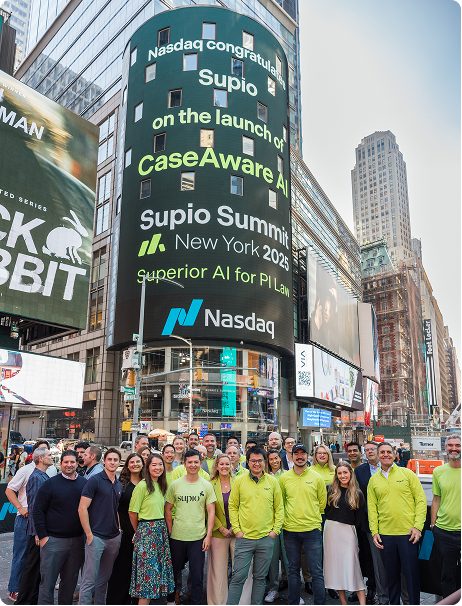
    At Law-Di-Gras, Supio unveils a layer connecting calls, texts, emails, and faxes to case context.

  2. Supio announces Long-Horizon Agents

    Product launch

    Long-horizon agent model lets AI execute multi-step case work over days or weeks.

Scenarios

1

Supio publishes customer proof that Case Communications delivers

Likely Resolves by Apr 2, 2027

Discussed by: Legal tech press including SiliconANGLE, and Supio's customer success team

Early adopters report that the agent handles follow-up calls, record requests, and insurance claims without human intervention. Supio publishes customer case studies or revenue disclosures showing the agent in active use across multiple law firms.

2

State bar issues first ethics ruling on AI agent outreach

Possible Resolves by Oct 2, 2027

Discussed by: Legal ethics commentators, bar ethics committees, and the American Bar Association

Concerns that AI agents making unsupervised calls could breach attorney-client privilege or misrepresent themselves to third parties prompt at least one state bar to issue formal guidance.

3

Rival legal tech platform ships its own agentic communications layer

Likely Resolves by Apr 2, 2027

Discussed by: Legal tech analysts and competitors monitoring Supio's launch

A major case management or legal AI platform announces a comparable autonomous communications feature, making agentic outreach standard across the industry.

Historical Context

3 moments from history that rhyme with this story — and how they unfolded.

Late 1990s to 2000s

Customer relationship management (CRM) adoption (late 1990s-2000s)

Before CRM software arrived, sales teams tracked prospects in spreadsheets, email folders, and paper notes, with no single record of a deal's history. Salesforce, founded in 1999, made the connected deal record standard.

Then

Sales teams gained a single source of truth for every interaction with a prospect.

Now

CRM became the operational backbone of nearly every B2B sales organization worldwide.

Why this matters now

Supio is attempting the same consolidation for plaintiff law firms, routing scattered communications into one case record.

2009 onward

Electronic health records and the HITECH Act (2009)

The Health Information Technology for Economic and Clinical Health (HITECH) Act of 2009 offered financial incentives for hospitals to adopt electronic health records (EHRs), pushing medicine from paper charts to digital systems.

Then

Hospitals and clinics digitized patient records at scale within a few years.

Now

EHRs became the foundation for clinical decision support, billing automation, and later, AI-assisted care.

Why this matters now

Like HITECH, Supio's layer connects disconnected communication channels to a unified case record that the agent can act on.

Mid-2010s

Robotic process automation in banking back offices (mid-2010s)

Banks deployed robotic process automation (RPA) software to handle routine, rules-based tasks like data entry and account reconciliation, freeing staff for judgment work.

Then

Banks cut operational costs and sped up transaction processing.

Now

RPA established a model for software taking over routine workflow steps, the same model Supio applies to legal follow-up.

Why this matters now

Supio's agent extends the RPA playbook to law, automating persistent follow-up tasks that previously consumed staff hours.

Sources

(6)