
Pull to refresh
Logo
Daily Brief
Following
Why Sign Up
Humanoid robot beats human half-marathon world record in Beijing

Humanoid robot beats human half-marathon world record in Beijing

New Capabilities
By Newzino Staff |

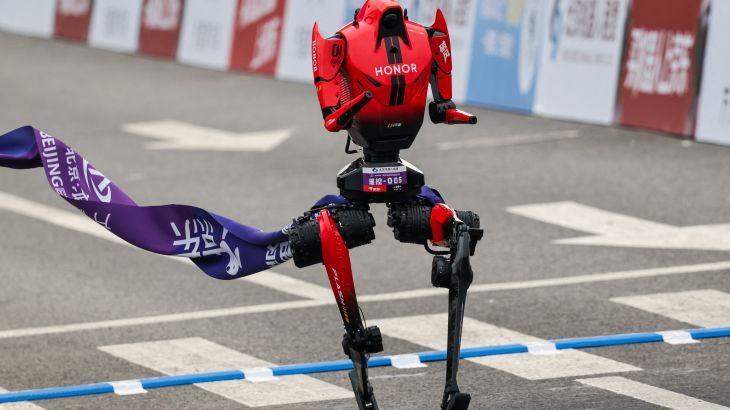
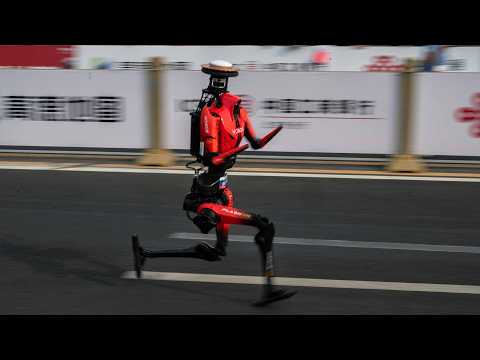
Honor's Lightning finishes 21.1km in 50:26 — twelve months after the previous champion took 2 hours 40 minutes

6 days ago: Lightning breaks human half-marathon record

Overview

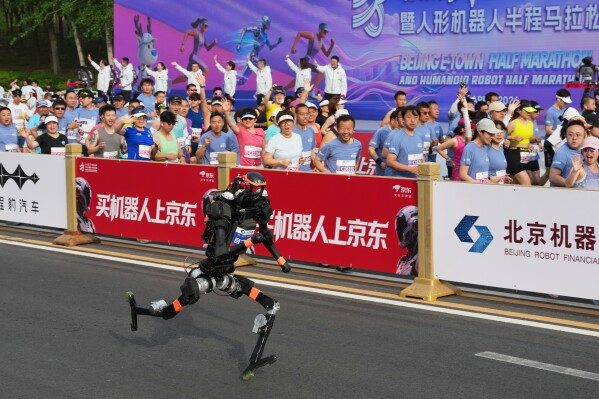
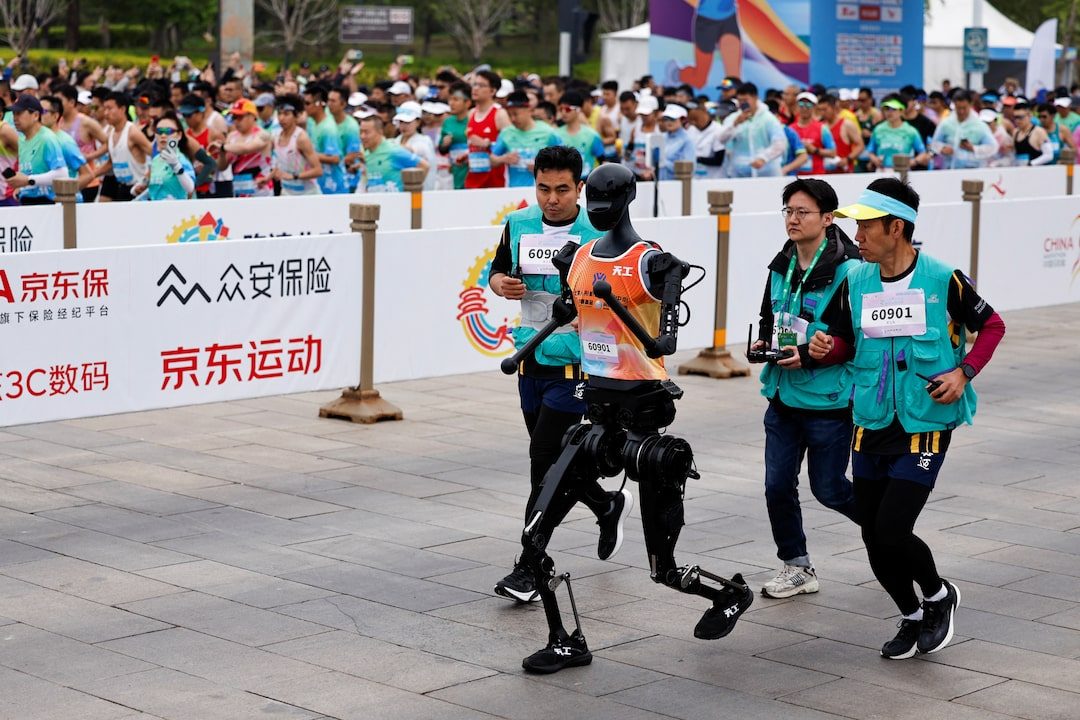
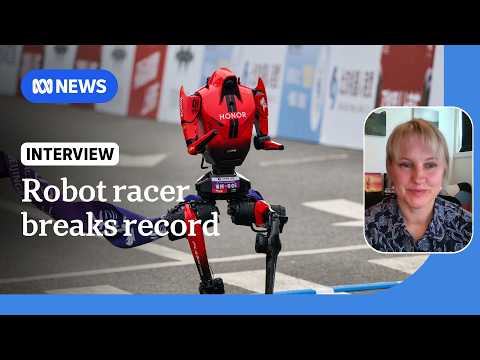
Twelve months ago a humanoid robot crossed the finish line of Beijing's E-Town half-marathon in 2 hours and 40 minutes, the only one of twenty competitors that didn't overheat, fall over, or need duct-tape repairs. On April 20, 2026, a different robot finished the same 21.1-kilometer course in 50 minutes and 26 seconds — faster than any human has ever covered the distance.

Why it matters

A robot that can run 21 kilometers autonomously without breaking is one that can stand on a factory floor for a shift — and China is shipping them at scale.

Key Indicators

50:26
Lightning's finishing time
About seven minutes faster than the human half-marathon world record of 56:42 set by Jacob Kiplimo in March 2025.
2:40:42
Last year's winning time
Tiangong Ultra's mark at the 2025 inaugural race — a 3.2x improvement in twelve months.
300+
Robots in the 2026 field
Up from six finishers and twenty starters at the 2025 race.
12,000
Human runners outpaced
Lightning crossed the line ahead of every human in the parallel field.
~50%
Robots running autonomously
Nearly half navigated the course without remote control, up from a small minority in 2025.
94%
Projected 2026 growth in Chinese humanoid output
TrendForce estimate for year-over-year unit growth, with Unitree and Zhiyuan capturing roughly 80% of domestic shipments.

Interactive

Exploring all sides of a story is often best achieved with Play.

Ever wondered what historical figures would say about today's headlines?

Sign up to generate historical perspectives on this story.

Sign Up

Debate Arena

Two rounds, two personas, one winner. You set the crossfire.

People Involved

Organizations Involved

Timeline

  1. Lightning breaks human half-marathon record

    Race

    Honor's Lightning finishes Beijing's E-Town half-marathon in 50:26, beating Kiplimo's mark by ~7 minutes; Honor robots sweep top three.

  2. Zhiyuan rolls 10,000th humanoid off the line

    Production milestone

    AgiBot/Zhiyuan reaches five-figure cumulative production of its Exped A3 — the first humanoid maker publicly past that mark.

  3. Unitree caps year as top global humanoid shipper

    Industry milestone

    Unitree closes 2025 with 5,500 units shipped, the most of any maker worldwide; Figure AI ships about 150.

  4. Inaugural humanoid half-marathon in Beijing

    Race

    Tiangong Ultra wins in 2:40:42; just six of twenty robots finish, most needing battery swaps, cooling sprays, and duct tape.

  5. Kiplimo sets human half-marathon record

    Sporting benchmark

    Uganda's Jacob Kiplimo runs 56:42 in Lisbon — the human benchmark a robot would clear thirteen months later.

  6. Beijing opens humanoid innovation center

    Industrial policy

    Beijing's E-Town zone formally launches a state-backed humanoid program, with Tiangong as the reference platform.

  7. Tesla announces Optimus humanoid program

    Industry milestone

    Elon Musk unveils a planned bipedal robot at Tesla AI Day, vaulting humanoids from research curiosity to commercial roadmap.

Scenarios

1

China's humanoid lead translates into the factory and warehouse

Discussed by: Roland Berger, TrendForce, Rest of World

If Chinese makers move from athletic demos to deployed industrial fleets — Unitree at 10–20k units, Zhiyuan past 10k cumulative, Honor entering the field — the half-marathon becomes a marketing moment for what is already happening on factory floors. Western firms keep narrowing the AI generalization gap, but lose the supply-chain race the way they lost solar and EVs.

2

Athletic showcase fails to translate to economically useful work

Discussed by: Scientific American, IEEE Spectrum, robotics academics

Running on a closed road is a narrow problem: smooth surface, known route, no manipulation, no human collaboration. Skeptics note that locomotion has been the easier half of humanoid robotics for years; dexterous hands, perception in messy environments, and safe interaction with people remain the hard parts. On this view, Lightning's record changes the marketing slide deck more than the deployment timeline.

3

Tesla Optimus and Western entrants close the gap on volume

Discussed by: Deloitte, IDN Financials, equity analysts

Tesla brings Optimus Gen3 online in Fremont this summer with a stated goal of one million units annually; Figure ramps with BMW; Apptronik with Mercedes. If Western makers convert AI-stack advantages into reliable shipments by 2027, the Chinese head start narrows from a generation to a model year, and the global humanoid market settles into a duopoly rather than a Chinese sweep.

4

Public backlash forces deployment limits before scale arrives

Discussed by: Labor economists, EU policymakers

As humanoids move from race tracks into warehouses and storefronts, regulators in the EU and parts of the U.S. respond to job-displacement concerns with deployment caps, mandatory human-in-the-loop rules, or robot-specific taxes. Adoption in those markets slows; China's domestic deployment continues largely unconstrained, widening the productivity gap.

Historical Context

DARPA Grand Challenge (2004 → 2005)

March 2004 and October 2005

What Happened

DARPA offered $1 million to any team whose autonomous vehicle could finish a 142-mile desert course. In 2004, no vehicle covered more than 7.5 miles; the field was a graveyard of stuck and overturned trucks. Eighteen months later, five vehicles finished, with Stanford's Stanley winning in under seven hours.

Outcome

Short Term

The 2005 finish reset expectations for autonomous driving overnight, validating sensor-and-software stacks that had failed publicly the year before.

Long Term

Stanley's team and competitors seeded Google's self-driving program, Cruise, Aurora, Waymo, and most of today's AV industry. The challenge is the canonical case of a public benchmark jumping from total failure to credible success in roughly twelve months.

Why It's Relevant Today

The Beijing race compresses the same arc into the same time window: 2025's overheating-and-duct-tape field becomes 2026's record-breaker. It suggests humanoid locomotion has crossed a similar inflection point — with the harder generalization work, like AVs in cities, still ahead.

Deep Blue defeats Kasparov (May 1997)

May 1997

What Happened

IBM's Deep Blue beat reigning world chess champion Garry Kasparov 3.5–2.5 in a six-game match in New York. It was the first time a computer beat a world champion in classical chess under standard time controls.

Outcome

Short Term

Kasparov accused IBM of cheating; IBM dismantled Deep Blue. The result was treated by some as a stunt and by others as an end-of-an-era moment.

Long Term

Within fifteen years, every grandmaster trained against engines stronger than any human; chess engines became infrastructure, not adversaries. The match marked the moment human dominance in a domain became a marketing line, not a technical fact.

Why It's Relevant Today

Lightning's 50:26 is humanoid robotics' Deep Blue moment for distance running: a narrow benchmark, contested terms, real result. The arc afterward — capability becomes infrastructure — is what to watch in factories and warehouses.

AlphaGo defeats Lee Sedol (March 2016)

March 2016

What Happened

DeepMind's AlphaGo beat South Korean Go champion Lee Sedol 4–1 in Seoul, in a game long considered a decade away from machine mastery because of its enormous branching factor and reliance on intuition.

Outcome

Short Term

AlphaGo's win triggered a surge of Chinese state and private investment in AI; Beijing published its national AI plan within sixteen months.

Long Term

The match is widely cited as the trigger for China's current AI build-out — the policy and capital response that put Chinese firms ahead in computer vision, large language models in Mandarin, and now humanoids.

Why It's Relevant Today

The Beijing race plays the same role in reverse: a public Chinese benchmark whose primary audience is Western policymakers and capital allocators. Whether it triggers a comparable Western mobilization is the open question.

Sources

(14)