
Pull to refresh
Logo
India's retail inflation breaches RBI's 6% ceiling

India's retail inflation breaches RBI's 6% ceiling

Rule Changes

Food prices push October CPI to 6.09%, the 12th straight month of acceleration

Overview

Updated 1 hour ago

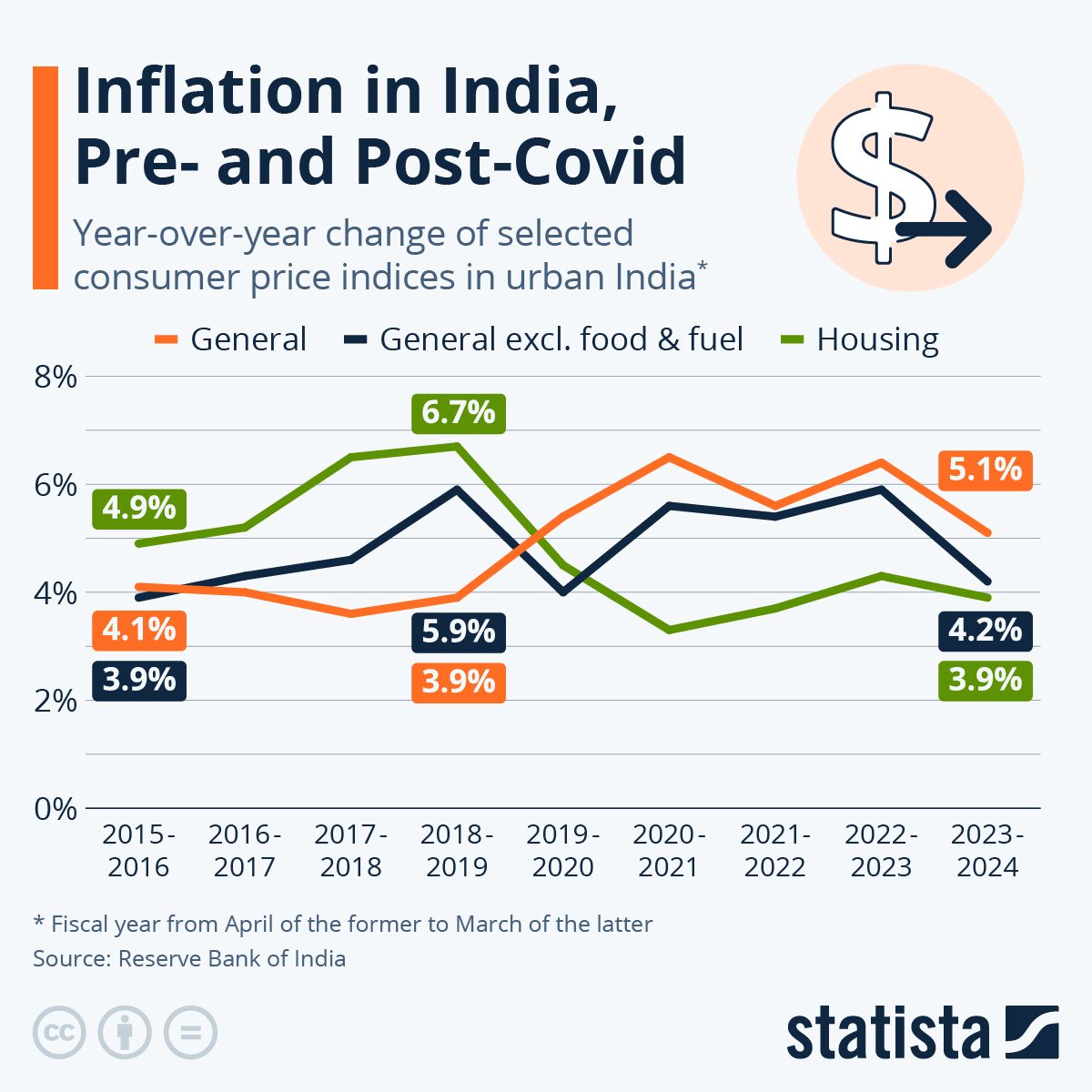
A basket of groceries that cost 1,000 rupees a year ago now costs about 1,089. Onion prices have more than doubled. In October, that pressure pushed India's retail inflation to 6.09%, the first time it has breached the Reserve Bank of India's 6% ceiling under the country's new price index.

The reading forces the central bank's hand. The RBI already raised its benchmark rate in October, its first hike in nearly four years, and economists expect another increase in December. Higher rates raise borrowing costs for mortgages and business loans, slowing demand to cool prices.

Why it matters

If the RBI keeps hiking, home loan repayments and business borrowing costs rise across India's economy.

Questions about this story

Free account needed to ask — your question is kept and asked for you right after sign-up. Answers are public.

No questions yet — be the first to ask.

Key Indicators

6.09%
Headline retail inflation, October 2026
Year-on-year rise in the Consumer Price Index, provisional.
8.94%
Food inflation, October 2026
Year-on-year rise in the Consumer Food Price Index.
5.50%
RBI repo rate
Benchmark lending rate after the October hike, the first in nearly four years.
116.22%
Onion price inflation
Year-on-year rise in onion prices, the highest among major food items.
5.54%
Headline inflation, September 2026
The prior month's final reading, before the breach.

Voices

Curated perspectives — historical figures and your fellow readers.

Sign up to generate historical perspectives on this story.

People Involved

Organizations Involved

Timeline

February 2026 November 2026

3 events Latest: Today
  1. October inflation hits 6.09%, breaching RBI ceiling

    Today Data Release

    Retail inflation accelerates from 5.54% in September; food inflation rises to 8.94%.

  2. RBI raises repo rate to 5.50%

    Monetary Policy

    The central bank lifts its benchmark rate by a quarter point, its first hike in nearly four years.

  3. India updates CPI base year to 2024

    Policy

    The government modernises the basket of goods used to track retail prices, replacing the 2012 base.

Scenarios

1

RBI raises repo rate to 5.75% in December

Likely Resolves by Dec 10, 2026

Discussed by: Reuters poll of economists; Telegraph India; Kotak Mahindra Bank

With inflation above the 6% ceiling and food prices still climbing, the Monetary Policy Committee lifts the benchmark rate by another quarter point at its December meeting. This is the consensus expectation among economists surveyed by Reuters.

2

Inflation stays above 6% through mid-2027, forcing more hikes

Possible Resolves by Q2 2027

Discussed by: Tanay Dalal of Axis Bank; Upasna Bhardwaj of Kotak Mahindra Bank

Food supply shocks from a weak monsoon and El Niño keep prices rising past the December meeting. Dalal projects inflation above 6% until June 2027, and Bhardwaj expects 50 basis points of hikes this financial year, with more possible if oil or food prices climb.

3

Inflation peaks and RBI pauses after one more hike

Unlikely Resolves by Q1 2027

Discussed by: RBI commentary citing ample foodgrain stocks and government measures

The RBI raises once more in December, then holds as food supply improves and the base effect turns favorable. The central bank has pointed to buffer stocks and government intervention as factors that could cool prices faster than forecast.

Historical Context

2 moments from history that rhyme with this story — and how they unfolded.

March 2022 - July 2023

US Federal Reserve rate-hike cycle (2022-2023)

US inflation hit 9.1% in June 2022, its highest in four decades, driven by supply-chain disruptions and energy prices. The Federal Reserve raised its benchmark rate from near zero to a range of 5.25% to 5.5% over 11 meetings.

Then

Borrowing costs for mortgages and business loans jumped, and growth slowed.

Now

Inflation fell back toward target by 2024 without a recession, though the higher-rate environment persisted.

Why this matters now

Shows how a central bank responds when inflation breaches its ceiling, and the lag between rate hikes and cooling prices.

2013-2014

India's 2013 inflation episode

India's consumer inflation ran near double digits, driven by food and fuel costs, while a sharp rupee depreciation and capital outflows pressured the economy. The RBI under Governor Raghuram Rajan raised rates to defend the currency and contain prices.

Then

Growth slowed and borrowing costs rose.

Now

Inflation fell sharply by 2015 as the RBI adopted a formal inflation-targeting framework.

Why this matters now

A domestic precedent for how food- and currency-driven inflation forces the RBI into a tightening cycle.

Sources

(5)