
Pull to refresh
Logo
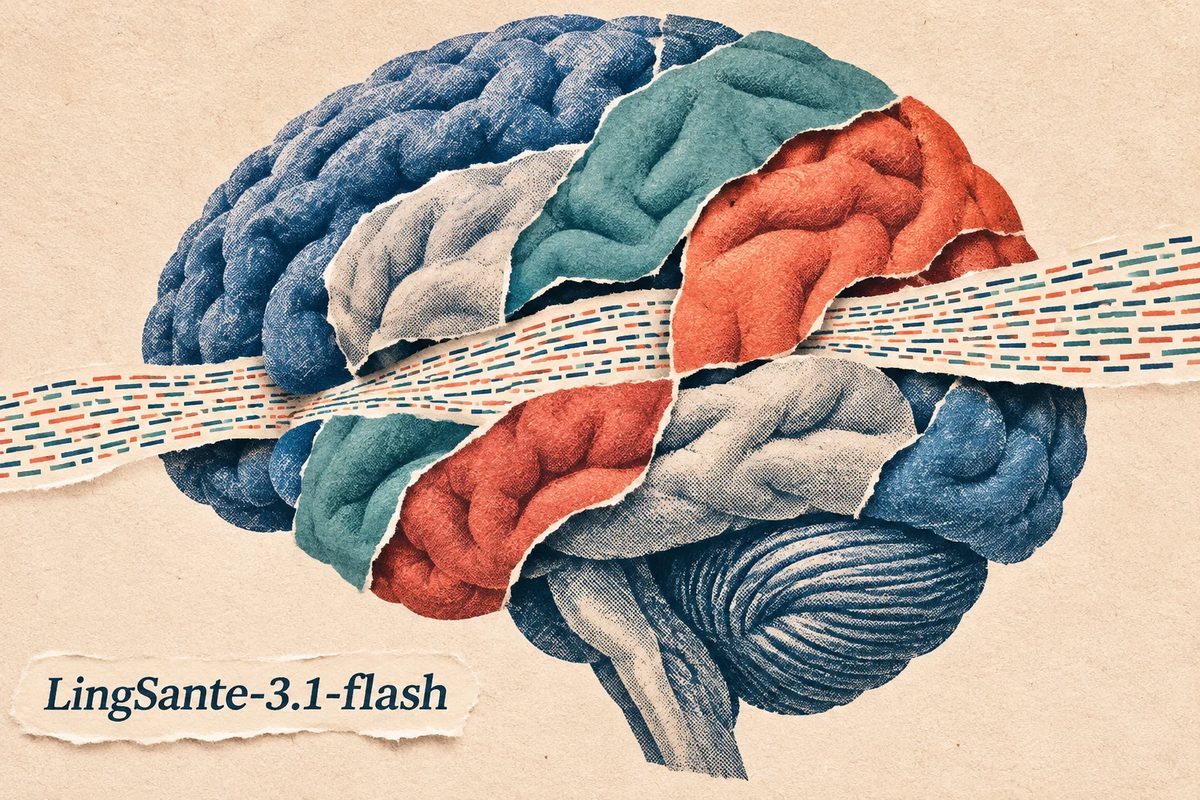
Ant Group publishes open weights for a 560-billion-parameter medical model

Ant Group publishes open weights for a 560-billion-parameter medical model

New Capabilities

LingSante-3.1-flash leads Ant's own open-model ranking and runs inside a health app the company says has 150 million users. Its card says it is not a medical device.

Overview

Updated 26 minutes ago

Ant Group posted the weights for a 560-billion-parameter medical model on November 23, 2026. Anyone can download LingSante-3.1-flash, run it on their own servers, and keep patient records behind their own firewall. The license is MIT, which permits commercial use.

The claim attached to it is narrower than it first sounds. Ant says the model ranks first among open medical models on InclusionMed, an evaluation platform Ant launched the same day with 29 research institutions. On that platform's overall index it places fifth of 23 configurations, behind four closed models, and trails GPT-6 Astra by less than a tenth of a point.

Why it matters

Open weights let a hospital keep patient records on its own servers, something hosted medical AI has never offered.

Questions about this story

Free account needed to ask — your question is kept and asked for you right after sign-up. Answers are public.

No questions yet — be the first to ask.

Key Indicators

560B
Total parameters
Roughly 4% of them fire on any given token.
25B
Parameters active per token
A mixture-of-experts design that keeps inference cheaper than the total size implies.
1M
Context window in tokens
Enough for a long patient file or a multi-step research task.
150M
Afu app users, per Ant
Company-supplied figure, not independently audited.
45.06
InclusionMed index score
Fifth of 23 configurations, first among open models.
65.72
HealthBench Professional
Model card table shows 64.18 for GPT-6 Astra and 61.19 for Claude Opus 5.5.
23.3%
MLCR-AA score reported outside Ant
Artificial Analysis harness on long-context medical reasoning over private documents.
29
Institutions behind InclusionMed
Includes Stanford, Harvard and Peking Union Medical College.

Voices

Curated perspectives — historical figures and your fellow readers.

Sign up to generate historical perspectives on this story.

Organizations Involved

Timeline

4 events Latest: Today
Tap a bar to jump to that date
  1. Outside harness puts long-context medical reasoning at 23.3%

    Today Evaluation

    OrcaRouter flags the Artificial Analysis MLCR-AA result, the first number on the model that Ant did not produce. It measures a harder task over private documents.

  2. Ant opens two LingSante model sets under MIT

    Release

    LingSante-3.1-flash ships at 560 billion parameters with a one-million-token context. A smaller vision-language model, air-VL, ships at 124 billion parameters.

  3. Model card claims top open-model score on HealthBench Professional

    Benchmark

    Ant's comparison table shows 65.72 against 64.18 for GPT-6 Astra and 61.19 for Claude Opus 5.5. It trails on MedQA-USMLE and on InclusionMed's diagnosis benchmark.

  4. Afu app adds real-time AI video consultations

    Product

    Ant says the feature lets users show symptoms on camera and estimates heart and breathing rates from video.

Scenarios

1

A hospital runs LingSante on its own servers and says so

Possible Resolves by Nov 23, 2027

Discussed by: Ant Group, which frames deployment control as the reason to open the weights; Neural Minute and AI Weekly both identify self-hosting as the central argument

The MIT license lets a health system download the weights and run them behind its own firewall, so records never leave the building. That is the case open weights carry in health care and the one a hosted API cannot match. The trigger is a named institution describing real use, not a demo. So far no hospital has reported one, and Neural Minute noted the model card listed no hosted inference provider.

2

Independent evaluation confirms the open-model lead

Uncertain Resolves by Q1 2027

Discussed by: Ant Group's model card; AI Weekly, which notes outside numbers are scarce

Ant's first-place claim rests on a platform it built. A second-place finish on a harness run by someone else would settle the question. Artificial Analysis already runs one such harness and reported a much lower figure on a harder task, so the two results would need to be read side by side rather than as a contradiction.

3

Long-context medical reasoning stays far below the headline scores

Possible Resolves by Q1 2027

Discussed by: AI Weekly and FreshSynapse, both citing the 23.3% MLCR-AA result

The 23.3% figure comes from a harness that stresses reasoning over lengthy private documents, a task closer to real chart review than a multiple-choice exam. If that number holds across other outside tests, the gap between Ant's broad professional-behaviour scores and document-heavy work becomes the story. FreshSynapse argues the two harnesses measure different things, so neither side is proven wrong yet.

4

Ant opens the rest of the LingSante family

Likely Resolves by Q2 2027

Discussed by: Ant Group, which said the remaining models will be opened in later phases

Ant described the November release as an entry point, not the full family. Further weights would extend the pattern: a vendor publishing models it already runs in production. The inclusionAI page on Hugging Face is where a release would appear first.

Historical Context

3 moments from history that rhyme with this story — and how they unfolded.

2015-2018

IBM Watson for Oncology (2015-2018)

IBM marketed Watson for Oncology to hospitals as a treatment-recommendation tool developed with Memorial Sloan Kettering. In July 2018, STAT News published internal documents showing the system had recommended unsafe or incorrect treatments in multiple cases.

Then

Several hospital partnerships stalled or were scaled back.

Now

It became the standard cautionary case for clinical AI deployed before external validation.

Why this matters now

LingSante's model card carries the disclaimer Watson's marketing lacked: not a medical device, not a basis for treatment decisions.

February-July 2023

Meta opens the LLaMA weights (2023)

Meta's LLaMA weights leaked in February 2023. LLaMA 2 shipped in July with a license permitting commercial use, putting frontier-scale language models on hardware their maker did not control.

Then

A large ecosystem of fine-tuned derivatives appeared within months.

Now

It established the argument Ant is now borrowing: whoever runs the weights controls the deployment.

Why this matters now

LingSante applies the same playbook to a field where data handling is regulated.

2023

Google keeps Med-PaLM 2 closed (2023)

Google said its medical language model, Med-PaLM 2, would be offered to a limited set of Google Cloud customers rather than released publicly.

Then

Access stayed gated to selected partners.

Now

Validation of closed medical models stayed largely inside the vendor.

Why this matters now

Ant's release is a direct test of whether the opposite arrangement draws faster scrutiny or faster adoption.

Sources

(9)