

Pull to refresh
Logo
Liquid AI releases d1.2 decision models with audio input and probability scores

Liquid AI releases d1.2 decision models with audio input and probability scores

New Capabilities

The hosted models add five extraction and detection tasks, return calibrated answers without generating text, and put d1.2-ultra atop Artificial Analysis's Decision Index v2.1.

Overview

Updated 48 minutes ago

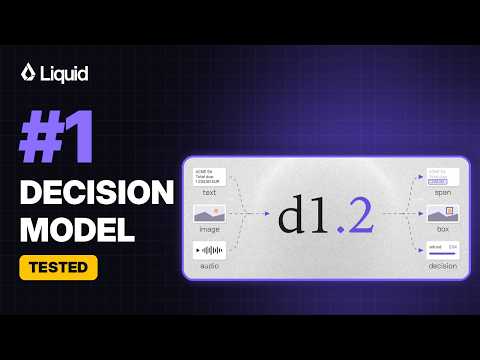
Ask Liquid AI's new model how much is due on an invoice. It returns the number, the characters it read it from, and a probability, without writing a sentence.

Liquid AI released d1.2 and d1.2-ultra on November 17, 2026. Both accept text, images and audio, and answer fixed questions by scoring options rather than generating prose; Artificial Analysis's Decision Index v2.1 lists d1.2-ultra at 75, two points above the previous top decision model. The models are hosted only, so the capability arrives as a rented API rather than a downloadable tool.

Why it matters

Businesses could automate invoices, forms and photo checks with confidence thresholds, paying per question instead of per generated word.

Questions about this story

Free account needed to ask — your question is kept and asked for you right after sign-up. Answers are public.

No questions yet — be the first to ask.

Key Indicators

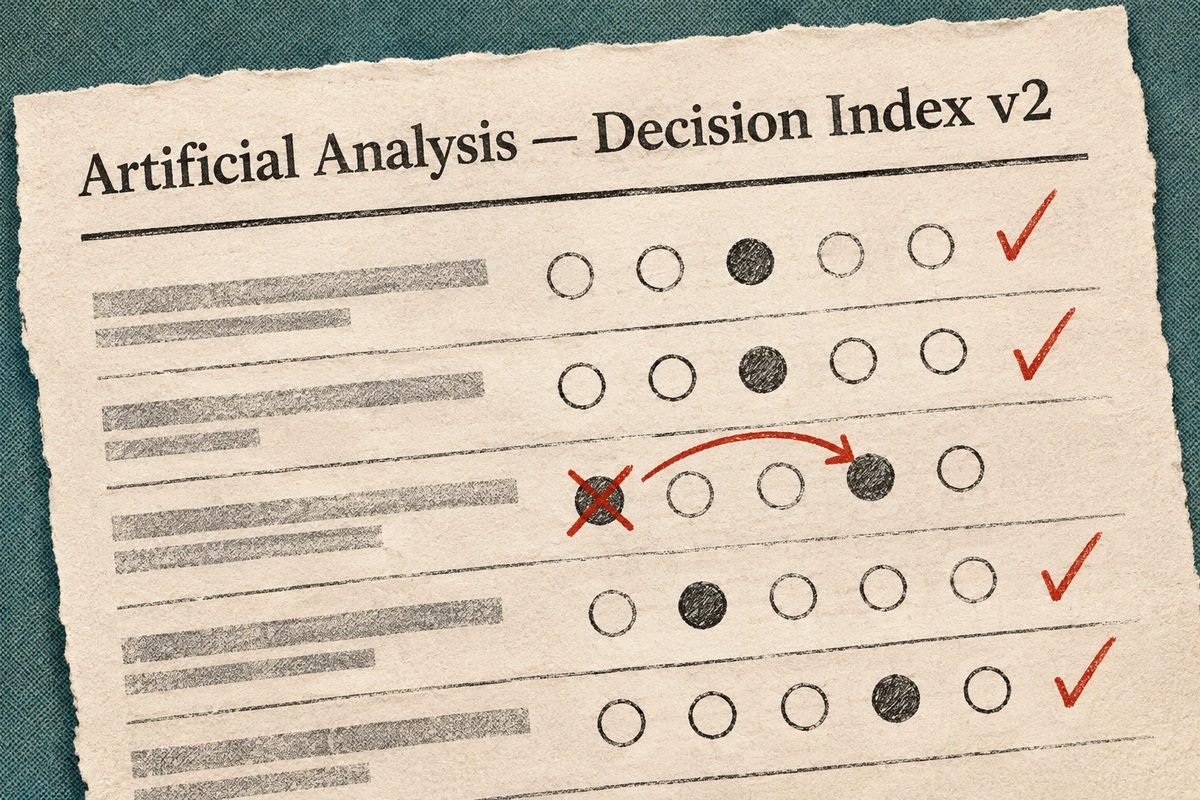
75
Decision Index v2.1 score
d1.2-ultra's score on Artificial Analysis's six-benchmark decision index.
$0.042
d1.2-ultra price per million input tokens
d1.2 costs $0.02 per million input tokens; neither model charges for output tokens.
65,536
Input tokens per question
The limit covers the question plus attached state, images and audio.
128
Questions per API call
A single request can carry up to 128 separate questions against the same state.
0.8
d1.2-ultra calibration error
Measured in percentage points across 13 benchmarks and 22,505 questions.
43
Languages in audio test
Held-out recordings tested language identification and sound recognition.
5
New task types
Value reading, span finding, object locating, number estimating and multi-option selection.

Voices

Curated perspectives — historical figures and your fellow readers.

Sign up to generate historical perspectives on this story.

People Involved

Organizations Involved

Timeline

October 2026 November 2026

4 events Latest: Yesterday
Tap a bar to jump to that date
  1. Liquid AI releases d1.2 and d1.2-ultra

    Latest Release

    Adds audio input and five task types to the hosted decision API.

  2. d1.2-ultra scores 75 on Decision Index v2.1

    Benchmark

    Artificial Analysis ranks it two points above the prior top decision model.

  3. Liquid AI changes billing to charge state once

    Pricing

    Images and audio bill once per request; extra questions add only their text.

  4. Liquid AI releases d1-ultra with a first-place claim

    Release

    Company claimed first on a Decision Index v1.0 published two days earlier.

Scenarios

1

Liquid AI publishes open weights for d1.2

Possible Resolves by Q2 2027

Discussed by: Liquid AI and MarkTechPost

Liquid AI says it will open the weights at some point, but the models are hosted-only today. An open release would let customers run d1.2 outside Liquid's API, changing the cost and data-control calculation. No date has been announced.

2

d1.2 reaches OpenRouter and Vercel

Likely Resolves by Feb 28, 2027

Discussed by: OHRENLab, citing Liquid AI

Liquid AI says the models are coming to OpenRouter and Vercel soon. A listing would put d1.2 in front of developers who do not manage a direct Liquid API account. That is a distribution test more than a technical one.

3

A rival model takes the Decision Index top spot

Likely Resolves by Q2 2027

Discussed by: Artificial Analysis

The index is a live leaderboard, and d1.2-ultra's two-point margin is narrow enough that a competitor's next release could pass it. That would not erase the model's calibration advantage, but it would end the headline claim.

Historical Context

3 moments from history that rhyme with this story — and how they unfolded.

October 2018

BERT and the fine-tuning era (2018)

Google researchers released BERT, a pretrained language model that developers fine-tuned on specific tasks such as classification and entity extraction. It beat prior task-specific systems on several standard benchmarks.

Then

Fine-tuned encoders became the default for document extraction and classification.

Now

Generative models later absorbed many of those tasks through prompting, but specialized models remained cheaper for high-volume extraction.

Why this matters now

d1.2 makes a similar bet on task-specific scoring, but sells it as a hosted API rather than a downloadable checkpoint.

June 2023

OpenAI function calling (2023)

OpenAI added function calling, letting models return structured JSON arguments instead of prose. Developers could wire model outputs directly into software without parsing free text.

Then

Structured outputs spread across major model APIs within months.

Now

Tool use and structured extraction became standard features of general-purpose models.

Why this matters now

d1.2 removes the generated tokens entirely, returning only scored answers and extracted spans. It tests whether a dedicated decision endpoint can beat a general model with a structured-output prompt.

1989

FICO scores and calibrated lending decisions (1989)

Fair, Isaac began selling FICO scores, a single number that summarized credit risk and came with a defined probability of default. Lenders used thresholds to approve, deny or review applications.

Then

Lenders could automate routine decisions and route edge cases to human review.

Now

The score became infrastructure for consumer credit, and its use brought regulation and disputes over explainability.

Why this matters now

d1.2 sells calibration error and confidence thresholds for document work, the same operating pattern: automate the easy cases, send low-confidence ones to people.

Sources

(6)