



Pull to refresh
Logo
Microsoft releases seven specialized AI models, priced to undercut rivals

Microsoft releases seven specialized AI models, priced to undercut rivals

New Capabilities

At Ignite 2026, Microsoft's in-house lab shipped coding, security, voice, image and routing models, plus a second-generation chip and licensable weights

Overview

Updated 37 minutes ago

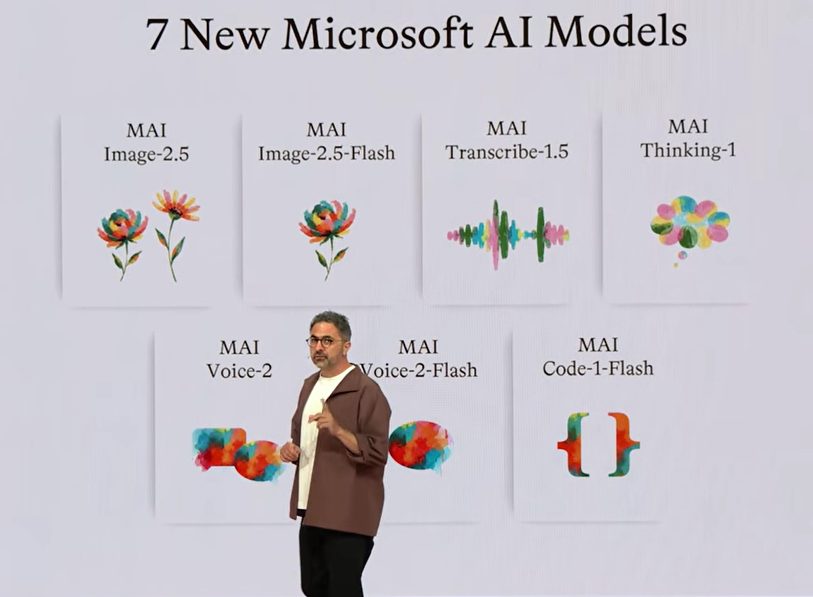
Microsoft released seven AI models on November 17, each tuned to one job: writing code, scanning for security flaws, editing images, holding a spoken conversation, transcribing a doctor's visit, and routing requests to cheaper models. Microsoft priced most of them well below the frontier model it benchmarked them against, from 40% of GPT-6.1 Sol's price for coding to one cent per audio minute for voice.

The launch puts Microsoft's in-house lab, Microsoft AI (MAI), in direct competition with OpenAI, whose models Microsoft still sells through its cloud, and with Anthropic. MAI chief Mustafa Suleyman says the trick is packing domain knowledge into fewer parameters, and that a true general-purpose frontier model is still in progress. Axios reported the comparisons rest on selected benchmarks and that some price advantages reflect promotional discounts.

Why it matters

If Microsoft's benchmark claims hold, running a coding agent around the clock costs 60% less per task than OpenAI's GPT-6.1 Sol.

Questions about this story

Free account needed to ask — your question is kept and asked for you right after sign-up. Answers are public.

No questions yet — be the first to ask.

Key Indicators

7
New MAI models released at Ignite
Coding, security, image, voice, transcription and decision models, plus a second-generation accelerator.
40%
MAI Code 2 price as a share of GPT-6.1 Sol's
Microsoft's figure, averaged over four coding benchmarks where it claims 98% of Sol's quality.
$0.01
Starting price per audio minute, MAI Realtime 1
Microsoft says the speech model beat GPT-Realtime 2.1 on its own evaluations.
4,000
Customers using the Decision 1.1 routing model
Now generally available, with image inputs added.
10M
Patient encounters a month on Dragon Copilot Transcribe
Runs on MAI Transcribe 2; Microsoft says multilingual error rates were halved.

Voices

Curated perspectives — historical figures and your fellow readers.

Sign up to generate historical perspectives on this story.

People Involved

Organizations Involved

Timeline

November 2026 December 2026

4 events Latest: Yesterday
Tap a bar to jump to that date
  1. MAI Cyber 2 Flash set to replace its predecessor in MDASH

    Upcoming Rollout

    Microsoft says the security model will automatically replace MAI Cyber 1.1 Flash for eligible customers in its MDASH product starting mid-December.

  2. Microsoft unveils seven MAI models at Ignite

    Latest Product launch

    Coding, security, image, voice, transcription and routing models ship, alongside the Maia 200 accelerator and licensable model weights.

  3. Decision 1.1 reaches general availability

    Product release

    The routing model, built on Gemma, adds image inputs and has 4,000 customers; Microsoft says it is 50 times faster than GPT-Sol 6.1.

  4. OpenAI answers with GPT-6.2 Astra and Sol

    Competitive response

    OpenAI released two new models the same day, with Astra priced 20% below its prior version.

Scenarios

1

GitHub Copilot runs most code requests on Microsoft's own models

Likely Resolves by Q2 2027

Discussed by: Mustafa Suleyman, who told Axios he expects significant adoption but declined to give a target

MAI Code 2 is live in GitHub Copilot at 40% of GPT-6.1 Sol's price. If Microsoft routes Copilot traffic to it at scale, the coding workloads that made OpenAI valuable to Microsoft start shifting inward, and OpenAI loses its largest distribution channel.

2

MAI Cyber 2 Flash becomes the default security model in MDASH

Likely Resolves by End of 2026

Discussed by: Microsoft, in its Cyber 2 Flash announcement

Microsoft said the model replaces MAI Cyber 1.1 Flash automatically for eligible customers starting mid-December, at 86% lower output-token pricing. A completed swap would make it the largest measured deployment of an MAI model inside a Microsoft product.

3

Microsoft sells licensed MAI weights to outside enterprises

Possible Resolves by Q3 2027

Discussed by: Microsoft AI, which introduced the program at Ignite

Licensed Weights let a customer fine-tune an MAI model on private data and run it inside their own Azure environment. If it reaches general commercial availability, Microsoft becomes a model vendor in the way it has been a model reseller, and customer fine-tunes stop leaving the building.

4

Microsoft ships a general-purpose frontier model

Uncertain Resolves by End of 2027

Discussed by: Suleyman, who said Microsoft has strong pre-training results but gave no release timeline

Every model in this launch is deliberately narrow; Microsoft says they are not tuned for open-ended research or long-horizon agent work. A general model that ranks alongside GPT-6.2 and Opus 5.5 would turn a cost play into a direct capability contest.

Historical Context

3 moments from history that rhyme with this story — and how they unfolded.

November 2020

Apple switches Macs to its own chips (2020)

Apple announced the M1 processor and began replacing Intel chips in its computers, claiming large gains in performance per watt. The company had designed the chip and the software together for years before shipping it.

Then

Some software ran slowly through translation layers until developers rebuilt it for the new architecture.

Now

Apple set its own upgrade schedule and stopped paying Intel for its most important component.

Why this matters now

Microsoft's Maia 200 follows the same logic: design the chip and the model together, then set your own price instead of renting the capability.

Late 2018

Amazon launches its own cloud chips (2018)

Amazon began selling cloud servers running on Graviton, its own Arm-based processor, priced below equivalent machines using Intel chips. Amazon kept offering Intel and AMD instances alongside them.

Then

Customers used the cheaper instances for workloads that did not need the fastest single core.

Now

Owning a chip gave Amazon leverage over supplier pricing and a margin its rivals could not match.

Why this matters now

Microsoft is running the same play with models: keep selling OpenAI's, price its own lower, and let customers choose on cost.

May 2024

Google splits Gemini into a cheap fast tier (2024)

Google introduced a smaller, cheaper version of its Gemini model for high-volume work, sold next to the larger model rather than replacing it. The cheap tier handled routine requests; the expensive one handled hard ones.

Then

Developers moved bulk traffic to the cheaper model to control bills.

Now

Two-tier model lines became the standard way labs sold AI: a flagship for benchmarks, a cheap one for production.

Why this matters now

MAI Code 2 Flash and Cyber 2 Flash copy that structure, with Microsoft claiming the cheap tier matches rivals' mid-tier models on price.

Sources

(10)