



Pull to refresh
Logo
Alabama's Mobile River Bridge clears final funding hurdle

Alabama's Mobile River Bridge clears final funding hurdle

Built World

After 30 years of planning, the $3.2 billion project starts construction with an Oct. 2 groundbreaking

Today: Full construction begins

Overview

Updated 1 hour ago

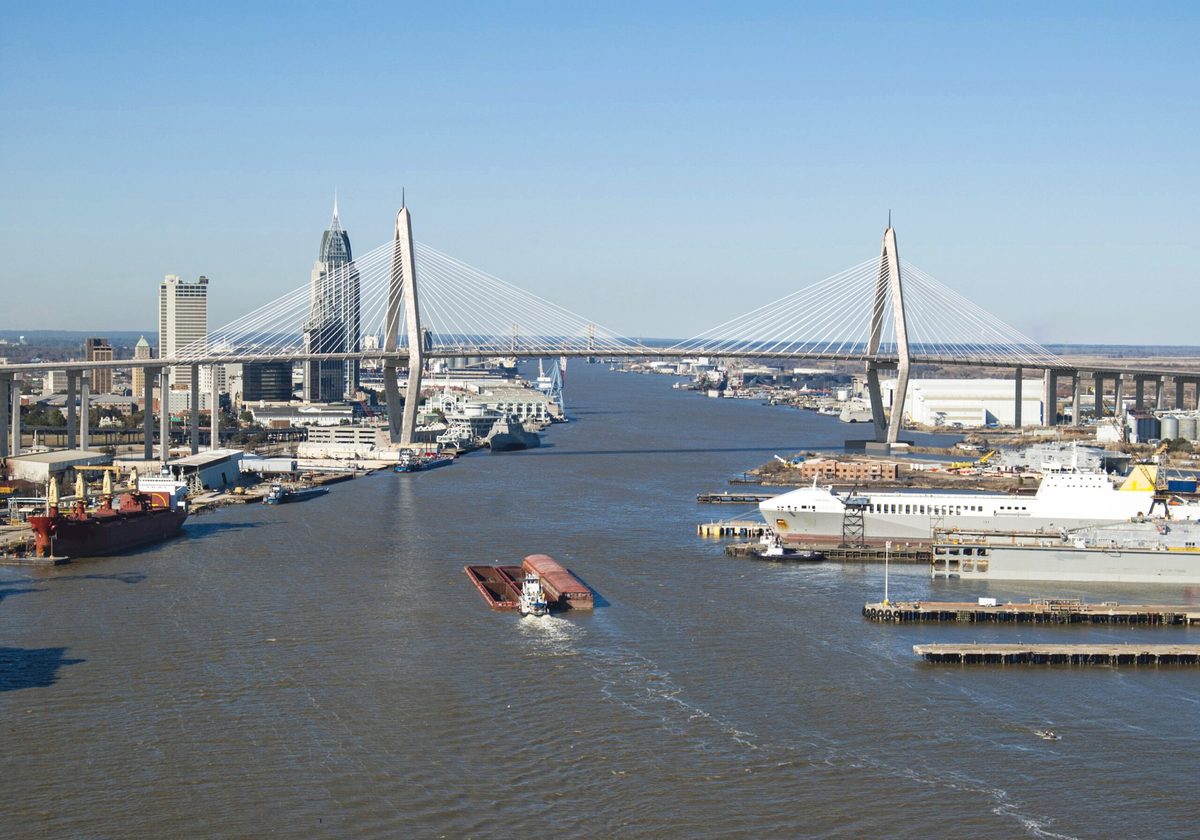
The 30-year wait is over. Alabama has cleared the final funding hurdle for the $3.2 billion Mobile River Bridge, the largest infrastructure project in state history, and construction starts this week with a ceremonial groundbreaking planned for October 2.

The six-lane cable-stayed bridge will replace a 1970s tunnel bottleneck on Interstate 10, give hazardous-material freight a safe river crossing, and expand access to the Port of Mobile. The first phase is funded by a $2.52 billion federal loan, and tolling starts when the bridge opens, projected for late 2031.

Why it matters

The bridge unblocks a 1970s tunnel bottleneck on I-10, routes hazardous freight off local streets, and expands access to the Port of Mobile.

Questions about this story

Free account needed to ask — your question is kept and asked for you right after sign-up. Answers are public.

No questions yet — be the first to ask.

Key Indicators

$3.2B
Phase 1 design-build contract value
Guaranteed maximum price, so cost overruns fall on contractors, not the state.
$2.52B
Federal TIFIA loan
The largest single piece of financing, finalized September 18, 2026.
2.5 miles
Cable-stayed bridge length
Spans the Mobile River navigational channel, bypassing two 1970s tunnels.
5 years
Construction duration
Full construction began October 1, with opening projected for late 2031.
$7.70
Maximum one-way toll
Rates rise 5% or inflation annually in the first 10 years of tolling.

Voices

Curated perspectives — historical figures and your fellow readers.

Ever wondered what historical figures would say about today's headlines?

Sign up to generate historical perspectives on this story.

People Involved

Organizations Involved

Timeline

January 2019 October 2026

10 events Latest: Today
Tap a bar to jump to that date
  1. Ceremonial groundbreaking planned

    Upcoming Milestone

    Governor Ivey and USDOT Secretary Sean Duffy scheduled to attend in Mobile.

  2. Full construction begins

    Today Milestone

    ALDOT authorizes the design-build team to proceed with full construction.

  3. Governor Ivey authorizes construction

    Decision

    Governor formally authorizes the start of work, the final procedural step before groundbreaking.

  4. ALDOT issues notice to proceed

    Decision

    State clears KMT to begin full construction of the bridge and Phase 1 work.

  5. Federal TIFIA loan finalized

    Funding

    USDOT closes the $2.52 billion TIFIA loan, the final major funding component.

  6. Toll authority adopts escalating rates

    Policy

    One-way tolls set up to $7.70 with annual 5% or inflation increases for the first decade.

  7. Program split into two phases

    Decision

    After total costs exceeded $5 billion, ALDOT separates the bridge from the Bayway replacement.

  8. KMT selected as design-build team

    Contract

    Kiewit-Massman-Traylor wins the $3.2 billion guaranteed maximum price contract.

  9. Project revived at local request

    Decision

    Mobile and Eastern Shore planning organizations ask ALDOT to restart the bridge program.

  10. ALDOT scraps public-private partnership

    Decision

    Amid public resistance to tolls, ALDOT drops the P3 plan for the bridge and Bayway.

Scenarios

1

Mobile River Bridge opens on schedule in late 2031

Likely Resolves by Q1 2032

Discussed by: ALDOT and KMT, who project a five-year construction window

The bridge opens to traffic around late 2031 with tolling starting immediately. KMT holds a guaranteed maximum price contract, placing cost overrun risk on the contractors and removing the usual driver of schedule blowouts. Early geotechnical work and long-lead procurement are already done.

2

Geotechnical and cost issues push opening past 2032

Possible Resolves by Jan 31, 2033

Discussed by: Engineering News-Record, which notes geotechnical challenges already drove Bayway costs higher

The program's own history shows how bay geology and rising labor and material costs ballooned earlier estimates, pushing the total past $5 billion. Similar surprises on the cable-stayed span or Bayway restriping could force ALDOT to revise the opening date.

3

Toll backlash triggers legislative intervention

Possible Resolves by End of 2032

Discussed by: Local Alabama media, including al.com, which reports one-way trips could cost up to $7.70

Public resistance to tolls already killed the original P3 plan in 2019. The new escalating schedule, adopted over the $2.50 flat rate officials endorsed in 2022, could revive that opposition once tolling begins.

Historical Context

3 moments from history that rhyme with this story — and how they unfolded.

1991–2007

Boston's Big Dig (1991–2007)

Boston's Central Artery/Tunnel project, begun in 1991, was originally priced near $2.8 billion. It finished in 2007 at roughly $14.8 billion, becoming America's most expensive highway project.

Then

Massive cost overruns, a fatal ceiling collapse in 2006, and years of disruptive construction in downtown Boston.

Now

The project became the standard cautionary tale for every U.S. megaproject since, driving demand for fixed-price and design-build contracts.

Why this matters now

The Mobile Bridge faces similar geotechnical and cost risks along Mobile Bay, which ALDOT says pushed the program beyond $5 billion.

2002–2013

San Francisco–Oakland Bay Bridge Eastern Span (2002–2013)

A seismic replacement of the Bay Bridge's eastern span, launched in 2002, was meant to open by 2007 at about $1.5 billion. Weld failures and design disputes pushed it to over $6 billion and a 2013 opening.

Then

A 10-year delay and a final cost more than four times the original estimate.

Now

Showed how steel fabrication quality and contractor accountability matter on complex marine bridge projects.

Why this matters now

Mobile's cable-stayed span over a navigable river carries the same geotechnical and steel-fabrication risks that delayed the Bay Bridge.

August 2007 – September 2008

Minneapolis I-35W Bridge Replacement (2007–2008)

After the I-35W bridge collapsed in August 2007, killing 13 people, Minnesota replaced it in 13 months, opening the new span in September 2008.

Then

An accelerated design-build approach delivered a new crossing in barely a year.

Now

A proof point that fast, accountable delivery is possible when funding is secured and the owner commits to design-build.

Why this matters now

A counter-example to the decade-plus timelines that have marked the Mobile and Bay Bridge projects.

Sources

(10)