
Pull to refresh
Logo
Mammoet rolls a 3,700-tonne Hamburg rail bridge into place in under a day

Mammoet rolls a 3,700-tonne Hamburg rail bridge into place in under a day

Built World

The Sternbrücke replacement shut a key Hamburg rail artery for six weeks instead of years

Overview

Updated 1 hour ago

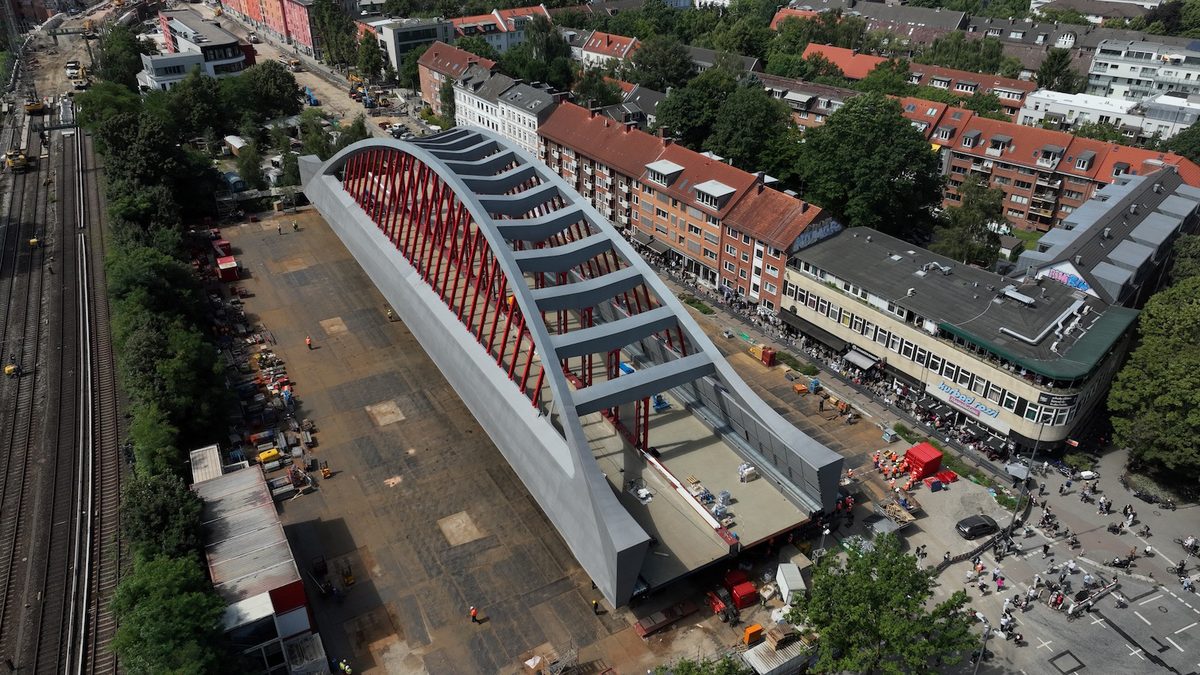
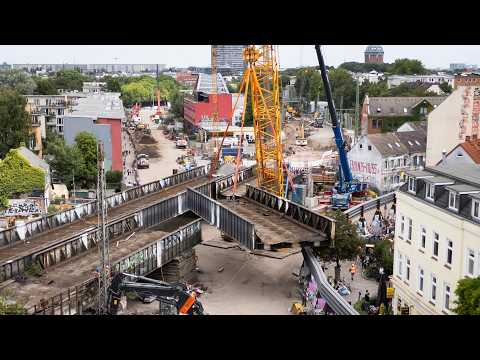
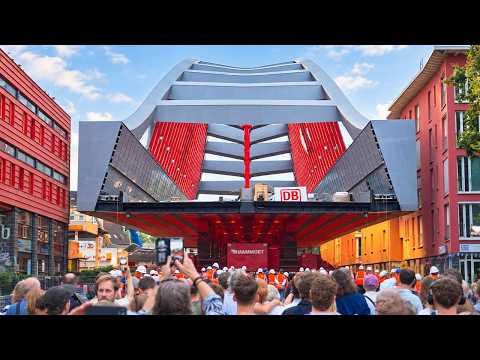
The old Sternbrücke carried about 1,000 long-distance, regional and commuter trains a day over two of Hamburg's busiest streets. Replacing it where it stood would have closed that line for years, so Deutsche Bahn had a 3,700-tonne replacement built in a yard nearby and rolled into place.

Crews assembled the new bridge over 14 months, then moved it 500 metres down the Max-Brauer-Allee and set it on its supports in under 24 hours. The street reopened after six weeks. Mammoet says the gap to the buildings on either side fell to 30 centimetres at the tightest points.

Why it matters

Building a bridge off to the side can turn a multi-year rail closure into a six-week one, if a city can spare the space.

Questions about this story

Free account needed to ask — your question is kept and asked for you right after sign-up. Answers are public.

No questions yet — be the first to ask.

Key Indicators

3,700 t
Weight of the new Sternbrücke
Assembled from sections in a laydown area beside the Max-Brauer-Allee.
500 m
Distance moved on self-propelled transporters
The bridge travelled down the Max-Brauer-Allee, then turned 45 degrees onto its abutments.
30 cm
Clearance at the narrowest point
Space between the moving bridge and buildings on either side, per Mammoet.
272
Axle lines on the transporters
Two configurations of four trains each, with 16 climbing jacks rated at 500 tonnes.
6 weeks
Road closure for the installation
Building the bridge in place would have closed the route for years.
1,000
Trains using the crossing each day
Long-distance, regional and commuter services between Hamburg Hauptbahnhof and Altona.

Voices

Curated perspectives — historical figures and your fellow readers.

Sign up to generate historical perspectives on this story.

People Involved

Organizations Involved

Timeline

2017 November 2026

5 events Latest: Today
Tap a bar to jump to that date
  1. Mammoet publishes photographs and details

    Today Disclosure

    Mammoet releases images and engineering detail from the July installation.

  2. Line and street reopen after six weeks

    Reopening

    The new Sternbrücke reopens to rail traffic and the road reopens to vehicles.

  3. Bridge rolls 500 metres and is set in place

    Installation

    The assembled bridge travels down the Max-Brauer-Allee and is set on its abutments in under 24 hours.

  4. Transport study fixes bridge dimensions

    Engineering

    The final revision sets the maximum width and height the bridge can be for the route.

  5. Mammoet studies a one-piece installation

    Planning

    Deutsche Bahn commissions a feasibility study into moving the replacement bridge in whole.

Scenarios

1

Mammoet books another single-piece rail bridge move in Europe

Possible Resolves by End of 2027

Discussed by: Heavy-lift trade press covering the Sternbrücke

The Sternbrücke is a showcase rather than a one-off: assembling off site and rolling in keeps a rail line open, which matters wherever a bridge carries heavy traffic. If other operators ask for the same approach, Mammoet would announce a comparable contract. The constraint is space, since the method needs a yard near the route big enough to build a bridge in.

2

Hamburg's next rail bridge replacement is built in place, not slid in

Possible Resolves by Q2 2028

Discussed by: Infrastructure and construction trade coverage

The Sternbrücke had unusual conditions: a long straight avenue to roll down and a large laydown area two streets over. Most urban rail bridges have neither, so the next replacement in the city could revert to conventional construction with a long closure. A decision on the next major crossing would settle it.

3

New Sternbrücke needs an early closure or speed limit

Unlikely Resolves by Aug 31, 2027

Discussed by: Rail operations reporting

A bridge set on its abutments in a single night has to settle and be checked under live traffic. If alignment or bearing problems appear, the operator would impose a speed restriction or take the bridge out of service briefly. That would not undo the method, but it would change the maintenance record.

Historical Context

3 moments from history that rhyme with this story — and how they unfolded.

August 2007 - September 2008

I-35W St. Anthony Falls Bridge, Minneapolis (2007-2008)

The I-35W bridge over the Mississippi collapsed on 1 August 2007, killing 13 people and cutting a main commuter route. Crews built the replacement using prefabricated segments and round-the-clock shifts, opening it on 18 September 2008, about 13 months later and months ahead of the original schedule.

Then

Traffic returned to the corridor far sooner than standard procurement would have allowed.

Now

The project became a standard reference for accelerated bridge construction in the United States.

Why this matters now

It shows how much time comes out of a schedule when large pieces are fabricated away from the site and the closure is the only thing on the clock.

August 2018 - August 2020

Genoa's San Giorgio Bridge (2018-2020)

The Morandi motorway bridge in Genoa collapsed on 14 August 2018, killing 43 people. The replacement, designed by Renzo Piano, was built with prefabricated steel and concrete components and opened on 3 August 2020, roughly two years after the collapse.

Then

The city regained a main road link on a timeline that normal design-and-tender cycles would not have produced.

Now

The project tied off-site fabrication to a hard public deadline, a formula now cited in other fast rebuilds.

Why this matters now

Same mechanism as Hamburg: build components elsewhere, then do the disruptive work in a short window.

2011 - August 2017

Queensferry Crossing, Scotland (2011-2017)

Rather than replace the Forth Road Bridge in place, authorities built a new crossing alongside it. Construction ran from 2011 and the Queensferry Crossing opened on 30 August 2017, with the old bridge kept in service during the work.

Then

The main east-coast route between Edinburgh and Fife stayed open throughout construction.

Now

Parallel construction became the accepted answer where a crossing cannot be closed, at the cost of building on a new alignment.

Why this matters now

Hamburg could not build on a new alignment, so it took the parallel-build idea one step further and moved the finished bridge to the old one's spot.

Sources

(4)