Pull to refresh
Logo
Daily Brief
Following
Why Sign Up
Mexico's quiet transformation: 13.4 million people exit poverty in six years

Mexico's quiet transformation: 13.4 million people exit poverty in six years

Rule Changes
By Newzino Staff |

A combination of wage increases, cash transfers, and remittances has driven measurable gains in housing, food security, and education—but the south still lags far behind

March 3rd, 2026: Human Progress reports broad improvements in Mexican housing, food, and education access

Overview

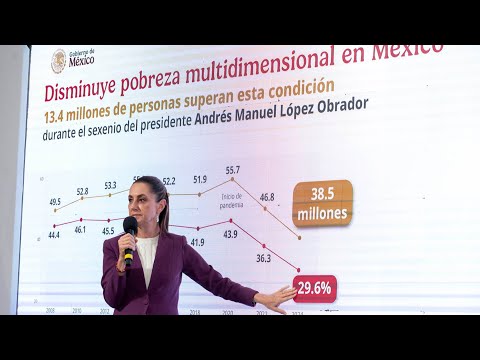
In 2018, 43 percent of Mexico's population lived in multidimensional poverty. By 2024, that figure had fallen to 29.6 percent—a drop of 13.4 million people, the largest reduction on record. The gains show up in concrete terms: 85.6 percent of Mexicans now have reliable access to nutritious food, up from 78 percent in 2016. Over 92 percent report adequate housing quality. And the upper secondary school dropout rate fell from 14.5 percent to 8.7 percent in five years.

Key Indicators

29.6%
Population in poverty (2024)
Down from 43.2% in 2016 and 41.9% in 2018—the lowest rate ever recorded in Mexico
135%
Minimum wage increase since 2018
Daily minimum rose from 88.40 to 278.80 pesos, the highest growth rate among all Organisation for Economic Co-operation and Development (OECD) member states
85.6%
Food-secure population (2024)
Up from 78.1% in 2016; 69.4% of households now report food security with a diverse diet
66.0%
Poverty rate in Chiapas (2024)
Nearly six times the rate in Baja California—five southern states have ranked last since 2015
$64.7B
Remittances received in 2024
A record high and eleventh consecutive year of growth, though remittances fell 5.5% in the first nine months of 2025

Interactive

Exploring all sides of a story is often best achieved with Play.

Winston Churchill

Winston Churchill

(1874-1965) · World Wars · politics

Fictional AI pastiche — not real quote.

"A nation that lifts thirteen million souls from poverty in six years has won a battle far harder than most generals dare attempt — yet victory remains incomplete so long as Chiapas and Oaxaca languish in the shadow of Mexico City's triumph, for a chain is only as strong as its weakest, most forgotten link."

Ever wondered what historical figures would say about today's headlines?

Sign up to generate historical perspectives on this story.

Sign Up

Debate Arena

Two rounds, two personas, one winner. You set the crossfire.

People Involved

Organizations Involved

Timeline

  1. Human Progress reports broad improvements in Mexican housing, food, and education access

    Data

    An analysis consolidating recent survey data showed 92.1% of Mexicans with adequate housing, 85.6% with food security, and a 33.5 percentage point increase in students' access to basic learning tools since 2016.

  2. Remittances to Mexico begin declining after record 2024

    Economic

    After reaching a record $64.7 billion in 2024, remittances fell 5.5% in the first nine months of 2025, raising questions about the sustainability of one pillar of poverty reduction.

  3. Constitutional reform dissolves CONEVAL, transfers poverty measurement to INEGI

    Institutional

    The independent poverty evaluation agency was eliminated, with its functions absorbed by the national statistics institute now led by a former Lopez Obrador cabinet member.

  4. Sheinbaum takes office, pledges to expand social programs

    Political

    Mexico's first female president continued her predecessor's social spending approach and began constitutionally enshrining welfare programs as permanent rights.

  5. Minimum wage reaches 278.80 pesos per day after sixth straight double-digit increase

    Policy

    Cumulative increases of 135% since 2018 made Mexico the OECD member with the fastest minimum wage growth, lifting an estimated 4.1 million people out of poverty through wages alone.

  6. Poverty rate drops to 36.3%, first major post-pandemic measurement

    Data

    The 2022 poverty measurement showed a substantial decline from the 2020 pandemic peak, driven by wage gains and social transfers.

  7. Prospera replaced with Becas Benito Juarez scholarships

    Policy

    The government discontinued the internationally recognized conditional cash transfer program, replacing its health and nutrition components with a simpler education scholarship scheme.

  8. Lopez Obrador takes office, begins minimum wage push

    Political

    The new president launched a series of double-digit annual minimum wage increases and expanded direct cash transfer programs, beginning a sustained social spending expansion.

  9. CONEVAL established to independently measure poverty

    Institutional

    Mexico created a dedicated agency to measure multidimensional poverty across six dimensions beyond income, setting a standard for the region.

  10. Mexico launches Progresa, the world's first national conditional cash transfer program

    Policy

    The program provided cash payments to poor families conditional on children attending school and family members visiting health clinics, becoming a global model for poverty reduction.

Scenarios

1

Mexico sustains progress and begins closing the north-south gap

Discussed by: BBVA Research, Social Progress Imperative analysts

If remittances stabilize, minimum wage gains continue outpacing inflation, and the budgeted welfare spending increase for 2026 is fully deployed to southern states, poverty could fall below 25% by 2028. This scenario requires sustained economic growth and targeted infrastructure investment in Chiapas, Guerrero, and Oaxaca—states where poverty rates remain above 50%. The Sheinbaum administration's Plan Mexico, committing 5.6 trillion pesos to major projects through 2030, includes southern development targets that could begin narrowing the gap if implemented.

2

National averages improve but southern states stagnate

Discussed by: World Bank, Social Progress Imperative, OECD Economic Survey of Mexico

The most likely trajectory based on current trends. National poverty continues declining as urban areas and northern states benefit from nearshoring investment, wage growth, and better infrastructure. But the structural barriers in southern states—geographic isolation, fragmented municipalities, weak institutional capacity, informal employment—prove resistant to cash transfers alone. The five lowest-ranking states on the Social Progress Index have remained the same since 2015 despite national progress. Without targeted investment in health, education infrastructure, and formal job creation in these regions, the internal gap widens even as headline numbers improve.

3

Remittance decline and fiscal pressure reverse recent gains

Discussed by: BBVA Research, Center for Strategic and International Studies (CSIS)

Remittances have already begun falling in 2025, down 5.5% through nine months. If United States immigration enforcement tightens further or the American economy slows, Mexico loses a pillar that lifted 1.1 million people above the poverty line in 2024 alone. Simultaneously, the government's commitment to expanding welfare spending without raising taxes creates fiscal strain—the 2026 budget allocates nearly one trillion pesos to social programs at 3% of gross domestic product. A sustained remittance decline combined with fiscal tightening could stall or partially reverse the poverty gains of the past six years.

4

Loss of independent poverty measurement erodes credibility of data

Discussed by: Former CONEVAL director Gonzalo Hernandez, independent economists

With CONEVAL dissolved and its functions housed inside INEGI—now led by a former government minister—skeptics question whether future poverty measurements will maintain methodological independence. If international organizations or domestic researchers identify discrepancies between official statistics and independent surveys, confidence in the reported progress could weaken. This would not necessarily mean the gains are fictitious, but it would make it harder to evaluate which policies are working and to hold the government accountable for outcomes.

Historical Context

Brazil's Bolsa Familia program (2003-present)

October 2003 - present

What Happened

Brazil launched the world's largest conditional cash transfer program, eventually reaching over 21 million households with payments tied to school attendance and health clinic visits. The program was modeled partly on Mexico's own Progresa, which had launched six years earlier.

Outcome

Short Term

Brazil's poverty rate fell 27.7% during President Lula's first term, with Bolsa Familia credited as a significant contributor alongside broader economic growth.

Long Term

The program became a permanent feature of Brazilian social policy, surviving changes in government across the political spectrum. It demonstrated that conditional cash transfers could operate at massive scale without reducing labor force participation—a finding that influenced social policy across Latin America.

Why It's Relevant Today

Mexico's current approach shares DNA with Bolsa Familia but has moved toward less conditional, more universal programs. The Brazilian experience suggests that broad-based cash transfers can deliver sustained poverty reduction, but also that gains depend on maintaining the economic conditions that fund them.

Mexico's Piso Firme housing program (2000-2012)

2000-2012

What Happened

The state of Coahuila launched a program to replace dirt floors with cement in low-income homes, at a cost of just $162 per household. The program scaled nationally under President Felipe Calderon, eventually installing 2.7 million cement floors across Mexico.

Outcome

Short Term

Rigorous evaluation showed a 78% reduction in parasitic infections, 49% reduction in diarrhea, and 81% reduction in anemia among children in treated homes. Adults reported 59% higher satisfaction with their housing and 69% higher quality-of-life satisfaction.

Long Term

Piso Firme became a globally cited example of how low-cost housing improvements can produce outsized health and cognitive development benefits, influencing housing policy in other developing countries.

Why It's Relevant Today

Today's housing quality data—92.1% of Mexicans reporting adequate housing—reflects the cumulative impact of programs like Piso Firme alongside broader economic gains. It illustrates how targeted, evidence-based interventions can complement wage and transfer policies in reducing multidimensional poverty.

Mexico's Progresa program launch (1997)

August 1997

What Happened

Mexico launched Progresa, the world's first national conditional cash transfer program, providing money to poor families who kept children in school and attended health clinics. The program was rigorously evaluated through randomized controlled trials and renamed Oportunidades in 2002, then Prospera in 2014.

Outcome

Short Term

Early evaluations showed significant increases in school enrollment, reduced child labor, and improved nutrition among participating families.

Long Term

The program operated for 22 years and inspired similar programs in over 60 countries. Research published in 2024 found that children of original beneficiaries were earning more as adults, confirming intergenerational effects. The program was discontinued in 2019 and replaced with simpler, less-conditional alternatives.

Why It's Relevant Today

Mexico's current poverty reduction draws on a nearly three-decade institutional tradition of social programs, even as the specific design has shifted from conditional transfers to a mix of universal pensions, scholarships, and wage policy. The question of whether the newer, less-targeted approach can sustain the same long-term gains remains open.

Sources

(15)