

Pull to refresh
Logo
Mistral opens Studio agents and apps in public preview

Mistral opens Studio agents and apps in public preview

New Capabilities

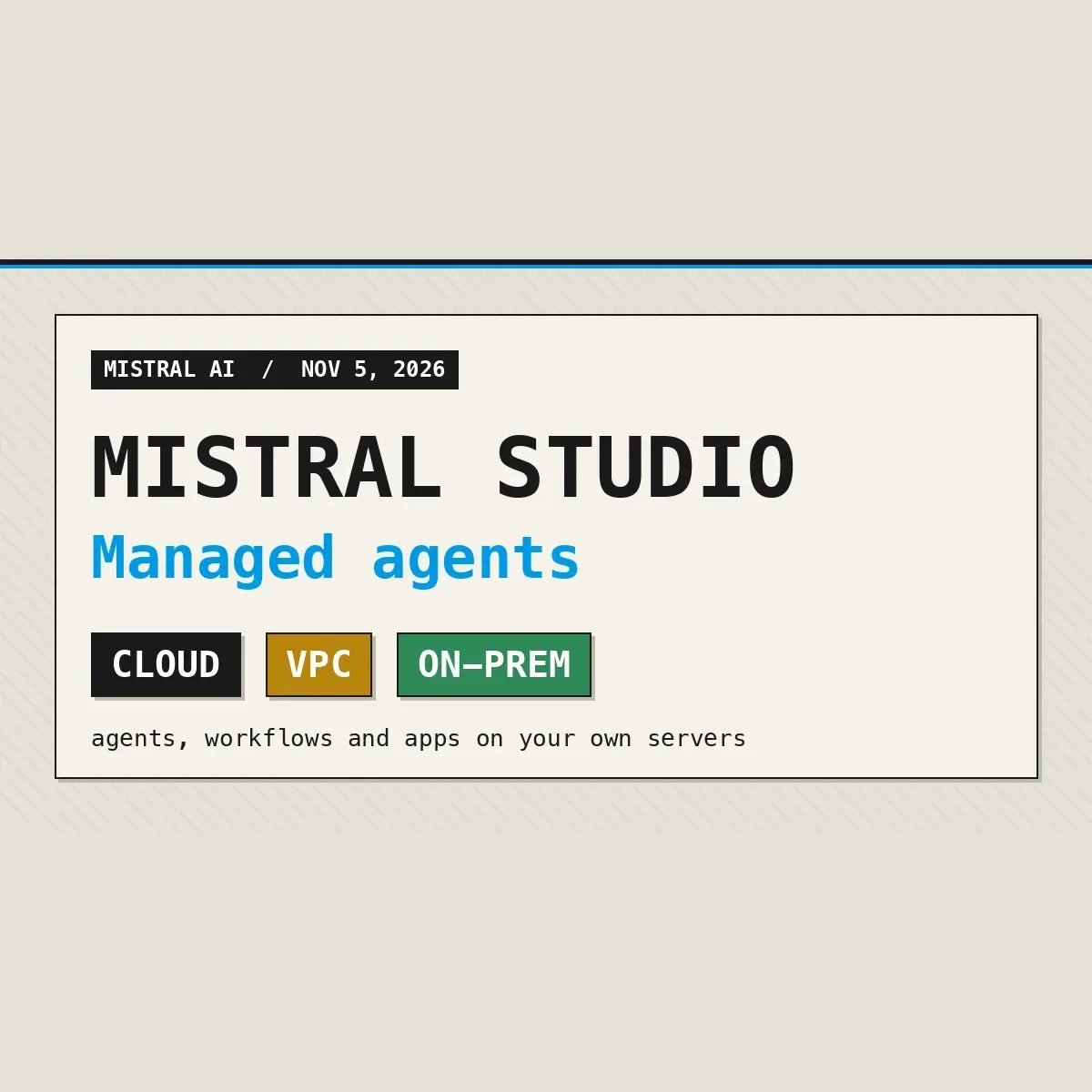
Managed agents can run for days, resume after a crash, and pause for human approval. Private cloud and on-premises versions are promised for late November.

Overview

Updated 1 hour ago

Mistral AI moved its agent-building tools from demo to product on November 5, 2026. Managed Agents and Studio apps entered public preview on Mistral Cloud, and Workflows reached general availability.

The pitch is infrastructure a developer no longer builds. Write an agent once in Python, then run it locally, on your own servers, or on Mistral's, where it keeps working after the app exits and picks up where it stopped after a crash.

Why it matters

If hosted agent runtimes become the default, the bottleneck for enterprise AI shifts from model quality to who controls the execution layer.

Questions about this story

Free account needed to ask — your question is kept and asked for you right after sign-up. Answers are public.

No questions yet — be the first to ask.

Key Indicators

3
Run modes for one agent codebase
In-process during development, self-hosted with agents serve, or Mistral-managed with agents deploy.
24 hours
Default session lifetime
Mistral's documentation lists 24 hours as the default maximum for a Studio-deployed session, and says it can be raised.
1 hour
Default wait for human approval
An agent waiting on a person's sign-off times out after one hour by default.
Late Nov 2026
Target for private cloud and on-premises
Mistral says the same features will reach private cloud and on-premises environments in late November.

Voices

Curated perspectives — historical figures and your fellow readers.

Sign up to generate historical perspectives on this story.

People Involved

Organizations Involved

Timeline

3 events Latest: Yesterday
  1. Managed Agents and apps enter public preview

    Latest Product launch

    Mistral opens Studio's hosted agent runtime and app builder to public preview on Mistral Cloud.

  2. Workflows reach general availability

    Product launch

    Studio Workflows add event triggers and a visual graph for inspecting process logic.

  3. Apps command line tool ships

    Tooling

    mistral apps init, dev, and deploy scaffold, run, and publish Studio apps from a capability registry.

Scenarios

1

On-premises Studio ships on schedule

Likely Resolves by Dec 15, 2026

Discussed by: Mistral's release notes and press coverage of the launch

Mistral said private cloud and on-premises deployments would follow in late November 2026. Shipping on that timeline would let regulated customers run the same agents inside their own environments, which is the main reason many of them have not adopted hosted agent platforms.

2

Mistral publishes managed-agent pricing

Possible Resolves by Feb 1, 2027

Discussed by: Neural Brew, which noted no pricing was published at launch

The launch materials describe capabilities but not what a deployed agent costs. A public price list would signal that Mistral is ready to bill for the runtime at scale rather than treat it as a preview feature.

3

An outside company reports a production deployment

Possible Resolves by Apr 1, 2027

Discussed by: Enterprise AI trade coverage

Mistral's own teams are the only source for the efficiency numbers cited at launch. A named customer describing a live deployment would show the runtime works outside Mistral's internal setup.

Historical Context

3 moments from history that rhyme with this story — and how they unfolded.

November 2014

AWS Lambda (2014)

Amazon launched Lambda, a service that ran code in response to events without the developer provisioning or managing servers. Customers paid for execution time rather than for machines.

Then

Developers could ship small functions without operating infrastructure.

Now

Serverless became a standard deployment model, and cloud providers competed on how much operational work they could absorb.

Why this matters now

Managed Agents makes the same trade for agent runtimes: give up control of the machine, gain durability and scale.

November 2023

OpenAI Assistants API (2023)

OpenAI released a hosted interface for building assistants with tools and file access, keeping conversation state on its servers. Developers got a fast path to agents, tied to OpenAI's runtime.

Then

Many teams built prototypes on the hosted API instead of running their own orchestration.

Now

OpenAI later steered developers toward its Responses API, showing how quickly a hosted agent interface can change underneath them.

Why this matters now

Mistral's pitch is the same convenience without a single-vendor runtime, including an option to run the agent on your own servers.

October 2020

Temporal open-sourced (2020)

Temporal released an open-source workflow engine that records each step of a process so it can resume after a failure. Teams used it for long-running business processes that outlast a single server.

Then

Durable execution became a separate piece of infrastructure that engineering teams had to adopt and operate.

Now

The category matured into a standard building block for long-running software.

Why this matters now

Mistral is selling durability as a built-in property of its agent runtime rather than a system customers assemble themselves.

Sources

(6)