



Pull to refresh
Logo
Redis expands Iris to run AI agent memory, routing and messaging

Redis expands Iris to run AI agent memory, routing and messaging

New Capabilities

Six capabilities, four generally available, as Redis pushes from cache to agent runtime

Overview

Updated 2 hours ago

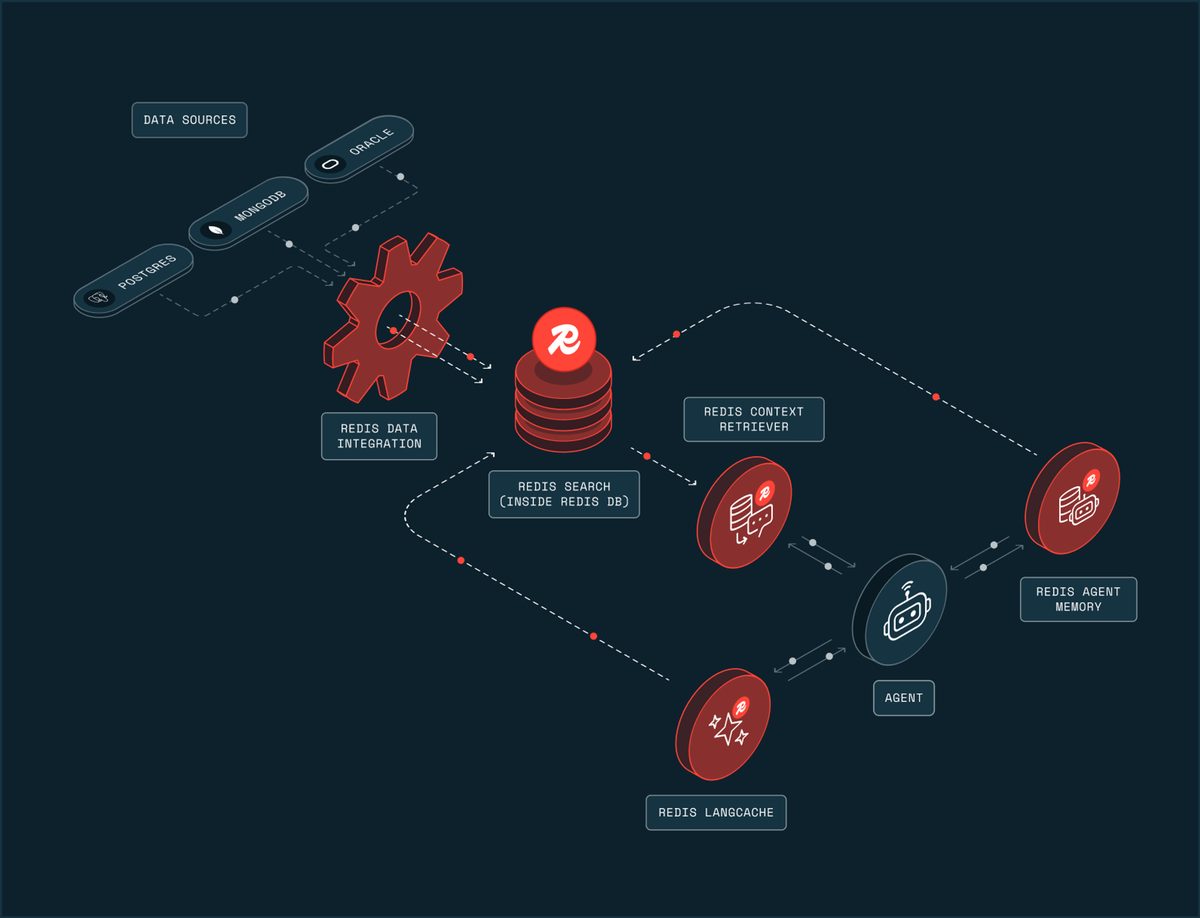
AI agents tend to start every task from zero. They re-read the same documents, re-run the same model calls, and forget what a user told them in the last session. On November 4, 2026, Redis released six capabilities for its Iris product meant to fix that: intent routing, reusable playbooks, memory, governed context retrieval, tracing, and messaging between agents.

Four of the six are generally available. Lens and Agent Mesh are in beta. Redis first launched Iris in May 2026, and the expansion moves it from a memory-and-context tool into a broader runtime for production agents.

Why it matters

Most teams still wire agent memory, routing and messaging together by hand. Redis is betting they would rather buy one runtime.

Questions about this story

Free account needed to ask — your question is kept and asked for you right after sign-up. Answers are public.

No questions yet — be the first to ask.

Key Indicators

6
Capabilities in the Iris release
Intent Router, Agent Playbooks, Agent Memory, Context Gateway, Lens and Agent Mesh.
4
Generally available at launch
Intent Router, Agent Playbooks, Agent Memory and Context Gateway.
2
Capabilities in beta
Lens, for tracing agent behavior, and Agent Mesh, for agent-to-agent messaging.
May 2026
Iris first launched
Redis introduced Iris as a real-time context engine five months before this expansion.

Voices

Curated perspectives — historical figures and your fellow readers.

Sign up to generate historical perspectives on this story.

People Involved

Organizations Involved

Timeline

May 2026 November 2026

2 events Latest: Yesterday
  1. Redis adds six Iris capabilities

    Latest Product release

    Intent Router, Agent Playbooks, Agent Memory and Context Gateway ship generally available; Lens and Agent Mesh enter beta.

  2. Redis launches Iris

    Product launch

    Redis introduces Iris as a real-time context engine for AI agents, focused on memory and retrieval.

Scenarios

1

Lens and Agent Mesh leave beta

Likely Resolves by Q2 2027

Discussed by: Redis product documentation and release notes

Redis typically moves capabilities from beta to general availability within a few quarters. If tracing and agent-to-agent messaging follow that path, Iris becomes a complete six-part runtime rather than a four-part one with two experiments attached.

2

A second named enterprise credits Iris in production

Possible Resolves by Q2 2027

Discussed by: Redis customer case studies and industry coverage

Paradigm is currently the only customer Redis names. A second public case study would show the product is spreading beyond a single design partner. Without one, adoption claims rest on a single quote.

3

A cloud or database rival bundles equivalent agent primitives

Possible Resolves by End of 2027

Discussed by: Cloud platform watchers and developer infrastructure analysts

Memory, routing and agent messaging are becoming standard building blocks. If a major cloud provider or database vendor ships a combined offering, Redis's advantage narrows to price and the fact that it already sits in the request path.

Historical Context

3 moments from history that rhyme with this story — and how they unfolded.

June 2016

MongoDB Atlas (2016)

MongoDB turned its database into a hosted cloud service, then added search, mobile sync and other services on top. The move put the company in direct competition with cloud providers that had been its distribution channel.

Then

Atlas gave MongoDB a recurring revenue stream and a way to reach developers who did not want to run their own clusters.

Now

Atlas became the majority of MongoDB's revenue, shifting the company from a software license business to a cloud platform.

Why this matters now

Redis is making the same move up the stack: from a component developers install to a managed runtime that owns more of the application.

2017-2019

Datadog expands beyond infrastructure monitoring (2017-2019)

Datadog started with server monitoring, then added application performance monitoring, log management and other products. Each new capability was sold into the same customer base and ran on the same agent.

Then

Customers consolidated spending on one vendor instead of buying separate tools for each monitoring job.

Now

Datadog became a multi-product platform and one of the most valuable developer infrastructure companies.

Why this matters now

Iris follows the same bundling logic: sell adjacent primitives to the same buyer from one runtime rather than five separate products.

October 2020

Twilio acquires Segment (2020)

Twilio, a communications API company, paid $3.2 billion for Segment, a customer data platform. The deal was an attempt to own the customer context layer that sits alongside messaging.

Then

Twilio gained a data platform to pair with its email, SMS and voice products.

Now

The acquisition did not produce the growth Twilio expected, and the company later wrote down much of the value.

Why this matters now

It shows the prize and the risk: owning the context layer next to the messaging layer is valuable, but buying or building it does not guarantee adoption.

Sources

(6)