



Pull to refresh
Logo
NYSE proposes extending clearly erroneous trade protections to overnight trading

NYSE proposes extending clearly erroneous trade protections to overnight trading

Rule Changes

Changes support 23/5 trading launch scheduled for December 6, 2026

Today: SEC publishes NYSE Rule 7.10 amendment proposal

Overview

Updated 1 hour ago

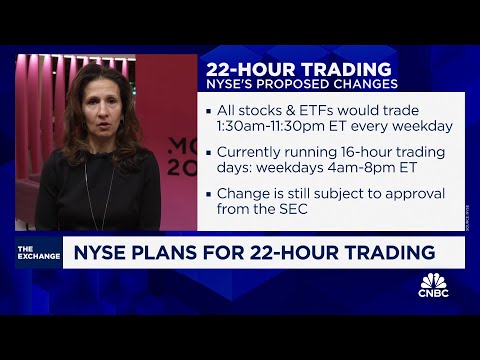
The Securities and Exchange Commission (SEC) published NYSE's proposal on September 22 to change which overnight trades can be canceled as clearly erroneous. It is a regulatory cornerstone of the industry's move to 23/5 trading — markets open 23 hours a day, five days a week — scheduled for December 6, 2026.

Right now, limit-up/limit-down price bands apply only during the core session from 9:30 a.m. to 4:00 p.m. Trades inside those bands are not reviewable as clearly erroneous; they stand.

NYSE's rule extends that protection to the new overnight session from 9:00 p.m. to 4:00 a.m., where temporary static bands of 20% above and below reference prices will apply. Without it, overnight trades could be broken after the fact.

Why it matters

Overnight trades within the new 20% price bands would stand, removing cancellation risk as 23/5 trading begins December 6.

Questions about this story

Free account needed to ask — your question is kept and asked for you right after sign-up. Answers are public.

No questions yet — be the first to ask.

Key Indicators

20%
Overnight price band width
Temporary static bands set 20% above and below reference prices during overnight hours.
Dec 6, 2026
23/5 trading launch date
Industry-wide start of 23-hour trading days, when the rule becomes operative.
7 hrs
Overnight protected session
9:00 p.m. to 4:00 a.m. ET nightly, five nights a week.

Voices

Curated perspectives — historical figures and your fellow readers.

Ever wondered what historical figures would say about today's headlines?

Sign up to generate historical perspectives on this story.

Organizations Involved

Timeline

September 2022 December 2026

4 events Latest: Today
Tap a bar to jump to that date
  1. 23/5 trading industry-wide launch scheduled

    Upcoming Milestone

    Industry-wide commencement of 23-hour trading days, when the amended Rule 7.10 becomes operative.

  2. SEC publishes NYSE Rule 7.10 amendment proposal

    Today Rule Change

    NYSE filed to amend Rule 7.10 to extend clearly erroneous execution protections to overnight trading hours, effective at the start of 23/5 trading.

  3. SEC approves overnight price bands

    Regulatory Approval

    The SEC approved Amendment 27 to the LULD Plan, establishing temporary static Overnight Price Bands of 20% for the overnight session.

  4. NYSE American makes clearly erroneous pilot permanent

    Rule Change

    NYSE American amended its clearly erroneous execution rules, making the pilot program permanent and limiting review circumstances.

Scenarios

1

23/5 trading launches December 6 with aligned rules

Likely Resolves by Dec 6, 2026

Discussed by: NYSE filing; Federal Register notice

The SEC accepts the NYSE proposal and identical filings from other exchanges and FINRA. Because the filing is for immediate effectiveness, the rule takes effect without prolonged review unless the SEC intervenes within its objection window. The rule then becomes operative at the December 6 launch.

2

Launch slips past December 6

Possible Resolves by Dec 6, 2026

Discussed by: NYSE Extended Hours FAQ (flags regulatory approval required)

If the SEC or another regulator delays any of the identical filings, the industry-wide launch could slip. The rule change is explicitly tied to the launch date, so a delay in either pushes the other. This would mark a postponement of the 23/5 trading timeline.

3

Overnight price bands adjusted after launch

Possible Resolves by Dec 1, 2027

Discussed by: LULD Plan Operating Committee (committed to post-implementation evaluation)

The proposal states the Operating Committee will evaluate the temporary 20% bands after implementation and propose changes in a new plan amendment. If the bands prove mispriced for thin overnight liquidity, a new amendment would adjust them, and the clearly erroneous rule would follow.

Historical Context

2 moments from history that rhyme with this story — and how they unfolded.

May 2010

Flash Crash (2010)

The Dow Jones Industrial Average plunged nearly 1,000 points in about 36 minutes, wiping out roughly $1 trillion in market value before recovering. Some stocks traded at absurd prices — Accenture briefly traded at a penny.

Then

The SEC and Commodity Futures Trading Commission opened investigations, exposing flaws in market structure.

Now

The crash led to the Limit Up-Limit Down Plan, a set of price bands designed to pause trading during extreme volatility.

Why this matters now

The LULD Plan is the mechanism this rule extends. The new Overnight Price Bands are a direct successor to the bands created after the Flash Crash.

May-June 2012

LULD Plan adoption (2012)

The SEC approved the Limit Up-Limit Down Plan, setting price bands for national market system stocks during regular trading hours. Stocks trading outside their bands trigger a pause or halt.

Then

Bands applied only during the core trading session, protecting regular-hours trades from extreme volatility.

Now

The plan established the precedent that trades within price bands are not reviewable as clearly erroneous — the principle now being extended to overnight hours.

Why this matters now

The Overnight Price Bands are the first major expansion of the LULD framework beyond regular hours, and the Rule 7.10 amendment codifies the same 'stands' principle for the night session.

Sources

(5)