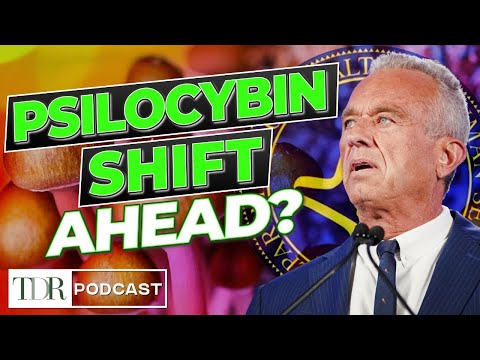
For 55 years, the federal government classified psilocybin, MDMA, LSD, and ibogaine as Schedule I substances. On April 18, 2026, President Trump signed an executive order 'Accelerating Medical Treatments for Serious Mental Illness' directing the FDA to expedite clinical trials of those substances for PTSD in veterans.
The order allocates $50 million through the Advanced Research Projects for Health (ARPA-H) for state-level ibogaine research, matched by state funds, and extends the Right to Try law to allow seriously ill patients to access psychedelics still under investigation. The signing ceremony included podcaster Joe Rogan and former Navy SEAL Marcus Luttrell and was driven substantially by Health and Human Services Secretary Robert F. Kennedy Jr. Within hours, FDA Commissioner Marty Makary announced 'national priority' review vouchers for three psilocybin-class drugs, a first for psychedelics, with decisions possible as early as summer 2026.
The move comes 20 months after the FDA rejected MDMA-assisted therapy for PTSD in August 2024, a decision that galvanized veteran advocacy groups and bipartisan congressional support. Legal analysts at the Harvard Law School Petrie-Flom Center raised questions about whether the Right to Try Act can be extended to Schedule I substances without DEA rescheduling. Safety experts flagged ibogaine's known risk of fatal cardiac arrhythmias, which prompted the National Institutes of Health to discontinue ibogaine research in the 1990s.
Why it matters
Millions of veterans with treatment-resistant PTSD may gain access to therapies banned by federal law for over five decades.
Questions about this story
Free account needed to ask — your question is kept and asked for you right after sign-up. Answers are public.
No questions yet — be the first to ask.
Key Indicators
$50M
Federal funding for ibogaine research
New federal dollars directed to state-level ibogaine research programs under the executive order.
4
Psychedelic substances covered
Psilocybin, MDMA, ibogaine, and LSD are named in the executive order for expedited FDA review.
55 years
Duration of Schedule I classification
These substances have been classified as having no accepted medical use since the Controlled Substances Act of 1970.
~13%
Estimated PTSD rate among US veterans
Roughly one in eight US veterans experiences PTSD, with many cases resistant to existing treatments.
14 events
Latest: April 18th, 2026 · 6 months ago
Showing 8 of 14
JK to step
Tap a bar to jump to that date
Jump to
April 2026
Trump signs executive order expediting psychedelic research
LatestExecutive Action
President Trump signed an executive order directing the FDA to issue new guidance expediting clinical trials of psilocybin, MDMA, ibogaine, and LSD for veteran PTSD, making $50 million available for state-level ibogaine research and opening a Right to Try pathway for seriously ill patients.
FDA Commissioner announces priority review vouchers for psilocybin drugs and US ibogaine trial clearance
Regulatory
FDA Commissioner Marty Makary announced that the agency would issue 'national priority' review vouchers for three serotonin 2a agonist drugs — a class that includes psilocybin — marking the first time the FDA has fast-tracked any psychedelic substance for priority review. Decisions could come as early as summer 2026. Makary also said the FDA is taking steps to clear the way for the first-ever human clinical trials of ibogaine on US soil.
Veterans Exploring Treatment Solutions (VETS), a nonprofit connecting veterans with psychedelic therapy, issued a formal statement applauding the executive order and calling on the government to accelerate scientific investment in ibogaine research for PTSD, traumatic brain injury, and addiction.
Harvard Law School legal analysts flag Schedule I conflict with Right to Try extension
Legal
Professors I. Glenn Cohen and Mason Marks of the Harvard Law School Petrie-Flom Center published a legal analysis warning that extending the Right to Try Act to Schedule I substances like psilocybin and ibogaine is legally contested, because the Act was designed for investigational drugs under FDA review — not substances still federally classified as having no accepted medical use.
August 2024
FDA rejects MDMA-assisted therapy for PTSD
Regulatory
The FDA formally rejected Lykos Therapeutics' application for MDMA-assisted therapy, following the advisory committee's recommendation. The rejection galvanized veteran advocacy groups and bipartisan congressional support for alternative pathways.
June 2024
FDA advisory committee votes against MDMA therapy approval
Regulatory
An FDA advisory committee voted against recommending approval of MDMA-assisted therapy for PTSD, citing concerns about clinical trial methodology, inadequate blinding, and potential risks of abuse.
November 2022
Colorado voters approve psychedelic access program
Legislation
Colorado passed Proposition 122, decriminalizing certain natural psychedelics and directing the state to create a regulated access program for psilocybin therapy.
Oregon passed Measure 109, creating the first state-regulated psilocybin therapy program in the United States. Licensed service centers began operating in 2023.
October 2018
FDA grants psilocybin breakthrough therapy designation
Regulatory
The FDA granted breakthrough therapy designation to psilocybin for treatment-resistant depression, developed by Compass Pathways. A second designation followed in 2019 for major depressive disorder via the Usona Institute.
May 2018
Trump signs Right to Try Act
Legislation
President Trump signed the Right to Try Act, allowing terminally ill patients to access investigational drugs that have completed Phase 1 trials without full FDA approval. The law's application to psychedelics was not envisioned at the time.
August 2017
FDA grants MDMA breakthrough therapy designation for PTSD
Regulatory
The FDA designated MDMA-assisted therapy as a breakthrough therapy for PTSD, signaling that preliminary clinical evidence showed it may offer substantial improvement over existing treatments and expediting its development.
1986
Rick Doblin founds MAPS to pursue legal psychedelic medicine
Organization
Doblin founded the Multidisciplinary Association for Psychedelic Studies with the explicit long-term goal of making MDMA a legal prescription medicine through the FDA approval process.
July 1985
MDMA added to Schedule I on emergency basis
Regulation
The Drug Enforcement Administration (DEA) placed MDMA into Schedule I using emergency scheduling authority, despite objections from researchers and a DEA administrative law judge who recommended Schedule III.
October 1970
Controlled Substances Act classifies psychedelics as Schedule I
Legislation
President Nixon signed the Controlled Substances Act, placing psilocybin, LSD, and other psychedelics into Schedule I — the most restrictive category, reserved for drugs deemed to have no accepted medical use and high abuse potential. This effectively halted decades of psychiatric research.
Scenarios
1
FDA approves first psychedelic therapy, rescheduling follows
Possible
Discussed by: Psychedelic medicine researchers, drug policy analysts, and industry advocates
Expedited FDA guidance leads to faster, better-designed clinical trials. One or more psychedelic substances — most likely psilocybin for depression or MDMA for PTSD — win FDA approval within 2-4 years. The executive order's rescheduling directive then moves the approved substance from Schedule I to a lower schedule, creating a legal framework for prescription use. This would represent the first federally approved psychedelic medicine since the 1970 Controlled Substances Act.
2
Right to Try becomes primary access channel, bypassing full approval
Possible
Discussed by: Veteran advocacy groups, libertarian-leaning policy analysts, and some Republican lawmakers
Rather than waiting years for full FDA approval, veterans and seriously ill patients begin accessing psychedelics through the Right to Try pathway. State-level ibogaine programs, funded by the $50 million allocation, create a patchwork of legal access. This de facto normalizes psychedelic therapy before the FDA formally approves any substance, creating political momentum that makes full prohibition untenable. Critics warn that safety monitoring in this scenario would be minimal compared to the clinical trial process.
3
FDA independence concerns stall implementation
Possible
Discussed by: Medical establishment figures, FDA staff, and some Democratic lawmakers
The FDA pushes back on executive pressure to expedite reviews, arguing that the MDMA rejection demonstrated real methodological problems that cannot be waved away by executive order. Legal challenges may arise over whether the Right to Try Act can be applied to Schedule I substances without DEA rescheduling. Implementation stalls in bureaucratic and legal disputes, with the executive order's practical impact limited to the $50 million ibogaine research allocation.
4
Safety incident triggers political reversal
Unlikely
Discussed by: FDA safety officials, addiction medicine specialists, and some psychiatrists
Expanded access through Right to Try or state programs leads to a serious adverse event — ibogaine carries known cardiac risks, and MDMA has abuse potential. A high-profile death or injury generates political backlash, particularly if it involves a veteran. The incident is used to justify tightening restrictions, potentially setting back the broader psychedelic therapy movement by years. This scenario echoes how individual incidents in the 1960s contributed to the blanket prohibition that followed.
Historical Context
3 moments from history that rhyme with this story — and how they unfolded.
1 of 3
October 1970
Nixon's Controlled Substances Act ends first wave of psychedelic research (1970)
Between the 1950s and late 1960s, researchers conducted over 1,000 clinical studies on LSD and other psychedelics, treating an estimated 40,000 patients for conditions including alcoholism, depression, and end-of-life anxiety. The Controlled Substances Act placed these substances into Schedule I, effectively criminalizing all research and therapeutic use. The decision was driven more by the association of psychedelics with the counterculture movement than by clinical safety data.
Then
Virtually all psychedelic research stopped. Scientists who had spent careers studying these compounds abandoned the field or moved abroad.
Now
A 40-year gap in psychedelic research. When trials resumed in the 2000s, researchers had to rebuild methodology and institutional knowledge from scratch.
Why this matters now
The current executive order represents the most significant federal reversal of the 1970 prohibition framework. Understanding that the original scheduling was politically rather than scientifically driven helps explain why breakthrough therapy designations and clinical evidence have not been sufficient to change policy through normal regulatory channels.
2 of 3
June–August 2024
FDA rejection of MDMA therapy despite breakthrough designation (2024)
After 38 years and over $100 million in research, MAPS' pharmaceutical arm Lykos Therapeutics submitted an application for MDMA-assisted therapy for PTSD based on two Phase 3 trials showing significant symptom reduction. An FDA advisory committee voted 9-2 against recommending approval, citing concerns about study blinding (participants could often tell whether they received MDMA), therapist influence on outcomes, and inadequate safety data on abuse potential. The FDA followed the committee's recommendation and rejected the application in August 2024.
Then
Lykos Therapeutics faced financial uncertainty. Veteran advocates who had expected approval felt betrayed by the regulatory process.
Now
The rejection shifted advocacy strategy from working within the FDA system to seeking political and executive intervention, directly contributing to the conditions that produced the April 2026 executive order.
Why this matters now
The MDMA rejection is the proximate cause of the executive order. It demonstrated that even with breakthrough therapy designation and positive clinical trial results, the standard FDA pathway could not deliver timely access — creating the political demand for an alternative approach.
3 of 3
May 2018
Right to Try Act expands experimental drug access (2018)
President Trump signed the Right to Try Act, allowing patients with life-threatening conditions to request access to investigational drugs that had completed Phase 1 trials but not yet received full FDA approval. The law was championed by libertarian-leaning groups and the Goldwater Institute, and passed the Senate unanimously. In practice, relatively few patients used the pathway — most pharmaceutical companies preferred the existing FDA expanded access program.
Then
Limited practical impact. Most drug companies continued routing compassionate use requests through the FDA's existing expanded access program.
Now
Established a legal precedent for patients to access unapproved drugs outside the FDA framework, which the 2026 executive order now extends to psychedelic substances.
Why this matters now
The executive order's extension of Right to Try to psychedelics tests the law's boundaries significantly. The original act was designed for terminally ill patients seeking experimental cancer drugs — applying it to Schedule I substances for PTSD represents a novel and potentially contested interpretation.