
Pull to refresh
Logo
Non-Abelian anyons prove capable of universal quantum computing

Non-Abelian anyons prove capable of universal quantum computing

New Capabilities

Braiding plus fusion on Quantinuum's H2 processor unlocks a gate set that braiding alone couldn't reach — and sidesteps the costliest step in quantum error correction.

Today: Press coverage frames anyons as error-correction 'dark horse'

Overview

Updated 1 hour ago

Researchers have shown that exotic quasiparticles called non-Abelian anyons can perform every operation a general-purpose quantum computer needs. Using 54 entangled qubits on Quantinuum's H2 trapped-ion processor, a team from the University of Chicago, Harvard, Stony Brook University, and Quantinuum combined two operations, braiding and fusion, to reach universal computation for the first time in a non-Abelian code.

The results, published in Nature, may eliminate the most expensive step in quantum error correction today: growing so-called magic states through a costly purification process called distillation. If the approach scales with active error correction, topological quantum computers could skip that step entirely.

Why it matters

If it scales, fault-tolerant quantum computers can skip their costliest step, making general-purpose machines practical years earlier.

Questions about this story

Free account needed to ask — your question is kept and asked for you right after sign-up. Answers are public.

No questions yet — be the first to ask.

Key Indicators

54
Entangled qubits used on Quantinuum H2
The processor prepared the ground state of the S3 quantum double across 54 qubits.
3
Topological operations demonstrated
One entangling gate from braiding and two distinct measurements from fusion.
23
Years from theory to experimental proof
Carlos Mochon proposed braiding plus fusion could reach universality in 2003.

Voices

Curated perspectives — historical figures and your fellow readers.

Ever wondered what historical figures would say about today's headlines?

Sign up to generate historical perspectives on this story.

People Involved

Organizations Involved

Timeline

January 2003 September 2026

7 events Latest: Today
Tap a bar to jump to that date
  1. Press coverage frames anyons as error-correction 'dark horse'

    Today Announcement

    University of Chicago and Quantinuum announce the S3 results, positioning non-Abelian codes as a route to fault tolerance without magic state distillation.

  2. Nature publishes S3 universal gate set proof

    Publication

    Researchers demonstrate a universal topological gate set on 54 qubits of Quantinuum's H2 processor, combining braiding and fusion, and topologically prepare a magic state without distillation.

  3. S3 universal gate set preprint posted

    Publication

    The team posts its S3 results as a preprint, drawing attention to fusion as a computational primitive for non-Abelian codes.

  4. D4 topological order realized on trapped-ion processor

    Experiment

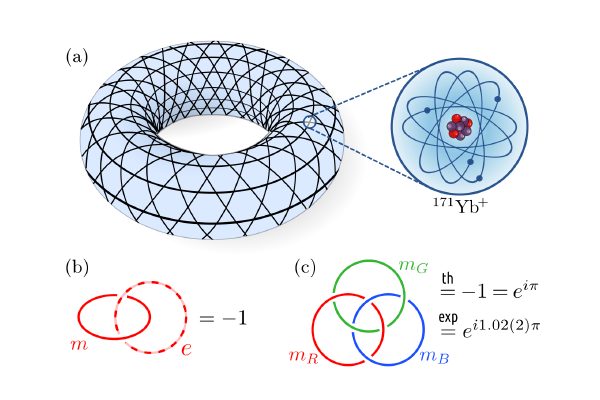
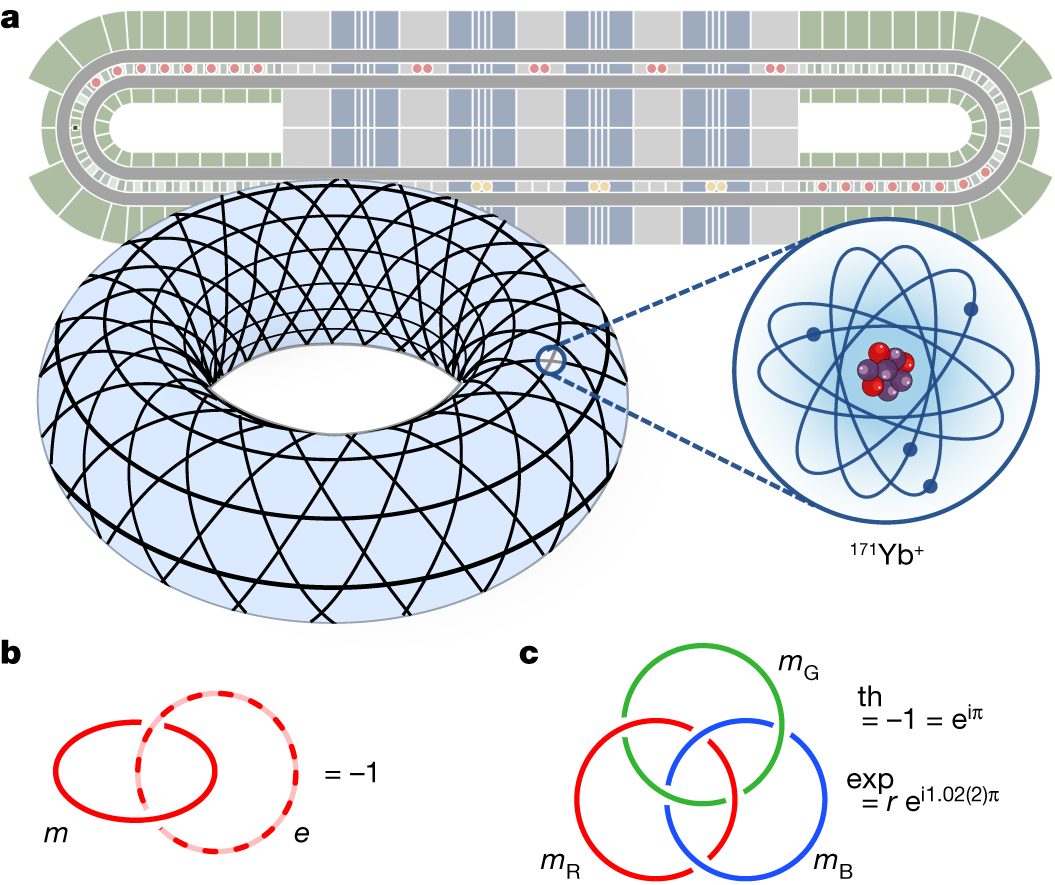
    27-qubit kagome lattice wavefunction realizes D4 topological order with anyon interferometry detecting non-Abelian braiding along Borromean rings. Braiding alone proves insufficient for universality.

  5. Quantinuum H2 hosts first non-Abelian anyons

    Experiment

    Physicists synthesize and manipulate non-Abelian anyons in a novel phase of quantum matter on Quantinuum's next-generation H2 processor.

  6. Google braids non-Abelian anyons on superconducting chip

    Experiment

    A Google team demonstrates braiding of graph vertices, realizing Ising anyons and their fusion rules on a superconducting processor.

  7. Mochon proposes braiding plus fusion reaches universality

    Theory

    Caltech student Carlos Mochon shows that combining fusion with braiding could achieve universal computation even where braiding alone cannot.

Scenarios

1

S3 gates combined with active error correction

Possible Resolves by End of 2027

Discussed by: Study authors at UChicago PME and Quantinuum

The team pairs the braiding and fusion building blocks with active error correction on a scaled processor, demonstrating a fault-tolerant non-Abelian memory and validating the approach for real machines. This is the natural next step Verresen names and the one that would make non-Abelian codes a practical foundation for large-scale quantum computers.

2

S3 method stays a proof of principle, standard codes win the race

Unlikely Resolves by Q2 2028

Discussed by: Quantum error-correction community watching competing approaches

The S3 demonstration does not scale beyond a few dozen qubits, and standard surface-code error correction with magic state distillation remains the practical path to fault tolerance. The non-Abelian approach continues as an academic curiosity without a commercial roadmap.

3

Non-Abelian magic states replace distillation in commercial machines

Possible Resolves by End of 2028

Discussed by: Quantum hardware vendors seeking cheaper error correction

The direct topological preparation of magic states, shown in this work, is adopted by a commercial quantum computer vendor as a way to avoid the qubit overhead of distillation, making the S3 approach part of a practical fault-tolerant architecture rather than an alternative to one.

Historical Context

3 moments from history that rhyme with this story — and how they unfolded.

September 1958

Kilby's integrated circuit (1958)

Jack Kilby at Texas Instruments demonstrated the first working integrated circuit, combining multiple electronic components on a single semiconductor substrate. At the time it was a laboratory curiosity with uncertain commercial value.

Then

Kilby and Robert Noyce (Fairchild) traded patent claims for years as the technology found few early buyers.

Now

The integrated circuit became the foundation of every modern computer, shifting the industry from discrete components to monolithic chips within two decades.

Why this matters now

Like Kilby's proof-of-concept, this work demonstrates a capability on a small scale that could transform an entire field if it scales — but scaling, not the lab result, determines whether it becomes foundational.

1995-1996

Shor's algorithm and fault tolerance threshold (1995-1996)

Peter Shor published his factoring algorithm and, with Andrew Steane, proposed quantum error correction, establishing the theoretical threshold that made fault-tolerant quantum computing conceivable despite noisy hardware.

Then

The threshold theorem created the field of quantum error correction and launched three decades of hardware development.

Now

Error correction became the central challenge of quantum computing; today's experiments are judged by whether they clear the threshold.

Why this matters now

The S3 work targets the same bottleneck Shor identified — protecting quantum information from noise — but from a different angle. Where Shor showed error correction was possible in principle, this work targets the most expensive part of that correction.

February 2023

Google's surface code milestone (2023)

Google's Quantum AI team published results showing their surface code reduced errors as code distance increased, the first experimental demonstration that error correction could beat raw hardware noise.

Then

The result validated the surface code as the leading error-correction approach and triggered a wave of investment in fault-tolerant roadmaps.

Now

Surface codes became the default plan for IBM, Google, and others, making magic state distillation the industry's standard but costly step.

Why this matters now

Google's surface code milestone defined the current roadmap; the S3 result offers a potential alternative path that could eliminate the distillation step that roadmap depends on.

Sources

(8)