



Pull to refresh
Logo
RBI begins first net bond sale in nine years to absorb record bank surplus

RBI begins first net bond sale in nine years to absorb record bank surplus

Money Moves

Central bank sells ₹50,000 crore in first of three auctions as foreign-currency inflows flood banks with cash

Yesterday: First tranche of ₹50,000 crore sells

Overview

Updated Yesterday

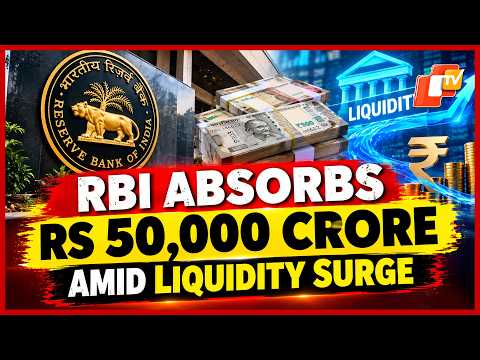
India's banks held roughly ₹10 lakh crore in spare cash, pushing overnight rates to 5.02%, 23 basis points below the central bank's 5.25% target. On September 17, the Reserve Bank of India began selling government bonds to drain that surplus, accepting the full ₹50,000 crore in its first net open-market sale in nine years.

The sale is the first tranche of a planned ₹1 lakh crore operation. If it pulls short-term rates back toward the policy target, borrowing costs across India's economy will adjust, and future RBI rate decisions will reach lenders more quickly.

Why it matters

If the drain works, Indian loan and deposit rates will track RBI policy moves more closely and likely drift higher.

Questions about this story

Free account needed to ask — your question is kept and asked for you right after sign-up. Answers are public.

No questions yet — be the first to ask.

Key Indicators

₹1 lakh crore
Total announced OMO bond sales
Three tranches of government securities to be sold by September 28.
₹50,000 crore
First tranche accepted
Banks bid ₹66,590 crore for the ₹50,000 crore offered, so the auction was fully subscribed.
5.25%
Repo rate
The RBI's policy rate, the target that short-term market rates are meant to track.
5.02%
Call money rate
Weighted average overnight rate before the OMO, well below the repo target.
~₹10 lakh crore
Banking-system surplus
Spare cash before the sales, up from ₹9.7 lakh crore in early September and briefly touching ₹11 lakh crore.
$127B
FCNR(B) deposits
Foreign-currency deposits mobilized by August 31 under the RBI's special scheme, a main source of the surplus.

Voices

Curated perspectives — historical figures and your fellow readers.

Ever wondered what historical figures would say about today's headlines?

Sign up to generate historical perspectives on this story.

Organizations Involved

Timeline

August 2026 September 2026

5 events Latest: Yesterday
Tap a bar to jump to that date
  1. Third tranche of ₹25,000 crore scheduled

    Upcoming Auction

    Final auction in the ₹1 lakh crore OMO sale, completing the liquidity withdrawal if fully subscribed.

  2. Second tranche of ₹25,000 crore scheduled

    Upcoming Auction

    The middle auction of the three-tranche operation, to be held through a multi-security auction.

  3. First tranche of ₹50,000 crore sells

    Latest Auction

    Banks bid ₹66,590 crore for the paper on offer; the RBI accepted the full amount at cut-off yields of 6.60% to 7.01%.

  4. RBI announces ₹1 lakh crore bond sale

    Announcement

    The central bank schedules three OMO sale auctions for September 17, 21, and 28, its first net bond sale since November 2017.

  5. Foreign-currency deposits reach $127 billion

    Liquidity build-up

    The RBI's special FCNR(B) scheme, plus other foreign borrowing, swelled bank cash to a record surplus.

Scenarios

1

RBI completes ₹1 lakh crore drain; overnight rates return near repo

Likely Resolves by Oct 15, 2026

Discussed by: Reuters and market participants

The September 21 and 28 auctions sell at or near full subscription. As cash leaves the banking system, the weighted average call money rate climbs from 5.02% back toward the 5.25% repo rate. Transmission improves without any change to the policy rate, and bond yields stabilize near their elevated levels.

2

RBI expands bond sales beyond ₹1 lakh crore

Possible Resolves by End of 2026

Discussed by: Reuters, citing bond traders; Bloomberg

The surplus is structural, built from $127 billion in foreign-currency deposits converted into rupees. If the call rate barely moves after the first ₹1 lakh crore, the RBI announces further OMO sales to pull rates back to target. Bond yields would likely rise further as supply grows.

3

RBI raises the repo rate to reinforce the liquidity drain

Possible Resolves by End of 2026

Discussed by: Reuters, which ties the OMO to expected rate hikes

Less spare cash raises banks' funding costs and sharpens transmission, setting up a policy-rate move. If inflation pressure persists, the RBI's Monetary Policy Committee raises the repo rate above 5.25%, tightening conditions further and pushing bond yields higher.

Historical Context

3 moments from history that rhyme with this story — and how they unfolded.

November 2016 to November 2017

Post-demonetization liquidity drain (2016-2017)

In November 2016, India invalidated 86% of its currency overnight. Banks were flooded with deposits as people returned old notes, creating a huge liquidity surplus. The RBI drained it over the following year, with its last net open-market bond sale in November 2017.

Then

The surplus was absorbed within about a year, and overnight rates returned to the policy corridor.

Now

It set the template for using balance-sheet tools to manage liquidity without touching the policy rate.

Why this matters now

Today's sale is the first net open-market sale since that episode, nine years earlier.

2018 to 2019

RBI bond purchases in 2018-19

By 2018, liquidity had swung the other way, turning structurally tight as currency demand grew. The RBI bought government bonds through open market operations to inject cash, the reverse of today's sales.

Then

The injections softened money-market rates and supported credit growth.

Now

They showed the same OMO tool works in both directions, adding or withdrawing cash.

Why this matters now

The September 2026 sales are the mirror image, withdrawing cash when the surplus is large.

2022 to 2025

US Federal Reserve quantitative tightening (2022-2025)

After pandemic-era bond purchases swelled its balance sheet, the US Federal Reserve shrank it from 2022, letting bonds mature and selling holdings to tighten financial conditions.

Then

Money-market rates stayed near the target range as liquidity was gradually withdrawn.

Now

It reinforced the principle that central banks manage liquidity separately from policy rates.

Why this matters now

It is the international benchmark for how a central bank shrinks cash in the system without changing its policy rate.

Sources

(9)