


Pull to refresh
Logo
Cohesity extends backup and disaster recovery to AI agents

Cohesity extends backup and disaster recovery to AI agents

New Capabilities

New Data Cloud capability protects agent memory, configuration, and credentials; general availability targeted for end of 2026.

Today: Cohesity introduces Agent Resilience at Catalyst event

Overview

Updated 1 hour ago

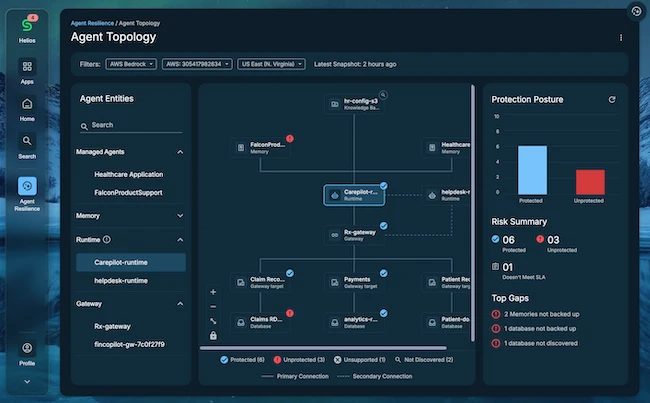
Cohesity now backs up AI agents the way it backs up databases and file servers. Its new Agent Resilience capability protects what drives an agent's behavior: memory, configuration, credentials, guardrails, and workflows, with point-in-time recovery to a known-good state.

The company announced the capability Tuesday at its Catalyst event in Santa Clara. It's available to select customers now, with general availability targeted for the end of 2026. Amazon Bedrock AgentCore and Amazon Bedrock Agents are supported at launch; Microsoft and Google agent platforms are on the roadmap.

Why it matters

A corrupted AI agent is useless until its memory and credentials are rolled back to a verified state. Until now, no tooling existed for that.

Questions about this story

Free account needed to ask — your question is kept and asked for you right after sign-up. Answers are public.

No questions yet — be the first to ask.

Key Indicators

78%
Organizations prioritizing system restoration over business continuity
Cohesity's 2026 Global Cyber Resilience Report found most recovery plans aim to restore systems, not keep operations running.
56%
Organizations unprepared for AI agent incidents
Majority lack confidence detecting, containing, and recovering from wrong actions taken by AI agents or workflows.
83%
Organizations needing plan changes for frontier AI attacks
Only 3% say current recovery plans handle attacks involving vulnerability discovery and multi-step intrusions.
2
Agent platforms supported at launch
Amazon Bedrock AgentCore and Bedrock Agents are covered; Microsoft and Google platforms are on the roadmap.

Voices

Curated perspectives — historical figures and your fellow readers.

Ever wondered what historical figures would say about today's headlines?

Sign up to generate historical perspectives on this story.

People Involved

Organizations Involved

Timeline

May 2024 September 2026

3 events Latest: Today
  1. Cohesity introduces Agent Resilience at Catalyst event

    Today Product Launch

    New Data Cloud capability protects agent memory, configuration, credentials, guardrails, and workflows; available to select customers, GA targeted for end of 2026.

  2. Cohesity releases Global Cyber Resilience Report

    Today Research

    Survey finds 78% of organizations focus recovery on restoring systems rather than business operations; 56% are unprepared for AI agent incidents.

  3. Cohesity completes Veritas data protection merger

    Merger

    Combination creates one of the largest independent backup vendors, positioning Cohesity to extend resilience to new infrastructure layers.

Scenarios

1

Agent Resilience reaches general availability with Microsoft and Google support

Likely Resolves by Jan 31, 2027

Discussed by: Cohesity's stated roadmap (GA targeted end of 2026)

Cohesity meets its GA target and expands protection to Microsoft and Google agent platforms through 2027. Early customers use point-in-time recovery after prompt injection or memory corruption, and Agent Resilience becomes a standard feature in enterprise AI deployments.

2

Rubrik, Veeam, or Dell ship competing agent-state backup

Possible Resolves by Q2 2027

Discussed by: Industry analysts tracking the backup market's competitive response

Seeing Cohesity define a new category, a major backup rival launches a product protecting AI agent memory and configuration. The market fragments into competing approaches, and agent-state backup becomes a checkbox in enterprise resilience evaluations.

3

Enterprises defer agent backup purchases

Possible Resolves by End of 2027

Discussed by: Cautious IT leaders; Cohesity's own report shows readiness gaps

Enterprises keep AI agents in pilot rather than production, limiting agent-state backup demand. Cohesity's Agent Resilience gains few paying customers beyond early adopters, and the category stays niche until a high-profile agent compromise forces the market.

Historical Context

3 moments from history that rhyme with this story — and how they unfolded.

2003-2008

VMware virtualization reshapes backup (2003-2008)

When VMware made servers into snapshottable files, the backup industry had to rebuild. Image-based, agentless backup replaced file-level agents, and vendors like Veeam emerged specifically for virtual machines.

Then

The backup market fragmented as legacy tools struggled with VM state.

Now

VM-aware backup became table stakes for every enterprise backup vendor.

Why this matters now

Each time infrastructure gains a new stateful layer, recovery tooling must be rebuilt for it. AI agents are the next such layer.

2015-2019

SaaS application backup emerges (2015-2019)

When companies moved to Salesforce, Office 365, and Google Workspace, their data left corporate control. Vendors like OwnBackup and Spanning built backup products specifically for SaaS data, a tier traditional backup ignored.

Then

SaaS backup became a fast-growing niche.

Now

Protecting data outside the firewall became standard practice.

Why this matters now

Agent memory and configuration live outside traditional backup scopes too, and Cohesity is betting the same pattern plays out for AI infrastructure.

2017-2020

Stateful Kubernetes backup (2017-2020)

Containers were designed to be ephemeral, but production workloads needed persistent state. Projects like Velero (from Heptio) and startups like Kasten appeared to back up cluster state and persistent volumes.

Then

Kasten was acquired by Veeam in 2020 for $150 million.

Now

Container-aware backup became a standard part of cloud-native operations.

Why this matters now

AI agents are similarly ephemeral but depend on persistent memory and configuration, creating the same gap between how they run and how they must be protected.

Sources

(7)