
Pull to refresh
Logo
Blueprint published for RFdiffusion3 AI that designs proteins atom by atom

Blueprint published for RFdiffusion3 AI that designs proteins atom by atom

New Capabilities

The generative model, running about 10 times faster than its predecessor, invents enzymes that work in real lab reactions.

Today: Full RFD3 blueprint reaches broad readership

Overview

Updated 48 minutes ago

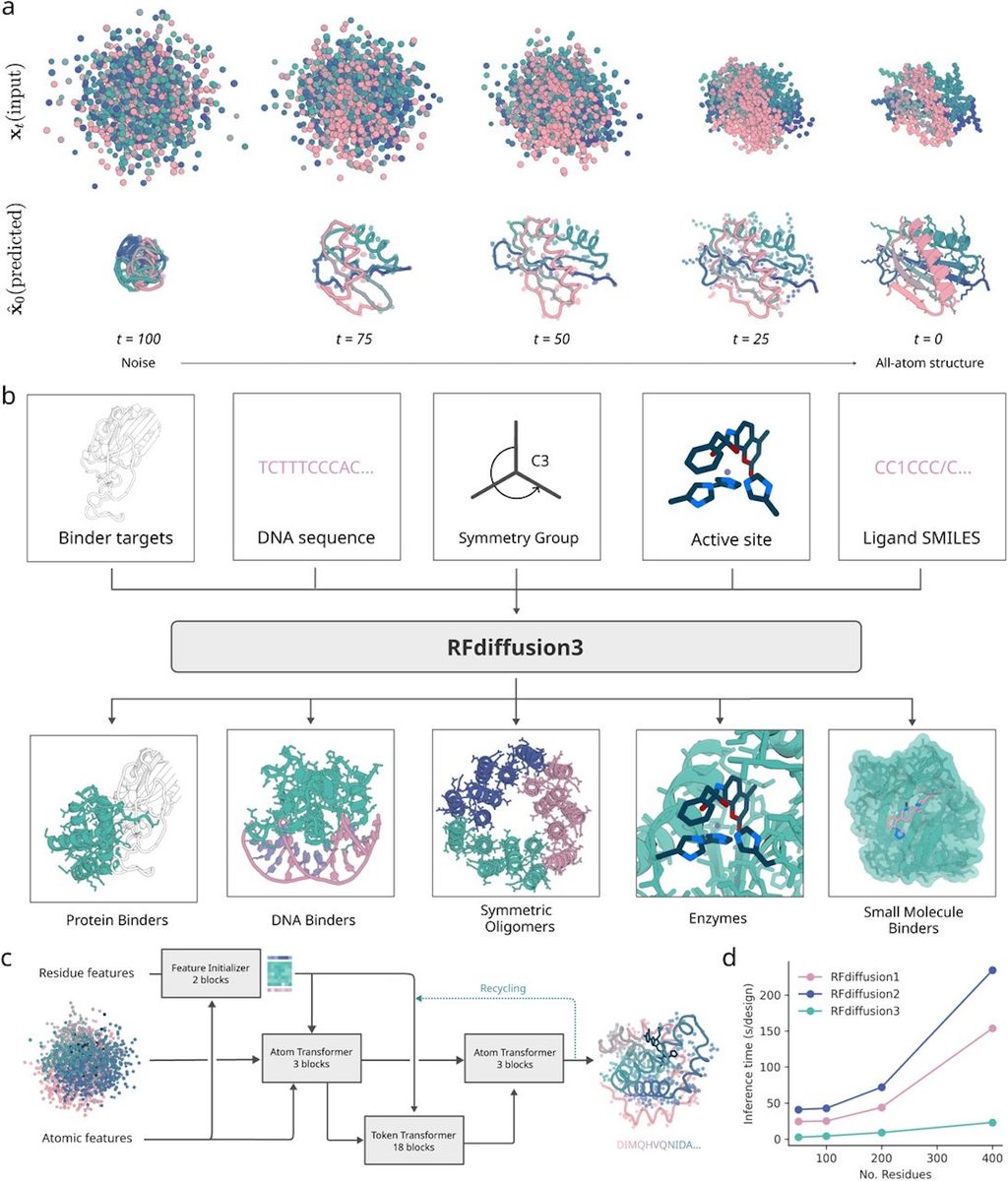
An international team published the complete blueprint for RFdiffusion3, an artificial intelligence that designs proteins and nucleic acids atom by atom. The system, detailed in Science, invents enzymes from scratch that carry out their intended chemistry in real laboratory tests.

The model has been open-sourced since December and generates structures about 10 times faster than its predecessor. It outscored the older tool on 37 of 41 active-site design challenges. Because the training code is public, any lab can adapt RFD3 for new reactions, binding targets, or molecular assemblies.

Why it matters

Custom-designed enzymes built in days instead of years could reach environmental cleanup, medicine, and industrial chemistry.

Questions about this story

Free account needed to ask — your question is kept and asked for you right after sign-up. Answers are public.

No questions yet — be the first to ask.

Key Indicators

37 of 41
Active-site benchmarks where RFD3 beat RFD2
90% of the atomic motif enzyme cases in the comparison study.
10×
Speed advantage over RFdiffusion2
Reported by the Institute for Protein Design and Chinese Academy of Sciences.
4 of 96
Zero-shot phosphotriesterase designs that proved active
From a single 96-construct design campaign, with no iterative optimization.
3,557
Best Kcat/Km for a designed cysteine hydrolase
Beats earlier designs for the same esterase reaction.

Voices

Curated perspectives — historical figures and your fellow readers.

Ever wondered what historical figures would say about today's headlines?

Sign up to generate historical perspectives on this story.

People Involved

Organizations Involved

Timeline

October 2024 October 2026

5 events Latest: Today
Tap a bar to jump to that date
  1. Full RFD3 blueprint reaches broad readership

    Today Publication

    The complete design scheme, with lab-validated enzymes, drew wide coverage of the platform's capabilities.

  2. Science publishes RFD3 paper

    Publication

    The journal detailed the model's design principles, including atom-level diffusion and benchmark results.

  3. RFD3 reaches Rosetta Commons Foundry

    Release

    The model became available through the consortium's Foundry distribution platform.

  4. RFdiffusion3 open-sourced

    Release

    Team released RFD3 with training code and model weights on GitHub through Rosetta Commons.

  5. Baker shares Nobel Prize for protein design

    Recognition

    David Baker awarded the Nobel Prize in Chemistry for computational protein design.

Scenarios

1

RFD3-designed enzymes deployed for toxic chemical cleanup

Possible Resolves by Oct 19, 2028

Discussed by: Science paper authors, Clinical Laboratory int.

The team built phosphotriesterases that break down paraoxon, a toxic organophosphate. Native enzymes hydrolyze only a subset of these compounds, so designed alternatives could serve environmental remediation and medical countermeasures. A peer-reviewed field or industrial test would mark the step from bench to deployment.

2

Open training code spawns specialized derivatives

Likely Resolves by Oct 19, 2027

Discussed by: Institute for Protein Design, Rosetta Commons

The release includes training code, so labs outside the original team can adapt RFD3 to new targets, new data, or new reaction types. The first third-party designs with experimental validation would signal broad adoption of the platform.

3

RFD3-designed therapeutic proteins enter clinical trials

Possible Resolves by Oct 19, 2029

Discussed by: Science paper authors, Clinical Laboratory int.

The team designed zinc proteases specific for transthyretin, whose misfolding drives systemic amyloidosis. More than half of 96 designed proteases showed activity against the target peptide, and the best cut most of it within an hour. A registered trial would mark a move from bench to clinic.

Historical Context

3 moments from history that rhyme with this story — and how they unfolded.

November 2020

DeepMind's AlphaFold2 (2020)

DeepMind's AlphaFold2 predicted protein structures from amino acid sequences with near-experimental accuracy, cracking a half-century problem in biology. The program won the biennial Critical Assessment of Protein Structure Prediction competition by a wide margin.

Then

Structure prediction became routine for researchers worldwide through the AlphaFold database.

Now

It pushed the field toward machine learning; Baker's lab responded with its own structure and design models.

Why this matters now

Like RFD3, AlphaFold showed deep learning could replace slow, labor-intensive biophysical methods in protein science. RFD3 extends that logic from predicting structures to designing new ones.

1993

Frances Arnold's directed evolution (1993)

Frances Arnold developed directed evolution, mutating enzymes across generations and selecting for desired traits. The method earned her the 2018 Nobel Prize in Chemistry.

Then

Industrial enzymes for fuels, chemicals, and pharmaceuticals emerged from iterative lab evolution.

Now

It established that improved enzymes could be grown in the lab rather than designed from first principles.

Why this matters now

RFD3 offers a faster, complementary path: design the enzyme computationally from scratch, then validate it. That collapses years of evolutionary cycles into days of computation.

2023

RFdiffusion1 (2023)

Baker's lab released RFdiffusion, a diffusion model that generated novel protein backbones by denoising random structures, adapting AlphaFold's architecture to design rather than prediction.

Then

Researchers generated new binding proteins and symmetric assemblies not found in nature.

Now

It became a standard design tool, with later generations adding new capabilities.

Why this matters now

RFD3 is the third generation of this line. Its advance is modeling every atom, including ligands, nucleic acids, and metal ions, rather than only the protein backbone.

Sources

(9)