
Pull to refresh
Logo
AWS gives its coding agents names, memory and a narrow set of permissions

AWS gives its coding agents names, memory and a narrow set of permissions

New Capabilities

Kiro bots hold one job each, keep an editable notes file, and cannot hand work to another bot

Overview

Updated Yesterday

A developer who starts five coding agents before a morning call comes back to five half-finished conversations. One is stuck waiting to re-approve a tool. Another fixed a test without explaining why. A third drafted a plan that needs rewriting. The parallel work happened; the context did not survive it.

Amazon Web Services began shipping Kiro bots on Nov. 5 to change where that context lives. A bot is a named agent that owns one recurring job, keeps its own markdown notes file, and runs its own worker sessions inside Kiro Crew. Each bot starts with only the tools its job needs, can ask for more, and cannot grant itself access or pass work to another bot.

Why it matters

If persistent memory holds, developers stop re-explaining their codebase every morning and start reviewing finished work instead of supervising sessions.

Questions about this story

Free account needed to ask — your question is kept and asked for you right after sign-up. Answers are public.

No questions yet — be the first to ask.

Key Indicators

1
Memory files per bot
Each bot reads and writes its own markdown notes file, which the developer can open and edit directly.
0
Bots allowed to delegate to other bots
AWS blocks bot-to-bot handoffs so one bot's context does not leak into another's.
4
Example bot roles in AWS's launch post
Issue intake, build health, code review and release readiness, each with different tool access.

Voices

Curated perspectives — historical figures and your fellow readers.

Sign up to generate historical perspectives on this story.

People Involved

Organizations Involved

Timeline

July 2025 November 2026

4 events Latest: Yesterday
Tap a bar to jump to that date
  1. Launch-week scrutiny turns to defaults

    Latest Analysis

    Reviewers note bots start in a permissive trust mode and that Crew's default sandbox leaves the ~/.ssh directory visible.

  2. Kiro bots reach general availability

    Product launch

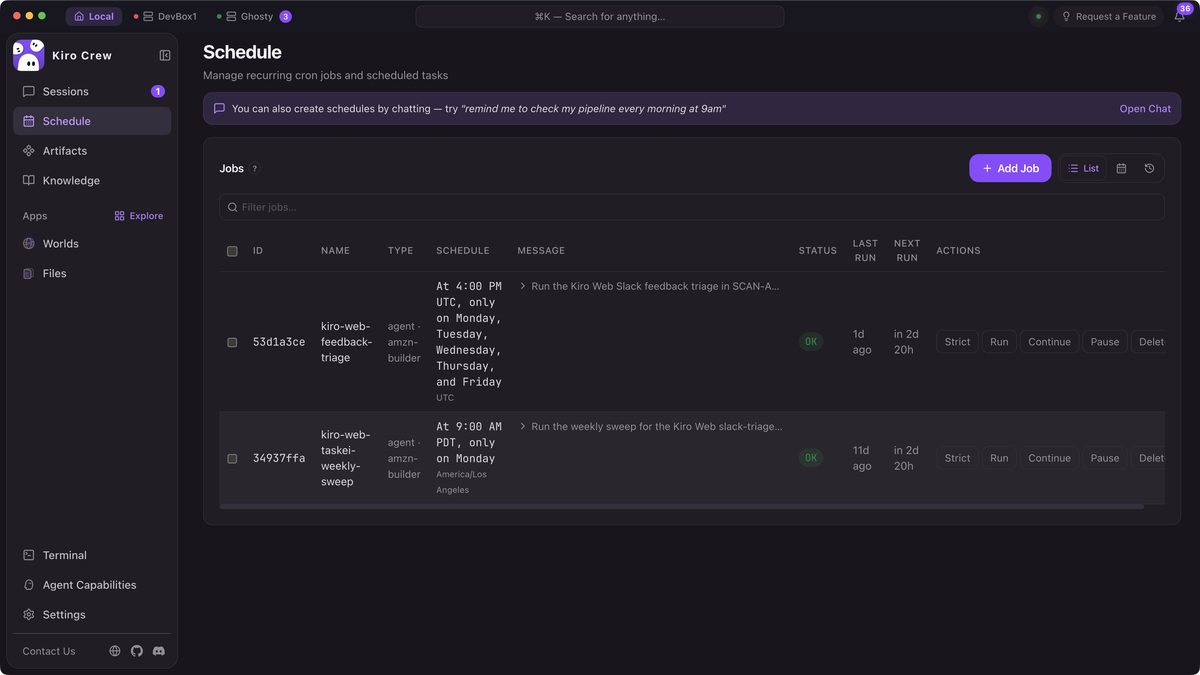
    Named bots get their own notes file, dashboard, schedules and a fixed set of tools; bot-to-bot delegation is blocked.

  3. Kiro Crew arrives with cross-session memory

    Product launch

    A persistent workspace that remembers context between sessions, but still leaves the developer tracking each session.

  4. AWS introduces Kiro

    Product launch

    A spec-driven coding environment where the agent works from written requirements rather than ad hoc prompts.

Scenarios

1

Security researchers demonstrate credential exposure in Kiro Crew's default sandbox

Possible Resolves by Q1 2027

Discussed by: World Programming's launch-week review

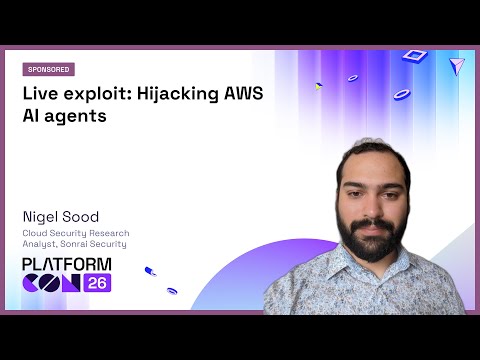
The review flags two defaults: bots begin in trust mode, and the sandbox leaves the user's ~/.ssh directory readable. If a researcher turns that into a working demonstration, AWS would have to change defaults or ship a patch, and enterprise buyers would ask for the audit trail first.

2

AWS adds bot-to-bot delegation

Unlikely Resolves by Q3 2027

Discussed by: AWS's Kathy Kam, who said the restriction is deliberate

Kam said bots cannot delegate to each other because handoffs are where context rots. Customer pressure for multi-step pipelines could reverse that. The signal to watch is documentation, not marketing: a changelog entry describing one bot assigning work to another.

3

A major rival ships persistent per-agent memory for coding

Possible Resolves by Q2 2027

Discussed by: Industry coverage framing bots as a competitive move

Kiro Crew's pitch is memory that survives sessions. If that becomes table stakes, GitHub, Google or Anthropic would ship an equivalent: a coding agent with a user-editable memory store scoped to one role. The announcement, not the rumor, is the trigger.

4

AWS publishes a customer running a Kiro bot on a schedule for a month

Uncertain Resolves by Q2 2027

Discussed by: AWS's launch post, which describes scheduled overnight and weekly bot runs

Scheduling is the feature that separates a bot from a chat session. A named customer running one on a recurring schedule for at least 30 days would show the model works outside a demo, and would be the first hard adoption evidence AWS has offered.

Historical Context

3 moments from history that rhyme with this story — and how they unfolded.

March 2023

AutoGPT (2023)

An open-source project let a language model set its own subtasks and loop through them, with a memory store so it could recall earlier steps. It drew tens of thousands of GitHub stars in weeks.

Then

Demonstrations were impressive and frequently circular; agents repeated work or drifted from the goal.

Now

The pattern of memory plus autonomous looping became standard, but shipped products added narrow scopes and human checkpoints.

Why this matters now

Kiro bots keep the memory and drop the open-ended looping, which is the trade AutoGPT's failures pointed toward.

March 2024

Devin (2024)

Cognition announced an autonomous software engineer that could plan and execute coding tasks end to end, with a demo that set expectations for the category.

Then

Independent evaluations found it solved a minority of real tasks, and early users reported mixed results.

Now

The product persisted with narrower positioning, and the gap between demo and deployment became a cautionary reference for agent launches.

Why this matters now

It is the clearest precedent for the question hanging over Kiro bots: whether a persistent agent's output holds up when a developer is not watching every step.

June 2021

GitHub Copilot (2021)

GitHub released a technical preview of an AI pair programmer that suggested code inside the editor, trained on public repositories.

Then

Adoption spread quickly through individual developers and then teams.

Now

It established the editor as the place where AI assistance lives, and set the expectation that the tool, not the developer, holds the working context.

Why this matters now

Kiro bots extend that same transfer of context one level up, from the file being edited to the recurring job being owned.

Sources

(6)