Anchor

Generalist AI releases robot model that learns new tasks from a single demonstration
New CapabilitiesGEN-1.5 averages 59% success on unseen tasks from one short demo, no training required
Yesterday: GEN-1.5 released with one-shot learningNew here? Follow stories to track developments over time. Create a free account to get updates when stories you care about change.
Overview
Updated 1 hour agoGeneralist AI released a robot model on August 24 that learns a new physical task from a single 3–12 second demonstration. The demo goes into a 30-second context window and the robot starts performing the task—no fine-tuning, no gradient updates, no custom code.
Across 10 manipulation tasks, one-shot prompting averaged 59% success from the pretrained model. Ten gradient steps on five minutes of data per task raised that to 83%. The company says the one-shot ability emerged from pretraining on physical interaction data, not from any explicit training for it.
Why it matters
If robots can learn a task from one short demonstration instead of months of programming, deploying them in factories and homes gets cheaper and faster.
Questions about this story
Free account needed to ask — your question is kept and asked for you right after sign-up. Answers are public.
No questions yet — be the first to ask.
Key Indicators
59%
One-shot success rate
Average success across 10 manipulation tasks from a single in-context demonstration, no training.
83%
Few-shot success rate
After 10 gradient steps on five minutes of demonstration data per task.
10
Tasks tested
Diverse manipulation tasks including zippers, jars, and wallet item extraction.
3–12
Demonstration length (seconds)
Length of the single demonstration needed for one-shot in-context learning.
$400M
Funding raised
Raised June 2026 at a $2 billion valuation, led by Radical Ventures.
Related Media
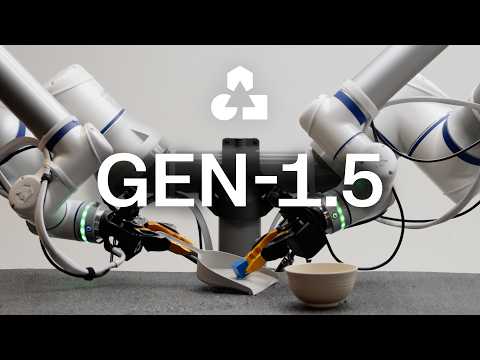
Generalist AI's GEN-1.5 robot model learns tasks from one demo
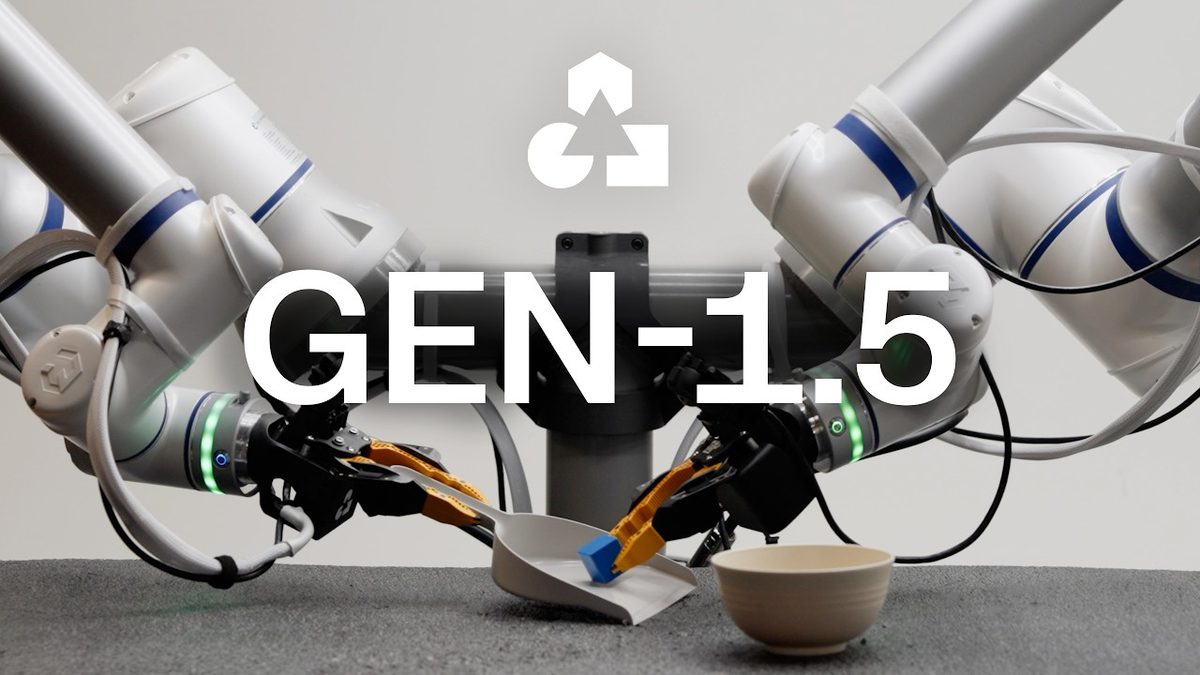
Generalist AI GEN-1.5: Robots Learn From a Single Demo
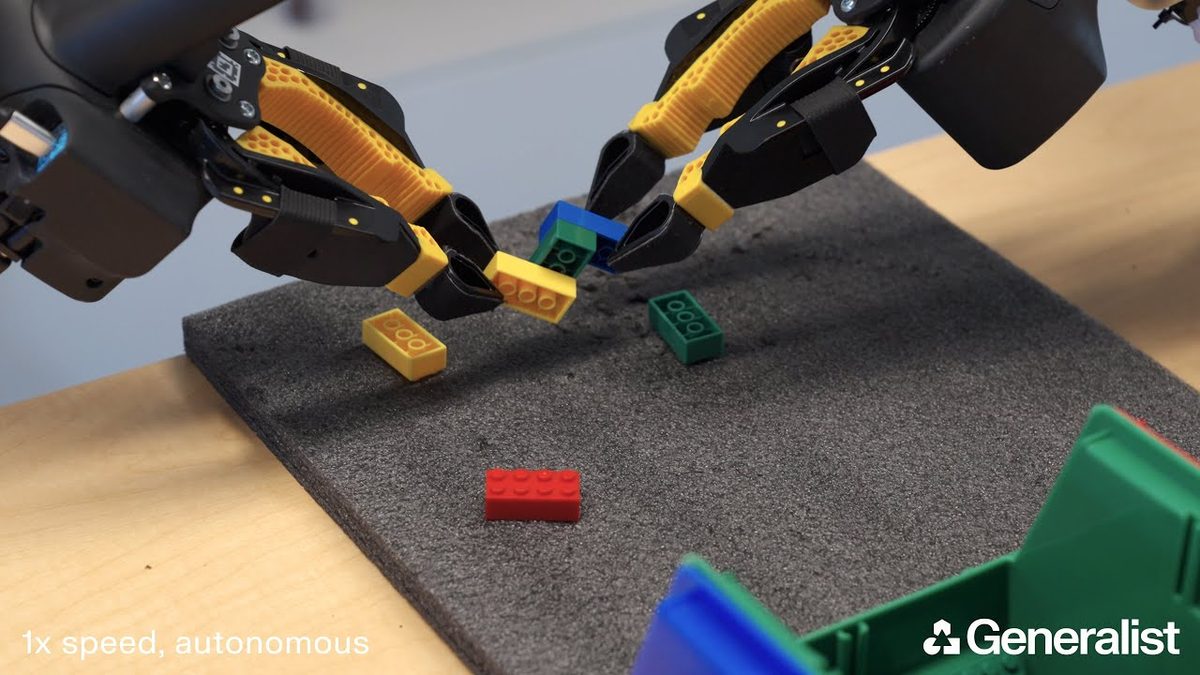
Generalist - Research Preview
490 views
6:44
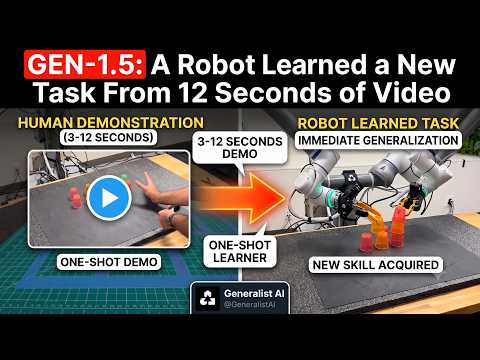
A Robot Learned a New Task From 12 Seconds of Video
AI WITH Rithesh
127.0K views
3:33
Introducing GEN-1.5, a one-shot learner
Generalist
Images from Openverse under Creative Commons licenses. Videos from YouTube.
Voices
Curated perspectives — historical figures and your fellow readers.
Play
Exploring all sides of a story is often best achieved with Play.
Most of these play right now — no account needed. Sign up to save scores, keep a streak, and unlock Debate and Predict.
Log in
Sign Up
Higher or Lower
A number from this story, against one from elsewhere in the news — guess which is bigger, then keep the chain going. 5 rounds, 3 strikes; a miss costs a strike and resets your streak.
Example
Anchor
EU tariff revenue
$52B
Big for this kind of number
Mystery
Pentagon AI contract
?
Round 1
Streak: 0
Mystery
?
Keyboard: ↓/L lower · ↑/H higher
0 pts
Best streak: 0 · Rounds: 0
0 points — sign up to put that on the leaderboard.
Now try on this story
Connections
Sixteen names from the news. Find the four hidden groups of four. Four mistakes max.
Loading today's puzzle…
0/4 groups
Mistakes
Sign up to keep a daily streak — a new puzzle lands every day.
Now try on this story
Exit debate?
Your progress in this debate will be lost.
How it works
- 1 Two AI personas square off on this story.
- 2 You predict who'll win each round — correct picks earn XP.
- 3 One crossfire question is yours to fire. Pick it carefully.
Couldn't generate a topic
Select Your Champions
Choose one persona for each side of the debate
DEBATE TOPIC
Choose personas with different perspectives for a more dynamic debate.
SIDE A (PRO)
Select debater for this side:
No debate personas available right now.
SIDE B (CON)
Select debater for this side:
No debate personas available right now.
VS
Get ready to make your prediction...
Round of
Claim
Evidence
Stakes
Crossfire Answer
Closing Statement
Claim
Evidence
Stakes
Crossfire Answer
Closing Statement
Your Crossfire Question
Generating arguments...
Who's Got This Round?
Make your prediction before the referee scores
The referee scores both sides on
Correct predictions earn +20 XP
· Press 1 or 2 to pick
Evidence
40%
Logic
30%
Detail
20%
Style
10%
Round Results
Your Pick
Not this time
(%)
Overall Score
/10
Your Pick
Not this time
(%)
Overall Score
/10
Set the Crossfire
Pick the question both personas must answer in the final round
Crafting crossfire questions...
Choosing a question earns +10 XP crossfire bonus
🏆
Total XP Earned
Cred Change
Predictions
Debate Oracle! You called every round!
Sharp Instincts! You know your debaters!
The Coin Flip Strategist! Perfectly balanced!
The Contrarian! Bold predictions!
Inverse Genius! Try betting the opposite next time!
XP Breakdown
Base completion
+20 XP
Rounds played ( rounds x 5 XP)
+ XP
Correct predictions ( correct x 20 XP)
+ XP
Crossfire bonus
+10 XP
Accuracy
%
Prediction History
Round
You picked:
✓
✗
Now try on this story
Keep debating to level up your credibility and unlock achievements
People Involved
Organizations Involved
Timeline
2024 August 2026
3 events
Latest: Yesterday
-
GEN-1.5 released with one-shot learning
Latest ProductModel learns physical tasks from a single 3–12 second demonstration in context, no training required.
-
$400M raise at $2B valuation
FundingRadical Ventures led the round; Nvidia, Bezos Expeditions, and Union Square Ventures participated.
-
Generalist AI founded
CompanyThree ex-Google DeepMind and Boston Dynamics researchers start a robot foundation model company.
Historical Context
3 moments from history that rhyme with this story — and how they unfolded.
June 2020
GPT-3 and emergent in-context learning (2020)
OpenAI's GPT-3 language model, trained on standard next-token prediction, began completing tasks from examples placed in its prompt—no weight updates, no fine-tuning. Few-shot and one-shot learning emerged as artifacts of scale that nobody had engineered directly.
Then
Researchers and developers adopted prompt engineering as a new adaptation method, radically lowering the cost of using language models for new tasks.
Now
In-context learning became a defining property of large language models and a template for scaling laws across AI domains.
Why this matters now
GEN-1.5's physical prompting mirrors the GPT-3 pattern: a capability the company says emerged from pretraining, not from explicit meta-learning objectives. It is the first physical analog at scale.
May 2022
DeepMind Gato (2022)
DeepMind trained a single transformer on 604 tasks spanning robotics, Atari games, and image and text data. Gato could play many games and manipulate objects, but it was mediocre at any single task and still required fine-tuning to adapt to new skills.
Then
Gato demonstrated that a generalist agent was technically feasible but weak in practice, sparking debate about the path to general physical intelligence.
Now
It set the foundation-model-for-agents agenda that companies like Generalist AI now pursue.
Why this matters now
GEN-1.5 moves past Gato's limitation: it adapts to new tasks from a single demonstration in context, where Gato needed task-specific training.
July 2023
Google RT-2: vision-language-action transfer (2023)
Google DeepMind's RT-2 trained a vision-language model on web data and robot actions, letting the model transfer semantic knowledge such as object recognition and reasoning to robot control. It improved generalization but still relied on fine-tuning for new behaviors.
Then
RT-2 showed web-scale pretraining could boost robot generalization and pushed the field toward multimodal foundation models.
Now
It helped establish the scaling approach—more data, bigger models—that Generalist AI has taken to its current extreme.
Why this matters now
Generalist AI's model is the direct descendant of this line of work, extending it with one-shot in-context learning and 100 Hz action output.
Sources
(9)Related Stories
AI foundation models give robots the ability to see, reason, and act in the physical world
New Capabilities
Updated May 31
The AI reasoning revolution
New Capabilities
Updated May 19
The race to build frontier AI
New Capabilities
Updated Aug 1
The AI science rush
New Capabilities
Updated May 19
OpenAI makes GPT-5.5 Instant ChatGPT's new default model
New Capabilities
Updated May 31
The recursive loop begins
New Capabilities
Updated May 19