Anchor

Microsoft makes Rust a Tier-1 language for internal development
New CapabilitiesRust joins C++, C#, and TypeScript as a first-class language, capping a four-year push
Today: Microsoft declares Rust a Tier-1 languageNew here? Follow stories to track developments over time. Create a free account to get updates when stories you care about change.
Overview
Updated 1 hour agoMicrosoft has formally elevated Rust to Tier-1 language status, placing it alongside C++, C#, and TypeScript as one of the best-supported languages for internal development. The designation gives engineering teams secure toolchain builds, developer tooling, quality workflows, and compliance with Microsoft's security requirements.
The move caps a four-year push led by Azure CTO Mark Russinovich, who in 2022 urged developers to stop using C and C++ for new projects. Roughly 70% of Microsoft's security vulnerabilities over the prior decade traced to memory safety issues in those languages.
Why it matters
The memory safety bugs behind 70% of Microsoft's vulnerabilities could disappear if its Rust shift succeeds.
Questions about this story
Free account needed to ask — your question is kept and asked for you right after sign-up. Answers are public.
No questions yet — be the first to ask.
Key Indicators
70%
Share of Microsoft vulnerabilities from memory safety issues in C/C++
Over a decade of Microsoft Security Response Center triage data, per Russinovich.
$10M
Microsoft's investment in Rust
Revealed by David Weston in 2022 to make Rust a first-class language.
$1M
Donation to Rust Foundation
Support for critical Rust language and project priorities.
1M
Lines of code per month refactoring target
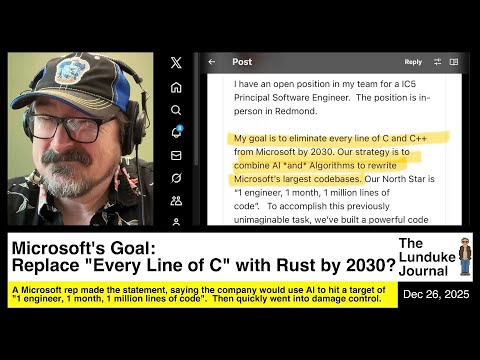
Galen Hunt's stated goal: '1 engineer, 1 month, 1 million lines of code.'
Related Media
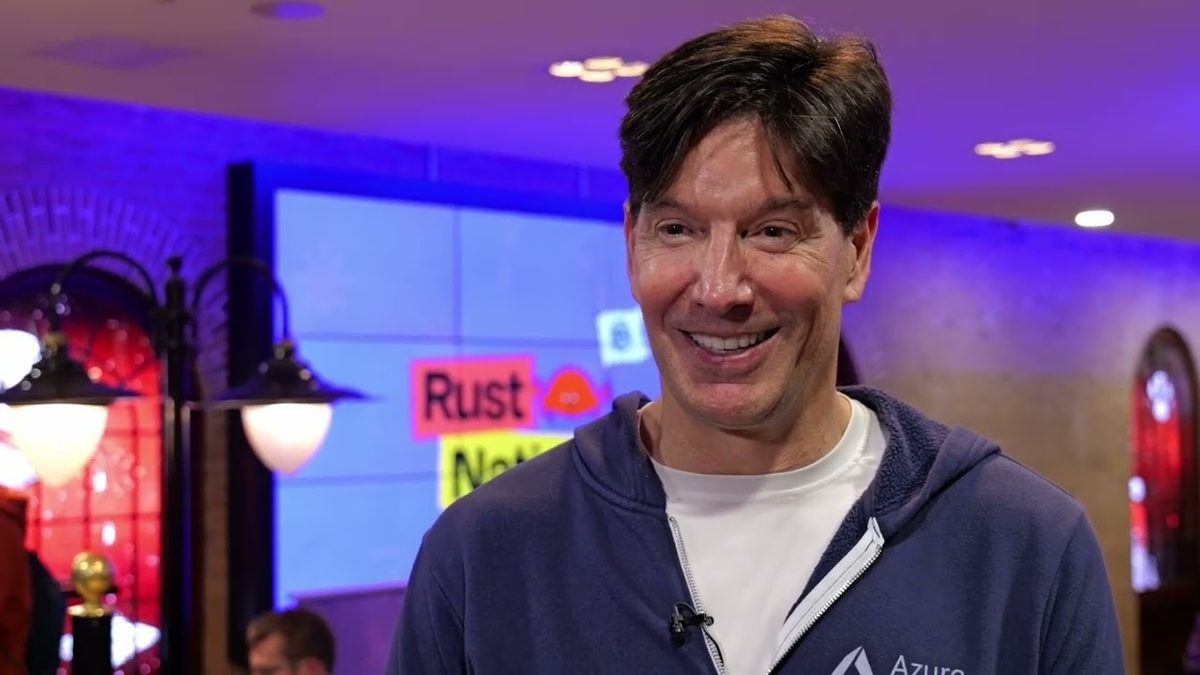
Mark Russinovich, Microsoft Azure CTO tells Rust Nation UK 2025 why Azure is moving to Rust from C++
Person holding a Rust programming language logo sticker with blurred background.

23.4K views
6:13
Microsoft Adopts Rust AGAIN For This Major App?
Travis Media
20.8K views
26:06
Microsoft's Goal: Replace "Every Line of C" with Rust by 2030?
The Lunduke Journal
91.0K views
8:01
Microsoft Is Abandoning C# for Rust! Now What? - Nick Chapsas
Nick Chapsas
Images from Openverse under Creative Commons licenses. Videos from YouTube.
Voices
Curated perspectives — historical figures and your fellow readers.
Play
Exploring all sides of a story is often best achieved with Play.
Most of these play right now — no account needed. Sign up to save scores, keep a streak, and unlock Debate and Predict.
Log in
Sign Up
Higher or Lower
A number from this story, against one from elsewhere in the news — guess which is bigger, then keep the chain going. 5 rounds, 3 strikes; a miss costs a strike and resets your streak.
Example
Anchor
EU tariff revenue
$52B
Big for this kind of number
Mystery
Pentagon AI contract
?
Round 1
Streak: 0
Mystery
?
Keyboard: ↓/L lower · ↑/H higher
0 pts
Best streak: 0 · Rounds: 0
0 points — sign up to put that on the leaderboard.
Now try on this story
Connections
Sixteen names from the news. Find the four hidden groups of four. Four mistakes max.
Loading today's puzzle…
0/4 groups
Mistakes
Sign up to keep a daily streak — a new puzzle lands every day.
Now try on this story
Exit debate?
Your progress in this debate will be lost.
How it works
- 1 Two AI personas square off on this story.
- 2 You predict who'll win each round — correct picks earn XP.
- 3 One crossfire question is yours to fire. Pick it carefully.
Couldn't generate a topic
Select Your Champions
Choose one persona for each side of the debate
DEBATE TOPIC
Choose personas with different perspectives for a more dynamic debate.
SIDE A (PRO)
Select debater for this side:
No debate personas available right now.
SIDE B (CON)
Select debater for this side:
No debate personas available right now.
VS
Get ready to make your prediction...
Round of
Claim
Evidence
Stakes
Crossfire Answer
Closing Statement
Claim
Evidence
Stakes
Crossfire Answer
Closing Statement
Your Crossfire Question
Generating arguments...
Who's Got This Round?
Make your prediction before the referee scores
The referee scores both sides on
Correct predictions earn +20 XP
· Press 1 or 2 to pick
Evidence
40%
Logic
30%
Detail
20%
Style
10%
Round Results
Your Pick
Not this time
(%)
Overall Score
/10
Your Pick
Not this time
(%)
Overall Score
/10
Set the Crossfire
Pick the question both personas must answer in the final round
Crafting crossfire questions...
Choosing a question earns +10 XP crossfire bonus
🏆
Total XP Earned
Cred Change
Predictions
Debate Oracle! You called every round!
Sharp Instincts! You know your debaters!
The Coin Flip Strategist! Perfectly balanced!
The Contrarian! Bold predictions!
Inverse Genius! Try betting the opposite next time!
XP Breakdown
Base completion
+20 XP
Rounds played ( rounds x 5 XP)
+ XP
Correct predictions ( correct x 20 XP)
+ XP
Crossfire bonus
+10 XP
Accuracy
%
Prediction History
Round
You picked:
✓
✗
Now try on this story
Keep debating to level up your credibility and unlock achievements
People Involved
Organizations Involved
Timeline
May 2015 September 2026
11 events
Latest: Today
Showing 8 of 11
Tap a bar to jump to that date
-
Microsoft declares Rust a Tier-1 language
Today AnnouncementRust joins C++, C#, and TypeScript as a best-supported language for internal development.
-
Galen Hunt sets 2030 C/C++ elimination goal
StatementDistinguished Engineer posts goal to eliminate every line of C and C++ by 2030.
-
Russinovich keynote at RustConf 2025
ConferenceAzure CTO recounts the Rust journey and details core projects powered by Rust.
-
Russinovich details Rust adoption at Rust Nation UK
ConferenceAzure CTO outlines successes, challenges, and commitment to Rust across Microsoft products.
-
Windows drivers in Rust framework announced
AnnouncementMicrosoft begins work on a framework for writing Windows drivers in Rust.
-
Azure SDK for Rust reaches stable
ReleaseProduction-ready SDK with stable APIs and semver guarantees.
-
Microsoft donates $1M to Rust Foundation
FundingDonation supports critical Rust language and project priorities.
-
Rust kernel features ship in Windows 11
ProductWindows 11 Insider Preview Build 25905 includes Rust-based kernel features.
-
Microsoft invests $10M in Rust
InvestmentDavid Weston reveals the investment to make Rust a first-class language.
-
Russinovich urges avoiding C and C++
StatementAzure CTO tweets that new projects should use Rust where garbage collection isn't required.
-
Rust 1.0 released
ReleaseMozilla Research ships the first stable version of Rust.
Historical Context
3 moments from history that rhyme with this story — and how they unfolded.
2010-2019
Google's Go language adoption (2010s)
Google developed Go for systems programming and adopted it for cloud infrastructure, including Kubernetes and other core services.
Then
Go became a standard language for cloud infrastructure.
Now
Demonstrated that a large tech company can shift its systems language over a decade.
Why this matters now
Google's Go adoption is the closest parallel to Microsoft's Rust shift, showing both the benefits and the long timeline required.
2016-2020
Microsoft's .NET Framework to .NET Core (2016-2020)
Microsoft rebuilt its.NET platform from a Windows-only framework to a cross-platform, open-source one. The migration required years of tooling work and code conversion.
Then
.NET Core became the default.NET implementation by 2020.
Now
Showed Microsoft can execute large platform migrations, but timelines often slip from initial estimates.
Why this matters now
Microsoft's last major platform migration shows both the company's capacity for large-scale change and the tendency for such timelines to extend.
November 2017
Mozilla's Firefox Quantum (2017)
Mozilla rewrote key components of Firefox in Rust, shipping the first major browser with Rust code. The rewrite improved performance and eliminated entire classes of memory safety bugs.
Then
Firefox Quantum shipped in November 2017 with significant performance gains.
Now
Proved Rust could handle large, production systems, giving other companies confidence to adopt it.
Why this matters now
Firefox was the first proof that Rust could work at scale in a major product, laying the groundwork for Microsoft's adoption.
Sources
(7)Related Stories
Linux kernel reaches version 7.0 with Rust now permanent and next-gen chip support
New Capabilities
Updated May 30
Microsoft flips the security switch
Rule Changes
Updated May 20
Operating systems become AI agent platforms
New Capabilities
Updated Jun 2
Microsoft's topological qubit claim challenged in peer-reviewed Nature critique
New Capabilities
Updated Jun 24
Microsoft's ongoing battle against zero-day exploits
Rule Changes
Updated May 27
AI takes over code authorship at major tech firms
New Capabilities
Updated May 31