
Pull to refresh
Logo
San Francisco school board narrows lottery replacement to two options

San Francisco school board narrows lottery replacement to two options

Rule Changes San Francisco, CA local

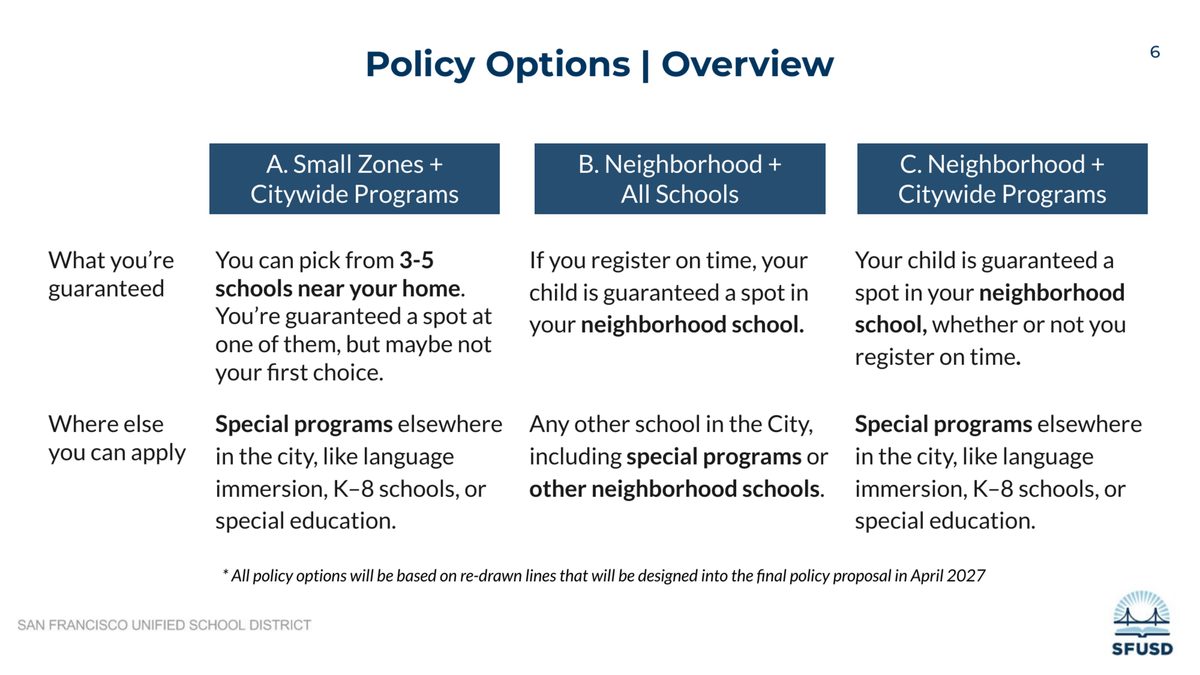
Both plans guarantee a neighborhood school; they differ on how much choice families keep

Today: Board narrows lottery replacement to two options

Overview

Updated 1 hour ago

San Francisco's school board is one vote away from replacing the citywide lottery that assigns elementary school students. The board narrowed its options from three to two on Tuesday, both guaranteeing a neighborhood school.

The decision caps an eight-year effort to scrap a lottery that was supposed to reduce socioeconomic segregation but didn't. The two plans split on how much choice families keep and what happens to the roughly 370 families who apply late each year.

Why it matters

This vote decides which San Francisco schools families can apply to starting in 2028, and whether a neighborhood seat is guaranteed.

Monday: what changed in San Francisco, CA

One short email a week with the openings, closings, permits and council votes we covered. Free. Unsubscribe in one click.

Questions about this story

Free account needed to ask — your question is kept and asked for you right after sign-up. Answers are public.

No questions yet — be the first to ask.

Key Indicators

67%
Current first-choice rate
Share of applicants getting their top school choice today; rises to 70% under Option B, falls to 54% under C.
71%
Families preferring Option B
Share of 2,725 surveyed families who said B would meet their needs, versus 48% for C.
370
Late applicants per year
Families who miss the main round deadline; 7 in 10 live near schools that aren't in high demand.
320
Projected seat shortage by 2033
Kindergarten seats short across 19 of 58 attendance areas; redrawing boundaries closes about half the gap.

Voices

Curated perspectives — historical figures and your fellow readers.

Ever wondered what historical figures would say about today's headlines?

Sign up to generate historical perspectives on this story.

Organizations Involved

Timeline

2018 October 2026

3 events Latest: Today
  1. Board narrows lottery replacement to two options

    Today Policy Decision

    Board drops Option A, leaving two plans that guarantee a neighborhood school. Vote set for October 13.

  2. Board adopts zone-based system

    Policy Decision

    Zone-based assignment system adopted but never put in place.

  3. SFUSD board votes to scrap lottery

    Policy Decision

    Board ends the citywide lottery after it failed to reduce socioeconomic segregation as intended.

Scenarios

1

Board adopts Option B: neighborhood guarantee plus citywide choice

Likely Resolves by Oct 20, 2026

Discussed by: SFUSD staff and Stanford simulations; 71% of surveyed families prefer this option

The board picks the plan that guarantees a neighborhood seat for on-time applicants while letting families apply to any other school in the city. First-choice placements rise from 67% to 70% under diversity-adjusted assignments. The district would need to redraw attendance boundaries and address a projected 320-seat shortage by 2033.

2

Board adopts Option C: neighborhood guarantee with limited choice

Possible Resolves by Oct 20, 2026

Discussed by: SFUSD staff, which rated it easiest to carry out

The board picks the plan that guarantees a neighborhood seat even for late applicants but limits other choices to citywide programs like language immersion and K-8 schools. More students stay closer to home: 48% within half a mile versus 40% under B. First-choice placements fall to 54%.

3

Board delays again, misses another deadline

Unlikely Resolves by Oct 20, 2026

Discussed by: Pattern of missed deadlines since 2018

The board fails to reach consensus and postpones the vote, extending a pattern of missed deadlines that has persisted since 2018. The current lottery would remain in place for the 2027-28 enrollment cycle, with the replacement pushed to a future date.

Historical Context

2 moments from history that rhyme with this story — and how they unfolded.

September 1974

Boston busing crisis (1974)

A federal judge ordered Boston to bus students across neighborhoods to desegregate schools. The order met violent resistance, with protests, boycotts, and attacks on Black students. White enrollment in Boston public schools fell sharply over the following decade.

Then

The 1974-75 school year opened with riots and National Guard deployment. Thousands of white families pulled their children from public schools.

Now

Boston's school assignment system became a cautionary tale about the limits of court-ordered integration. The city eventually shifted to a choice-based system in the 1980s.

Why this matters now

San Francisco's lottery was designed to achieve integration through choice rather than force. Its failure to reduce segregation mirrors the broader retreat from desegregation policies that began in the 1970s.

September 1999

Charlotte-Mecklenburg ends busing (1999)

Charlotte-Mecklenburg Schools in North Carolina, once a national model for court-ordered busing, voted to end the policy and return to neighborhood schools. The district had been under a desegregation order since 1971's Swann v. Charlotte-Mecklenburg decision.

Then

The district adopted a school choice system with magnet programs. Some schools resegregated within a decade.

Now

The end of busing marked a national shift away from integration policies. By 2000, most districts had returned to neighborhood-based assignment.

Why this matters now

SFUSD's move toward neighborhood guarantees follows the same trajectory: districts that once pursued integration through assignment policies are now prioritizing proximity and predictability.

Sources

(4)