


Pull to refresh
Logo
SEC adds 'no central party' test to token buyback guidance

SEC adds 'no central party' test to token buyback guidance

Rule Changes

Staff narrowed its Sept. 25 answer three days later, excluding centrally controlled projects

3 days ago: TLDR FEED Feed reports the clarification

Overview

Updated 2 hours ago

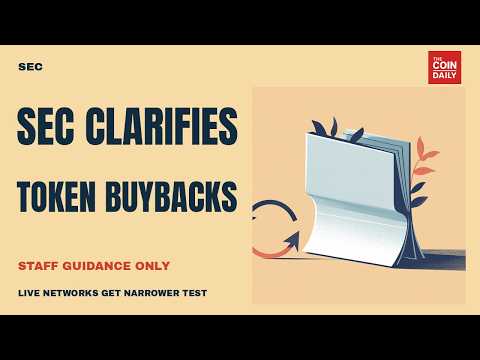
The Securities and Exchange Commission (SEC) staff said on Sept. 25 that a crypto project could announce a token buyback without that promise turning the token into a security, so long as the network was functional. Three days later, staff added a second condition: the network must also have no central party.

The revision narrows the safe harbor to truly decentralized protocols. Projects whose foundations or development companies still control upgrades, treasuries, or admin keys are excluded, and stay subject to a full, case-by-case Howey test.

Why it matters

The buyback guidance draws a sharp line for crypto projects: decentralized networks get staff cover, centralized ones stay in legal limbo.

Questions about this story

Free account needed to ask — your question is kept and asked for you right after sign-up. Answers are public.

No questions yet — be the first to ask.

Key Indicators

$638M
Token buyback spending in 2026
Record amount crypto projects spent repurchasing their own tokens through late August.
3 days
Days between FAQ and its narrowing
Sept. 25 guidance vs. Sept. 28 revision adding the no-central-party test.
No central party
New condition for buyback safe harbor
The network must lack operational, economic, or voting control by any person or group.

Voices

Curated perspectives — historical figures and your fellow readers.

Ever wondered what historical figures would say about today's headlines?

Sign up to generate historical perspectives on this story.

People Involved

Organizations Involved

Timeline

March 2026 September 2026

6 events Latest: 3 days ago
Tap a bar to jump to that date
  1. TLDR FEED Feed reports the clarification

    Latest Report

    Feed summarizes that decentralized buyback programs are not investment contracts under the Howey test.

  2. Staff adds 'no central party' to buyback guidance

    Regulatory Guidance

    Question 2.5 now says the network must be functional and have no central party for the buyback comfort to apply.

  3. SEC staff FAQ addresses token buybacks

    Regulatory Guidance

    Question 2.5 says a buyback announcement on a functional network is not a promise of essential managerial efforts.

  4. Peirce and Jennings clash over buyback answer

    Statement

    Peirce posts that the FAQ requires no central party; Jennings argues only Question 2.4 carries that limit.

  5. SEC proposes Regulation Crypto Assets

    Rulemaking

    The proposed rule builds on the March interpretation and is cited as the basis for the FAQ answers.

  6. SEC interpretive release defines 'central party'

    Regulatory Guidance

    The release defines a central party as anyone with operational, economic, or voting control of a crypto system. It anchors the later buyback guidance.

Scenarios

1

SEC codifies decentralized buyback exemption in final rule

Possible Resolves by Mar 17, 2027

Discussed by: The Company Chronicle, free.cc

The proposed Regulation Crypto Assets rule, cited in the FAQ, builds on the March interpretation the buyback answer rests on. If the SEC finalizes it with the decentralized treatment intact, projects without a central party trade staff views for a binding safe harbor.

2

SEC enforcement action tests a centralized buyback

Possible Resolves by Q3 2027

Discussed by: bitsandbips, free.cc

Projects whose foundations control upgrades, treasuries, or admin keys cannot use the FAQ. A buyback on such a network stays subject to the full Howey test, and an SEC action would mark the first real test of where the line sits.

3

Buyback guidance remains nonbinding staff views

Likely Resolves by Mar 17, 2027

Discussed by: coinnews.com, free.cc

The FAQ explicitly carries no legal force and binds no one. If rulemaking stalls, projects keep running their own Howey analysis, and the uncertainty the FAQ was meant to resolve continues.

Historical Context

3 moments from history that rhyme with this story — and how they unfolded.

May 1946

SEC v. W.J. Howey Co. (1946)

The Supreme Court ruled that Howey's offer of citrus grove contracts plus service agreements was an investment contract. It set a four-part test: money invested in a common enterprise with profits expected from the efforts of others.

Then

Howey was enjoined from offering the contracts without registering.

Now

The Howey test became the standard for what counts as a security in the U.S.

Why this matters now

The 'essential managerial efforts' test the buyback guidance addresses is the modern form of Howey's 'efforts of others' prong.

July 2017

The DAO Report (2017)

The SEC said tokens sold by The DAO, a decentralized autonomous organization, were securities because investors relied on the efforts of the Slock.it team and other curators.

Then

The SEC found the offering violated securities law, and trading in the tokens halted.

Now

It established that token sales can fall under U.S. securities law.

Why this matters now

It showed the SEC treats projects with central teams as securities, the same situation the new no-central-party test addresses.

April 2019

SEC Framework for 'Investment Contract' Analysis (2019)

The SEC's innovation hub, FinHub, issued a framework analyzing when digital assets count as investment contracts, discussing networks that operate autonomously.

Then

The framework gave market participants a self-assessment tool.

Now

It shaped how projects structured token sales and fed into the March 2026 interpretive release.

Why this matters now

It introduced the functional-network and decentralization distinctions the buyback guidance now applies to repurchases.

Sources

(9)