


Pull to refresh
Logo
ServiceNow launches AI Workflow Factory to turn workflow improvement into a continuous loop

ServiceNow launches AI Workflow Factory to turn workflow improvement into a continuous loop

New Capabilities

Process discovery, AI-assisted development, and governance meet in one system as ServiceNow extends its AI Control Tower portfolio

Yesterday: ServiceNow launches AI Workflow Factory and Autonomous Engineer

Overview

Updated 59 minutes ago

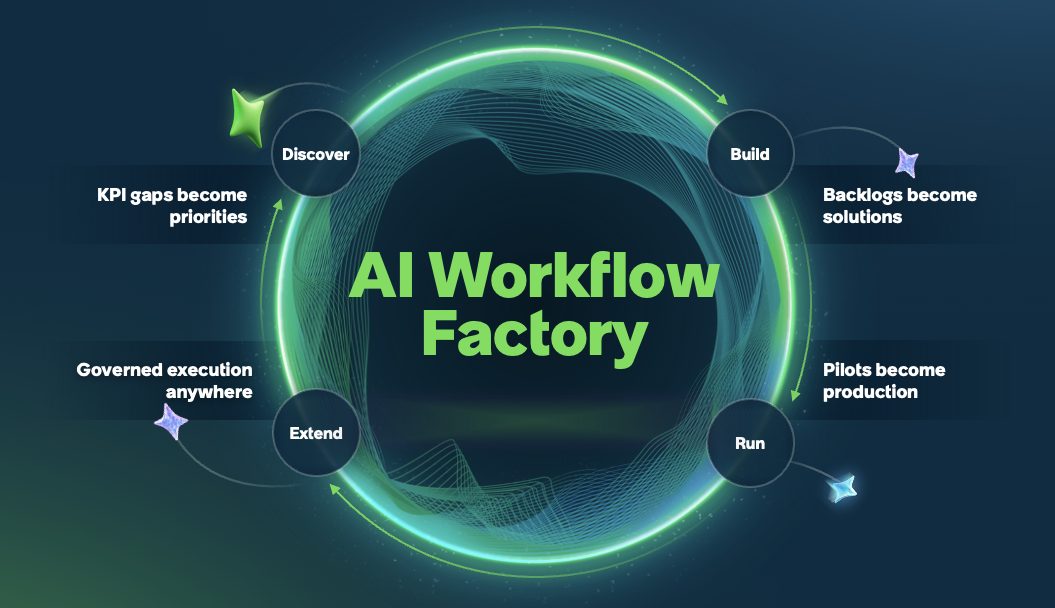
ServiceNow launched two AI tools on October 6 in Mumbai that make workflow improvement a continuous, governed loop. AI Workflow Factory maps business processes to AI services, while Autonomous Engineer builds and manages the resulting workflows with humans approving plans and validating finished work.

The pitch: enterprises stop launching a fresh transformation project each time a business problem surfaces. Each outcome reveals the next process to improve. The loop runs under ServiceNow's AI Control Tower, which logs every agent action for audit.

Why it matters

Enterprises that adopt it can cut months of workflow redesign to days, shifting developers from building to refining AI-run processes.

Questions about this story

Free account needed to ask — your question is kept and asked for you right after sign-up. Answers are public.

No questions yet — be the first to ask.

Key Indicators

$15.8B
2026 full-year subscription revenue guidance
Raised to $15,760–$15,780 million after Q2 2026 earnings.
24%
Q2 2026 revenue growth year over year
ServiceNow reported revenue growth of 24% for the quarter.
$30B+
ServiceNow revenue target for 2030
Management reiterated its target of $30 billion or more by 2030.
30%
AI share of annual contract value target by 2030
ServiceNow expects AI to account for 30% of ACV by decade's end.
119%
One-year growth in India enterprise AI investment
One of the strongest showings in ServiceNow's 2026 Enterprise AI Maturity Index.
73.5%
GAAP subscription gross margin, Q2 2026
Down from 80% a year earlier, reflecting investment in AI and cost pressures.

Voices

Curated perspectives — historical figures and your fellow readers.

Ever wondered what historical figures would say about today's headlines?

Sign up to generate historical perspectives on this story.

People Involved

Organizations Involved

Timeline

May 2026 October 2026

4 events Latest: Yesterday
Tap a bar to jump to that date
  1. Q3 2026 earnings call scheduled

    Upcoming Financial

    ServiceNow reports third-quarter results, the first earnings since the AI Workflow Factory launch.

  2. ServiceNow launches AI Workflow Factory and Autonomous Engineer

    Latest Product Launch

    ServiceNow unveils the two tools at World Forum Mumbai, connecting process mining, AI-assisted development, and workflow execution into one governed loop.

  3. AI Control Tower gains security and measurement

    Product

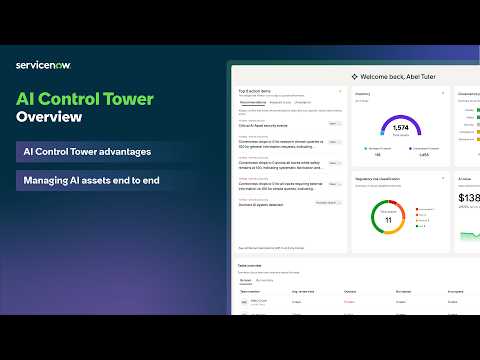
    ServiceNow adds AI security and measurement capabilities across cloud environments.

  4. ServiceNow expands AI Control Tower

    Product

    ServiceNow announces broader AI asset discovery and governance features for its AI Control Tower.

Scenarios

1

AI Workflow Factory accelerates ServiceNow toward its $30 billion revenue target

Likely Resolves by Feb 15, 2027

Discussed by: ServiceNow management and analysts tracking the company's 2030 target

ServiceNow targets $30 billion in revenue by 2030 with AI at 30% of annual contract value. The Q4 2026 earnings release will show whether AI Workflow Factory and Autonomous Engineer drive net-new subscription growth or simply reposition existing products. Early traction shows up as raised guidance and disclosed AI ACV figures.

2

Regulated industries hold back on unattended automation

Possible Resolves by Q3 2027

Discussed by: Greyhound Research chief analyst Sanchit Vir Gogia and customer concerns in regulated sectors

Gogia warned that production responsibility must remain explicit even when implementation is unattended, and that enterprises need coordinated governance across agents. Banks, insurers, and telecom operators, which the launch explicitly targets, may defer unattended coding and demand human sign-off on each build. AI Control Tower's audit trail is designed to address this, but adoption in these sectors will test whether governance alone is enough.

3

Microsoft, Google, or AWS match the capability and erode ServiceNow's edge

Possible Resolves by Oct 6, 2027

Discussed by: EveryTicker and analysts noting direct competition with major cloud and enterprise software players

The launch puts ServiceNow against Microsoft, Google, and AWS, all investing heavily in AI agents and workflow automation. If a hyperscaler ships a comparable governed loop bundled with its platform, ServiceNow must win on workflow depth and agent governance rather than price. Market share reports will show whether ServiceNow holds its position.

Historical Context

2 moments from history that rhyme with this story — and how they unfolded.

2015-2022

Robotic process automation wave (2015–2022)

Vendors like UiPath and Blue Prism promised to automate business workflows by recording and replaying human clicks. Enterprises deployed thousands of software bots to handle tasks such as data entry and invoice processing.

Then

Bots performed narrow, repetitive tasks, but many proved brittle. When underlying systems changed, bots broke and required manual upkeep, creating what the industry called bot sprawl.

Now

The standalone RPA market consolidated as companies demanded automation that could learn and adapt rather than replay fixed steps.

Why this matters now

AI Workflow Factory is ServiceNow's answer to RPA's maintenance problem: autonomous agents that build, deploy, and refine workflows in a continuous loop instead of fixed bots.

2014-2020

Low-code app development boom (2014–2020)

Platforms promised business users could build applications without waiting in IT backlogs. Adoption grew quickly as line-of-business teams assembled their own tools.

Then

Growth produced fragmented point solutions and shadow IT, where systems ran outside IT oversight.

Now

Governance and enterprise integration became the bottleneck, and low-code capabilities folded into larger platforms rather than standing alone.

Why this matters now

ServiceNow extends the same promise with AI doing the building, paired with AI Control Tower governance intended to avoid the fragmentation that plagued citizen development.

Sources

(6)