Every conventional solar cell hits the same wall: a single photon can knock loose one electron, at most. That constraint, formalized in 1961, caps silicon panels at roughly 33% efficiency.
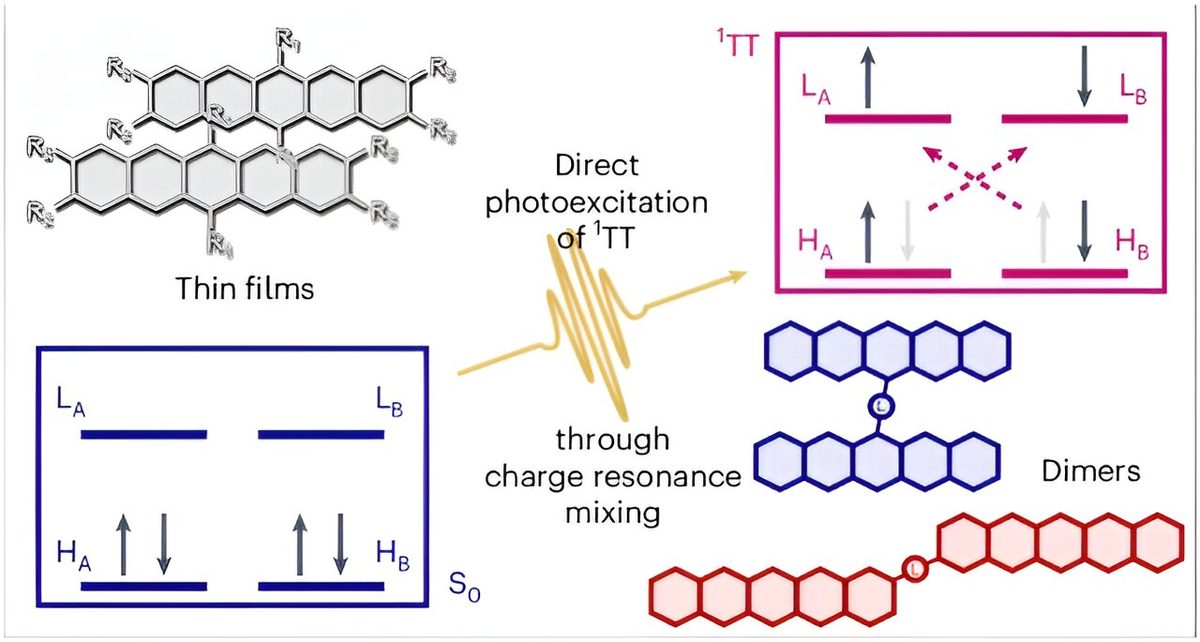
A team from Kyushu University and Johannes Gutenberg University Mainz demonstrated a system producing 1.3 energy carriers per photon—a 130% quantum yield. It splits one photon's energy through singlet fission and captures it with a molybdenum-based emitter. This is a proof-of-concept in liquid solution, not a finished solar panel.
But the result validates a specific mechanism, pairing singlet fission with spin-flip emitters, that theorists long predicted could push silicon solar cells from today's 27% practical ceiling toward 42%. With major manufacturers investing in related singlet fission research, the focus shifts from whether the physics works to how fast it can be engineered into solid-state devices.