

Pull to refresh
Logo
Sri Lanka extends senior judges' terms to clear massive court backlog

Sri Lanka extends senior judges' terms to clear massive court backlog

Rule Changes

Constitutional amendment raises judge retirement ages as courts face 1.1 million pending cases

Yesterday: Parliament passes amendment; Speaker certifies

Overview

Updated 1 hour ago

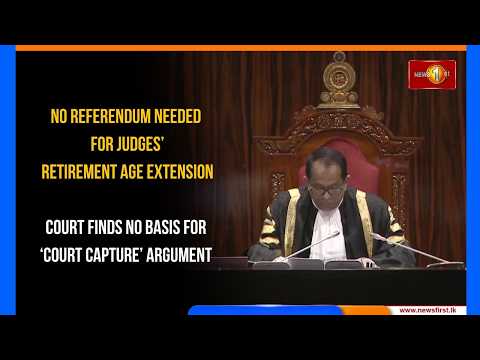
Sri Lanka's parliament voted on Sept 25 to raise the retirement age of Supreme Court judges from 65 to 67 and Court of Appeal judges from 63 to 65. Speaker Jagath Wickramaratne certified the 22nd Amendment the same day, after it passed with 158 of 225 MPs in favour.

The change is part of a reform push aimed at a backlog of 1.1 million court cases and a prison system built for about 11,000 inmates that now holds more than 41,000. A companion law extends lower-court judges to 62, adds judges to the Court of Appeal and High Court, and plans new courts outside the capital. Sri Lanka's criminal cases take more than 17 years to conclude on average.

Why it matters

The amendment targets a 1.1 million-case backlog that keeps remand prisoners waiting years in prisons built for a quarter of today's inmates.

Questions about this story

Free account needed to ask — your question is kept and asked for you right after sign-up. Answers are public.

No questions yet — be the first to ask.

Key Indicators

1.1M
Pending court cases
Estimated backlog the amendments aim to reduce.
41,000+
Prisoners in facilities built for 11,000
Overcrowding fuelled two riots that killed 31 people.
411
Judges receiving term extensions
Supreme Court, Court of Appeal, and lower-court judges get two extra years.
158
MPs voting in favour
Of 225 in Parliament, enough for the two-thirds majority required.

Voices

Curated perspectives — historical figures and your fellow readers.

Ever wondered what historical figures would say about today's headlines?

Sign up to generate historical perspectives on this story.

People Involved

Organizations Involved

Timeline

August 2026 September 2026

6 events Latest: Yesterday
Tap a bar to jump to that date
  1. Parliament passes amendment; Speaker certifies

    Latest Legislative

    158 MPs vote for the 22nd Amendment; Speaker Jagath Wickramaratne certifies it the same day, making it law.

  2. Two-day debate opens

    Legislative

    Parliament begins the second reading debate on both reform bills.

  3. Bills placed on Order Paper

    Legislative

    Both bills are placed on Parliament's Order Paper ahead of debate.

  4. Judicial reform bills gazetted

    Legislative

    The 22nd Amendment and the Judicature Amendment bills are gazetted, starting the formal legislative process.

Scenarios

1

Backlog drops below one million

Possible Resolves by End of 2028

Discussed by: Sri Lanka's Ministry of Justice reform plan

If the extended judge terms, new courts, and 10,000 additional police recruits work as planned, official statistics would show pending cases falling below the current 1.1 million within two years. The government has made this its stated target.

2

Reforms stall on funding

Possible Resolves by End of 2026

Discussed by: Opposition MPs and the Bar Association of Sri Lanka

The term extension is cheap to implement; the harder parts are new courthouses, more magistrates, and 10,000 police hires. If the next budget underfunds them, the backlog shrinks slowly and prison overcrowding persists.

3

Judicial independence dispute escalates

Unlikely Resolves by Q2 2027

Discussed by: Tamil Guardian, UCA News, Bar Association of Sri Lanka

The Chief Justice heading the bench that cleared his own term extension, and the rejection of referendum calls, could draw formal criticism from Commonwealth or United Nations bodies. The Bar Association says the change undermines judicial independence.

Historical Context

3 moments from history that rhyme with this story — and how they unfolded.

February-July 1937

FDR's Court-Packing Plan (1937)

President Franklin Roosevelt proposed adding up to six justices to the U.S. Supreme Court after it struck down several New Deal laws. Critics called it court packing and a threat to judicial independence.

Then

Congress rejected the bill after months of debate; the Court also began upholding New Deal programs.

Now

The episode reinforced a strong norm against politically motivated changes to the Court's composition.

Why this matters now

Sri Lanka's opposition invokes the same court-packing concern, and the Sri Lankan Supreme Court explicitly rejected that accusation in its ruling.

April 1990

Argentina's Supreme Court Expansion (1990)

President Carlos Menem expanded Argentina's Supreme Court from five to nine justices after a law enabled the increase. Critics said the new appointees were allies expected to back his policies.

Then

The expanded court ruled in Menem's favor on several key cases.

Now

It became a reference point for executive power over Latin American judiciaries.

Why this matters now

Shows how changing a court's composition can look like executive capture, the concern Sri Lanka's opposition raises about the term extension.

December 2004

Venezuela's Court Expansion (2004)

President Hugo Chávez expanded Venezuela's Supreme Tribunal from 20 to 32 magistrates after his allies gained a legislative majority. The new court later issued rulings that favored his government.

Then

The court aligned closely with the executive.

Now

It became a standard example of court packing eroding judicial independence.

Why this matters now

Adds weight to fears that changing judicial composition serves political ends, even when a government frames it as efficiency.

Sources

(10)