

Logo
Daily Brief
Following
Why
AI Cracks the Sleep Code: One Night Predicts 130 Diseases

AI Cracks the Sleep Code: One Night Predicts 130 Diseases

Stanford's SleepFM turns polysomnography into a crystal ball for heart attacks, dementia, and cancer

Overview

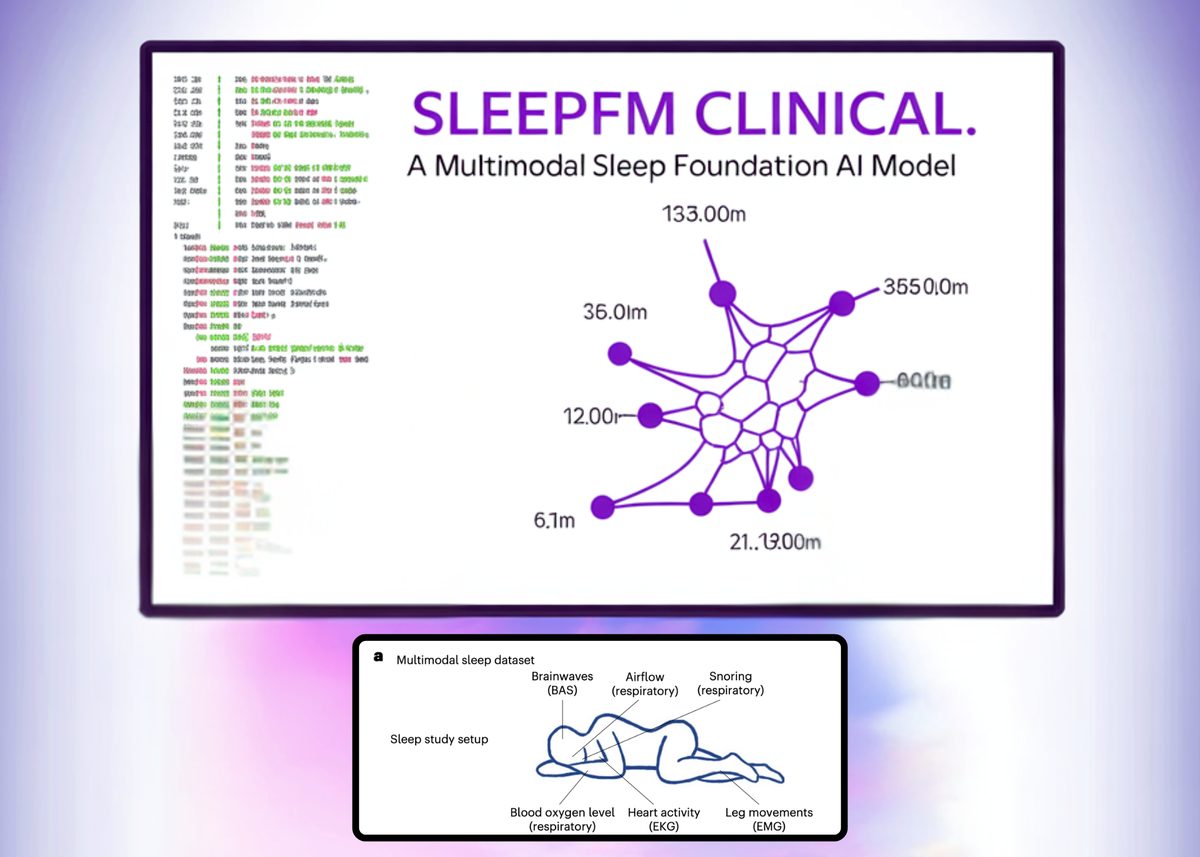
Stanford researchers trained an AI on 600,000 hours of people sleeping. SleepFM analyzes brain waves, heartbeats, and breathing from a single night and predicts your risk for 130 diseases—dementia, heart attacks, cancer, mental disorders—with over 80% accuracy. The breakthrough turns sleep studies into full-body diagnostic scans.

A $3,000 overnight test currently reserved for sleep disorder diagnosis just became preventive medicine's new frontier. The AI spots what human doctors miss: a brain asleep but a heart awake, lungs and neurons out of sync. These mismatches forecast disease years before symptoms appear. But the promise collides with reality—polysomnography is expensive, inaccessible, and the data raises thorny questions about insurance discrimination and who gets to know your health future.

Key Indicators

130
diseases predicted from one night of sleep
From over 1,000 conditions analyzed, AI accurately forecasts 130 with C-index ≥0.75
585,000
hours of sleep data analyzed
Training dataset from 65,000 participants across four major cohorts
0.85
C-index for dementia prediction
85% concordance between AI predictions and actual outcomes; similar accuracy for heart disease (0.84), Parkinson's (0.89)
$3,000
average cost of polysomnography
Lab-based sleep studies range $2,925-$6,700, creating accessibility barrier
$134.7B
projected sleep tech market by 2034
From $29.3B in 2025, driven by wearables and AI integration

People Involved

Emmanuel Mignot
Emmanuel Mignot
Craig Reynolds Professor in Sleep Medicine, Stanford (Co-senior author of SleepFM study published in Nature Medicine)
James Zou
James Zou
Associate Professor of Biomedical Data Science, Stanford (Co-senior author of SleepFM study)

Organizations Involved

ST
Stanford Medicine
Academic Medical Center
Status: Leading AI medical research institution

Stanford Medicine combines one of the world's top medical schools with cutting-edge AI research infrastructure.

NA
Nature Medicine
Peer-Reviewed Scientific Journal
Status: Published SleepFM research

Top-tier medical research journal with 87.2 impact factor, publishing transformative biomedical discoveries.

Timeline

  1. U.S. News Covers Clinical Implementation Challenges

    Media Coverage

    U.S. News & World Report publishes analysis highlighting that while SleepFM science is robust, clinical deployment faces barriers around validation, interpretability, and regulatory clarity before real-world use.

  2. Stanford Publishes SleepFM in Nature Medicine

    Scientific Discovery

    Mignot and Zou unveil SleepFM, AI trained on 585,000 hours of sleep data predicting 130 diseases from one night of polysomnography.

  3. FDA Issues AI Drug Development Guidance

    Regulatory

    FDA releases draft guidance on AI supporting regulatory decisions for drugs, introducing risk-based framework for model credibility.

  4. Nobel Prize Awarded for AlphaFold

    Recognition

    Demis Hassabis and John Jumper win Nobel Prize in Chemistry for AlphaFold, validating AI's role in fundamental science.

  5. Apple Watch Gets FDA Sleep Apnea Clearance

    Regulatory

    FDA approves Apple Watch Series 9, 10, and Ultra 2 for sleep apnea detection, bringing medical-grade screening to consumer wearables.

  6. Mignot Wins $3M Breakthrough Prize

    Recognition

    Mignot shares Breakthrough Prize in Life Sciences for narcolepsy discoveries that transformed sleep disorder understanding.

  7. AlphaFold 2 Solves Protein Folding Problem

    AI Breakthrough

    DeepMind's AlphaFold 2 predicts protein structures with unprecedented accuracy at CASP 14 competition, demonstrating AI's potential in biomedicine.

  8. Hypocretin Deficiency Confirmed in Human Patients

    Scientific Discovery

    Mignot demonstrates hypocretin absence in narcolepsy patients' cerebrospinal fluid, establishing biomarker for diagnosis.

  9. Mignot Discovers Narcolepsy's Molecular Cause

    Scientific Discovery

    Emmanuel Mignot publishes Cell paper showing orexin/hypocretin system disruption causes narcolepsy, launching modern sleep neuroscience era.

Scenarios

1

Wearables Democratize Sleep Diagnostics Within 3 Years

Discussed by: Stanford researchers, sleep medicine industry analysts, consumer health tech companies developing wearable integration

SleepFM's algorithms get adapted for Apple Watch, Fitbit, and Oura Ring sensors, bypassing expensive polysomnography. The research team explicitly stated they're working on wearable integration. Consumer devices already have FDA clearance for sleep apnea detection. The $134.7 billion sleep tech market by 2034 suggests massive commercial incentive. Challenges include inferior data quality from fewer sensors and validation requirements before medical claims. This path makes early disease screening accessible to millions but raises accuracy concerns—wearables miss the brain activity signals that proved most predictive in the full SleepFM model.

2

Insurance Industry Weaponizes Sleep-Based Risk Scores

Discussed by: Privacy advocates, medical ethicists publishing on AI discrimination, life insurance underwriting experts

Life and long-term care insurers mandate sleep studies for applicants, using SleepFM predictions to deny coverage or jack up premiums. The predictive health industry will reach $50 billion by 2030, driven by computational underwriting. GINA protects against genetic discrimination in health insurance but explicitly excludes life, disability, and long-term care policies. Whistleblower reports already document AI-driven claim denials at major insurers. SleepFM predictions—available before disease onset—let insurers price out high-risk individuals years in advance. This scenario would bifurcate healthcare access, with those showing sleep-based disease markers effectively uninsurable.

3

Preventive Medicine Revolution Catches Diseases Early

Discussed by: Stanford Medicine researchers, preventive cardiology specialists, oncologists focused on early intervention

Healthcare systems integrate SleepFM into routine screening, detecting heart disease, dementia, and cancer at treatable stages. The 0.85 C-index for dementia and 0.81 for heart attacks means catching cases years before symptoms when interventions actually work. Medical literature shows early detection dramatically improves outcomes for the conditions SleepFM predicts best. Sleep studies become standard at age 40, like mammograms or colonoscopies. Insurance covers testing because preventing heart attacks and late-stage cancer is cheaper than treating them. This requires overcoming the $3,000 polysomnography cost barrier, likely through simplified home testing protocols or wearable validation.

4

FDA Regulatory Gridlock Stalls Clinical Deployment

Discussed by: Medical device regulatory experts, FDA officials grappling with AI approval pathways, healthcare AI bias researchers

SleepFM's multi-disease predictions defy existing regulatory frameworks designed for single-indication devices. The FDA's 2025 draft guidance on AI emphasizes transparency, validation, and addressing algorithmic bias—all areas where foundation models struggle. Training data from 65,000 participants may not represent diverse populations, raising bias concerns that derailed previous medical AI tools. Each of the 130 disease predictions might require separate validation studies, a decade-long process. Black-box interpretability problems plague AI diagnostics. While the science is published, clinical deployment requires regulatory clearance that could take 5-10 years, stranding SleepFM in research limbo.

Historical Context

AlphaFold Transforms Protein Structure Prediction (2020-2024)

2020-2024

What Happened

DeepMind's AlphaFold 2 solved the 50-year-old protein folding problem in 2020, predicting 3D structures from amino acid sequences with astonishing accuracy. By 2021, the team released predictions for 200 million proteins. AlphaFold 3 expanded to DNA, RNA, and drug molecules. The breakthrough won the 2024 Nobel Prize in Chemistry.

Outcome

Short term: Research tool adoption exploded—universities and pharma companies integrated AlphaFold into drug discovery pipelines within two years.

Long term: By 2025, AI-designed drugs entered clinical trials, with Isomorphic Labs' compounds reaching human testing in under 18 months versus typical decade-long timelines.

Why It's Relevant

SleepFM follows the AlphaFold playbook: train AI on massive biological datasets, achieve breakthrough accuracy, publish open science. Both show AI finding patterns in complex physiological data that humans missed for decades.

Apple Watch Gets FDA Clearance for Atrial Fibrillation Detection (2018-2024)

2018-2024

What Happened

Apple's ECG app received FDA clearance in 2018 for detecting irregular heart rhythms. The 2020 Apple Heart Study validated the feature with 400,000 participants. In September 2024, FDA cleared Apple Watch for sleep apnea detection. Consumer wearables crossed from wellness gadgets to FDA-regulated medical devices.

Outcome

Short term: Millions of users gained access to cardiac screening without doctor visits, detecting previously unknown atrial fibrillation cases.

Long term: Created precedent for wearable-based diagnostics and FDA pathways for consumer health tech, paving the way for more sophisticated AI health monitoring.

Why It's Relevant

If FDA cleared Apple Watch for sleep apnea, the path exists for wearable-integrated SleepFM predictions. Consumer adoption beats clinic-based testing by orders of magnitude.

23andMe Genetic Testing Raises Insurance Discrimination Fears (2013-2025)

2013-2025

What Happened

Direct-to-consumer genetic testing exploded after FDA initially blocked 23andMe in 2013, then approved limited health reports in 2017. Millions uploaded genetic data. GINA protects against health insurance discrimination but not life, disability, or long-term care policies. By 2025, reports emerged of insurers requesting genetic data and using predictive algorithms for underwriting.

Outcome

Short term: Consumers gained health insights but privacy advocates warned about data misuse and third-party sales to insurers.

Long term: State legislatures introduced bills preventing genetic data use in premiums, but enforcement remains spotty. The predictive health industry grew to $11.6 billion in 2025.

Why It's Relevant

SleepFM predictions raise identical discrimination concerns—disease risk scores before symptoms appear could be weaponized by insurers just like genetic data, with similar regulatory gaps.