
Pull to refresh
Logo
Daily Brief
Following
Why Sign Up
Vijay sworn in as Tamil Nadu chief minister, ending Dravidian duopoly

Vijay sworn in as Tamil Nadu chief minister, ending Dravidian duopoly

Rule Changes

Six-party TVK coalition takes power after 59 years of DMK or AIADMK rule

In 3 days: Confidence vote deadline

Overview

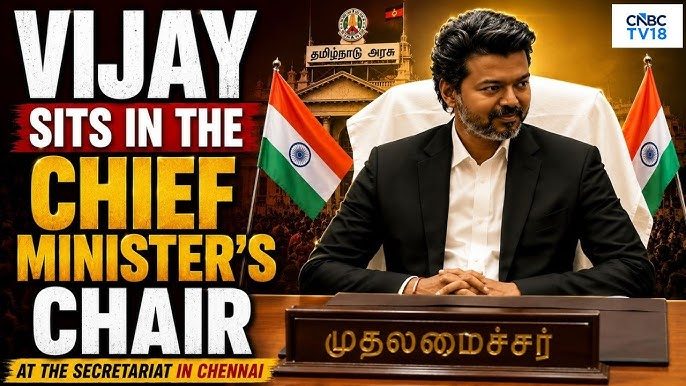
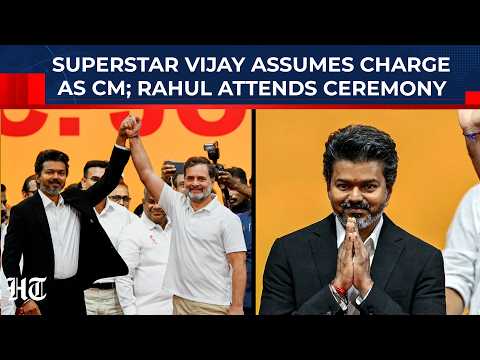
Tamil Nadu has been ruled by either the Dravida Munnetra Kazhagam (DMK) or the All India Anna Dravida Munnetra Kazhagam (AIADMK) for 59 years. On Saturday, that ended when Tamil film star C. Joseph Vijay was sworn in as Chief Minister at Chennai's Jawaharlal Nehru Stadium.

Why it matters

Tamil Nadu's two-party lock has broken, putting India's sixth-largest state in the hands of an untested coalition with no template to follow.

Key Indicators

59
Years of Dravidian duopoly
Every Tamil Nadu chief minister since 1967 came from either the DMK or AIADMK. That run ended Saturday.
120/234
Coalition seats
TVK and its five partners hold a majority of 13 seats in the new assembly.
6
Parties in coalition
TVK governs with the Congress, CPI, CPM, VCK and IUML — Tamil Nadu's first formal coalition cabinet.
May 13
Confidence vote deadline
The Governor has directed Vijay to prove his majority on the assembly floor within three days.

Interactive

Exploring all sides of a story is often best achieved with Play.

Ever wondered what historical figures would say about today's headlines?

Sign up to generate historical perspectives on this story.

Sign Up

Debate Arena

Two rounds, two personas, one winner. You set the crossfire.

People Involved

Organizations Involved

Timeline

  1. Confidence vote deadline

    Legal

    The Governor's order requires Vijay to prove a majority on the assembly floor on or before this date.

  2. Vijay sworn in as chief minister

    Political

    Vijay takes the oath of office at Jawaharlal Nehru Stadium in Chennai, leading Tamil Nadu's first coalition government.

  3. TVK holds first political conference

    Political

    Vijay addresses a large rally at Vikravandi, attacking both DMK and AIADMK and outlining party ideology.

  4. Vijay registers TVK as a political party

    Political

    The Tamil film star formalises his entry into politics with the Election Commission of India.

  5. Stalin sworn in after DMK landslide

    Political

    M.K. Stalin becomes chief minister with 159 of 234 seats, the DMK's largest mandate in two decades.

  6. Jayalalithaa dies, AIADMK weakens

    Political

    AIADMK supremo J. Jayalalithaa's death triggers a long succession fight that erodes the party's electoral base.

  7. DMK ends Congress rule in Tamil Nadu

    Political

    C.N. Annadurai becomes the first non-Congress chief minister of Madras State, beginning 59 years of unbroken Dravidian rule.

Scenarios

1

Coalition holds, Vijay completes a full term

Discussed by: The Hindu editorial, News Minute analysis

Coalition partners stay in line because none can govern alone and a fresh poll would favour TVK. Vijay leans on Congress and the Left for legislative drafting and welfare design while TVK builds administrative depth. Confidence vote on May 13 passes without defections. Welfare cash transfers continue, keeping the AIADMK out of contention until 2031.

2

Coalition fractures within first year

Discussed by: Frontline magazine, Deccan Herald commentary

Cabinet allocation disputes or Congress-Left tension over economic policy strain the alliance. Smaller partners pull support over a flashpoint such as a NEET exemption bill, language policy or local-body elections. The Governor calls for a fresh vote of confidence and Vijay either negotiates new partners or faces dissolution and re-election within 18 months.

3

DMK rebuilds and retakes power in 2031

Discussed by: DMK strategists quoted in News Minute

Stalin's party uses opposition years to rework its dynastic image and reabsorbs Congress and the Left as TVK's coalition strains. Anti-incumbency hits TVK harder because Vijay has no record to defend a state-wide welfare brand against. The DMK regains majority in the 2031 election cycle and frames TVK as a one-term experiment.

4

TVK absorbs AIADMK voters and becomes dominant party

Discussed by: Organiser, Indian Express analysts

AIADMK fragments after its third-place finish, with cadres and second-rung leaders moving to TVK. Vijay consolidates the anti-DMK pole into a single party and reduces Tamil Nadu to a TVK-DMK contest by 2031. The Dravidian binary returns in form but with TVK replacing AIADMK as the second pole, and the BJP remains shut out of state power.

Historical Context

DMK ousts Congress in Madras State (1967)

March 1967

What Happened

C.N. Annadurai's DMK won 137 of 234 seats in Madras State, ending two decades of Congress rule. The campaign mobilised Tamil pride, anti-Hindi sentiment from the 1965 protests, and opposition to food shortages. Annadurai was sworn in as the first non-Congress chief minister of the state.

Outcome

Short Term

Annadurai's government renamed the state Tamil Nadu in 1969 and rolled out subsidised rice schemes. The Congress was reduced to a marginal player in state politics within a single election cycle.

Long Term

No non-Dravidian party won a Tamil Nadu assembly election for the next 59 years. The DMK and its 1972 breakaway, AIADMK, alternated power until 2026.

Why It's Relevant Today

The 1967 result is the benchmark Vijay's win is being measured against. It is the only other time in living memory that Tamil Nadu voters replaced an entrenched governing tradition wholesale.

N.T. Rama Rao founds Telugu Desam Party (1982-83)

March 1982 to January 1983

What Happened

Telugu film star N.T. Rama Rao launched the Telugu Desam Party in March 1982 on a platform of Telugu pride and anti-Congress politics. Within nine months his party won 199 of 294 seats in Andhra Pradesh, defeating the Congress. NTR was sworn in as chief minister in January 1983.

Outcome

Short Term

The Telugu Desam Party formed Andhra Pradesh's first non-Congress government and remained a force in state politics through the 1980s and 1990s. NTR served three non-consecutive terms as chief minister.

Long Term

TDP and a later breakaway, the YSR Congress, have shared power in Andhra Pradesh ever since. The Congress never returned to majority in the state.

Why It's Relevant Today

NTR's nine-month sprint from launch to chief minister is the closest Indian parallel to Vijay's path. Both used film celebrity, regional pride and anti-incumbency to break a single dominant party.

Aam Aadmi Party breaks Delhi's two-party system (2013-2015)

December 2013 to February 2015

What Happened

Arvind Kejriwal's Aam Aadmi Party, founded in November 2012, won 28 of 70 Delhi assembly seats in December 2013 and formed a 49-day minority government. After resigning over the Lokpal bill, AAP returned in February 2015 with 67 of 70 seats, wiping out both the Bharatiya Janata Party and the Congress.

Outcome

Short Term

AAP governed Delhi with a near-total majority and rolled out free electricity, water and Mohalla clinics. The party became the third pole in Indian politics outside Congress and BJP.

Long Term

AAP held Delhi until 2025 and won Punjab in 2022 but lost Delhi back to the BJP in February 2025. The party never broke through nationally.

Why It's Relevant Today

AAP showed that a new party can break a two-party lock in an Indian state within two years. It also showed how hard governing coalitions and welfare promises are to sustain — a warning Vijay's TVK now faces.

Sources

(4)