
Pull to refresh
Logo
Logarithms of rational numbers proven to have irrationality measure 2

Logarithms of rational numbers proven to have irrationality measure 2

New Capabilities

Machine-verified proof replaces best-known bound of 3.5746 for log 2

Yesterday: Result reaches wide audience via Hacker News

Overview

Updated Yesterday

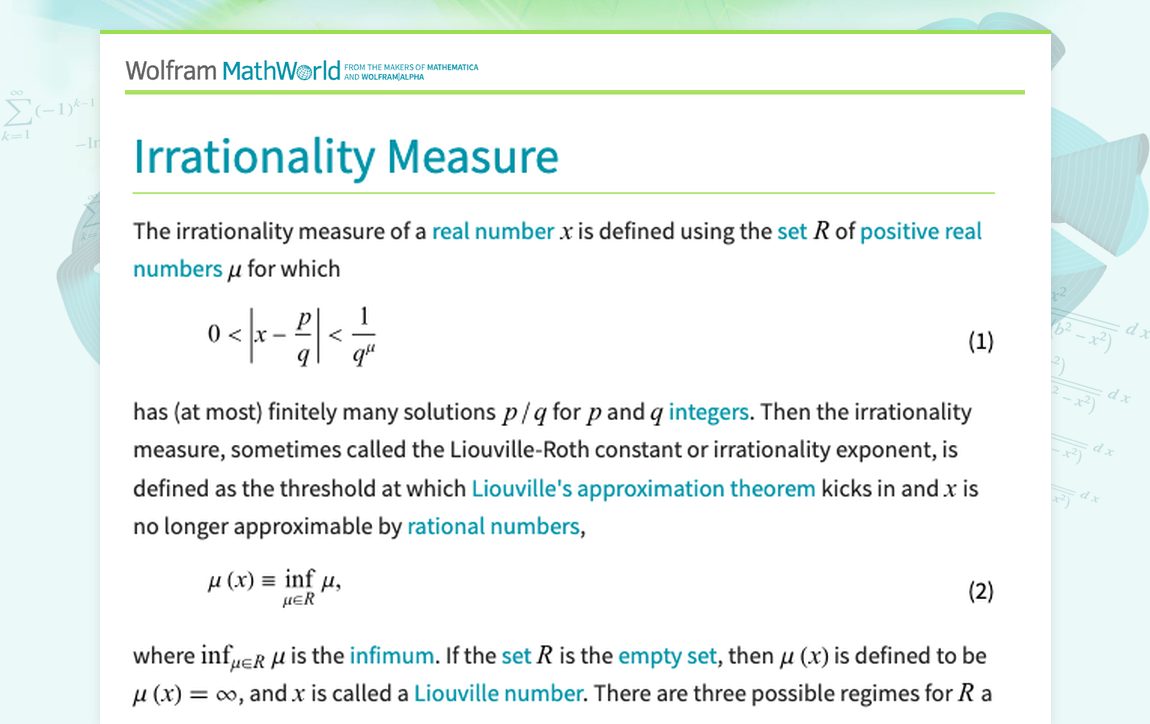
Every irrational number can be approximated by fractions, but some yield better approximations than others. A new proof shows log 2 and every logarithm of a positive rational number are as resistant as possible, with irrationality measure exactly 2.

The theoretical floor is 2, guaranteed by Dirichlet's theorem, so the result is the best possible. The previous upper bound for log 2 stood at 3.5746; the proof is machine-verified in Lean 4, and an independent proof from Wuhan University reached the same conclusion.

Why it matters

Log 2 and all rational-number logarithms are now proven maximally irrational, settling a question whose best-known bound sat at 3.5746 for over a decade.

Questions about this story

Free account needed to ask — your question is kept and asked for you right after sign-up. Answers are public.

No questions yet — be the first to ask.

Key Indicators

2
Irrationality measure of log r for rational r ≠ 1
The theoretical minimum for any irrational number, by Dirichlet's theorem.
3.5746
Previous best upper bound for μ(log 2)
Marcovecchio's bound, the state of the art before the new proof.
2
Independent proofs of the result
The pseudonymous GitHub paper and the Wuhan University team reached the same conclusion.

Voices

Curated perspectives — historical figures and your fellow readers.

Ever wondered what historical figures would say about today's headlines?

Sign up to generate historical perspectives on this story.

People Involved

Organizations Involved

Timeline

1844 October 2026

7 events Latest: Yesterday
Tap a bar to jump to that date
  1. Result reaches wide audience via Hacker News

    Latest Distribution

    The paper was shared on Hacker News, bringing the result to broad public attention.

  2. Proof of exact measure 2 posted

    Discovery

    Paper dated October 7 proves μ(log r) = 2 for every positive rational r ≠ 1, with the proof formalized in Lean 4.

  3. Independent proof posted on arXiv

    Discovery

    Wuhan University researchers Liu and Jiang posted an independent proof of the same result to arXiv.

  4. Marcovecchio's bound of 3.5746 becomes record

    Discovery

    By 2010, Marcovecchio's estimate of 3.5746 for log 2's irrationality measure was established and discussed in the literature, improving on Hata and Rukhadze.

  5. Rukhadze improves log 2 bound

    Discovery

    Rukhadze obtained an improved irrationality measure for log 2, starting the modern quest for its exact value.

  6. Roth proves exponent 2 for algebraic numbers

    Discovery

    Klaus Roth showed every algebraic irrational has irrationality exponent exactly 2, the benchmark for all later work. He received a Fields Medal in 1958.

  7. Liouville establishes first irrationality bounds

    Discovery

    Liouville proved algebraic numbers cannot be approximated too well by rationals, founding the theory of irrationality measures.

Scenarios

1

Result confirmed in peer-reviewed literature

Likely Resolves by End of 2028

Discussed by: Mathematical community, formal verification community

The Lean 4 formalization means the proof's logical steps are machine-checked, so mathematical acceptance is essentially guaranteed. The remaining question is journal publication. The pseudonymous authorship of one paper may slow its acceptance, but the Wuhan proof provides independent confirmation.

2

Technique extended to algebraic arguments

Possible Resolves by Q2 2029

Discussed by: The paper itself, number theorists studying irrationality measures

The paper notes that for a real algebraic number α of degree d, the same argument gives μ(log α) ≤ 2d. A follow-up making this explicit and proving it in full detail would extend the reach of the method beyond rational arguments.

3

Effective bounds derived from the proof

Possible Resolves by End of 2030

Discussed by: Number theorists seeking concrete constants

The current proof establishes a threshold Q(r, ν) but provides no computable value—the paper explicitly says "no effective value for it is obtained here." A future paper could extract explicit constants, valuable for computational applications.

Historical Context

3 moments from history that rhyme with this story — and how they unfolded.

1955

Roth's theorem (1955)

Klaus Roth proved that every algebraic irrational number has irrationality exponent exactly 2, resolving a problem posed by Liouville in 1844. The proof used a combinatorial argument and earned Roth a Fields Medal in 1958.

Then

Established exponent 2 as the target for all irrational numbers of algebraic origin.

Now

Provided the benchmark that the new log proof matches for a transcendental family—logarithms of rational numbers.

Why this matters now

The new proof is explicitly described as a "Roth-type argument" on the exponential curve, directly adapting Roth's framework.

c. 2010

The Marcovecchio bound for log 2 (c. 2010)

Marcovecchio obtained an upper bound of 3.5746 for the irrationality measure of log 2, improving earlier work by Rukhadze (1987) and Hata. The result used Meyer G-functions and complex integral techniques, a different approach from Pade-type constructions.

Then

Set the best-known upper bound for log 2's irrationality measure, a record that stood for over a decade.

Now

Represented the limit of the Pade-type construction approach; the new proof bypasses it entirely.

Why this matters now

The new result renders this line of bounds obsolete, replacing 3.5746 with the exact value 2.

Recent

The proof that μ(π) = 2 (reference [4])

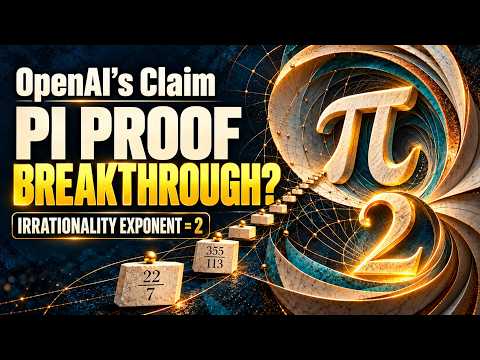
A companion paper, also attributed to the pseudonymous author, proved that the irrationality measure of π is exactly 2. The method used an interpolation determinant with centers on the exponential curve, relying on a property of π that placed centers on the curve.

Then

Established an exact irrationality measure for a classical transcendental constant.

Now

The same method, with centers moved from the π-based points to (log r, r), yields the new log result.

Why this matters now

The log proof is a direct adaptation of this π proof, substituting the identity e^(log r) = r for the property of π used in the original.

Sources

(5)