

Pull to refresh
Logo
OpenAI preprint claims to disprove the polynomial Hirsch conjecture

OpenAI preprint claims to disprove the polynomial Hirsch conjecture

New Capabilities

A Lean-checked construction would end a decades-old search for a polynomial bound on polytope diameters

Overview

Updated 55 minutes ago

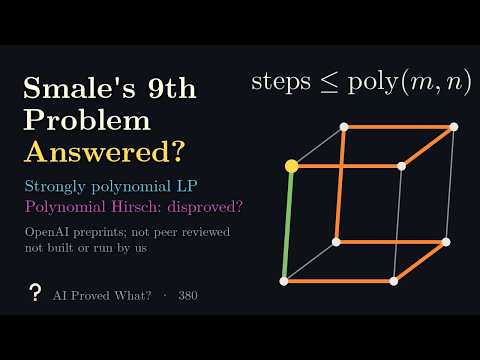
A polytope with n flat sides has a graph, and the Hirsch conjecture bounded the walk between any two of its vertices. For decades, a weaker, polynomial version of that bound survived. A preprint OpenAI posted on November 24 claims it is false too.

The construction is a family of simple rational polytopes with n facets whose edge diameter outgrows every fixed power of n, with dimension rising slowly in n. AI Proof Watch reports that the Lean proof assistant checked the stated claims. No journal has reviewed the work, and the tracker rates human understanding of it as minimal.

Why it matters

If polytope diameter can outgrow every polynomial, no edge-walking simplex pivot rule can be guaranteed to run in polynomial time.

Questions about this story

Free account needed to ask — your question is kept and asked for you right after sign-up. Answers are public.

No questions yet — be the first to ask.

Key Indicators

43
Dimensions of the 2010 counterexample
Francisco Santos built a 43-dimensional polytope that broke the original Hirsch bound.
86
Facets on that polytope
Its diameter was 44, one more than 86 minus 43 allowed.
16
Years the polynomial version stayed open
Santos killed the linear bound in 2010; the polynomial question outlived it until this preprint.

Voices

Curated perspectives — historical figures and your fellow readers.

Sign up to generate historical perspectives on this story.

People Involved

Organizations Involved

Timeline

1957 November 2026

5 events Latest: 2 days ago
Tap a bar to jump to that date
  1. OpenAI posts its preprint

    Latest Mathematics

    OpenAI posts a preprint claiming superpolynomial diameter for simple rational polytopes.

  2. Polymath3 opens

    Collaboration

    Gil Kalai opens Polymath3 to attack the polynomial Hirsch conjecture.

  3. Santos breaks the linear bound

    Mathematics

    Francisco Santos publishes a 43-dimensional, 86-facet polytope with diameter 44.

  4. A quasipolynomial ceiling

    Mathematics

    Kalai and Kleitman prove a quasipolynomial upper bound on polytope diameter.

  5. Hirsch poses his bound

    Conjecture

    Warren Hirsch conjectures diameter at most n − d for a d-polytope with n facets.

Scenarios

1

Outside mathematicians reproduce the construction

Possible Resolves by End of 2027

Discussed by: AI Proof Watch, which flags minimal human understanding of the result as the open problem

The Lean proofs cover the stated edge-diameter claim and the extension to moves across low-dimensional faces. Independent readers would need to reconstruct the polytope family and the argument in ordinary prose. If that happens, the polynomial Hirsch conjecture gets retired in textbooks and the result finds a journal.

2

The Lean proof holds but the headline claim shrinks

Possible Resolves by Q2 2027

Discussed by: AI Proof Watch, which distinguishes the formally checked subset from the full natural-language claim

A proof assistant checks exactly what it is given, and the gap between a formal statement and a paper's framing is where scope disputes start. If reviewers find the Lean theorem covers a narrower family or a weaker bound than the title implies, the disproof survives in reduced form while the press framing does not.

3

A gap is found and the claim withdraws

Unlikely Resolves by End of 2027

Discussed by: No named critic has published an objection; this is the standard risk for an unreviewed preprint

The construction is a family statement with subpolynomial dimension growth, which leaves room for an indexing or asymptotic error that a formalization could inherit from a misstated theorem. A specific published objection that OpenAI acknowledges would end the claim.

Historical Context

3 moments from history that rhyme with this story — and how they unfolded.

1957

Hirsch conjecture posed (1957)

Warren Hirsch, working on the simplex method for linear programming, conjectured that any d-dimensional polytope with n facets has graph diameter at most n − d. The bound would have meant that a simple pivot rule could reach any vertex in at most n − d steps.

Then

The conjecture became the standard guess about pivot counts in linear programming.

Now

It organized polytope diameter theory for five decades, and its polynomial relaxation carried the algorithmic stakes after the original bound fell.

Why this matters now

The preprint attacks the relaxation that survived 2010, not the original 1957 statement.

1992

Kalai–Kleitman quasipolynomial bound (1992)

Gil Kalai and Daniel Kleitman proved that the diameter of a polytope with n facets and dimension d is bounded by roughly n raised to a power proportional to log d. That is subexponential in n but not polynomial in n.

Then

It gave the first general bound well below the trivial exponential one.

Now

It remains the reference ceiling, and it explains why a superpolynomial but subexponential diameter is consistent with everything already known.

Why this matters now

The claimed construction sits inside this window: faster than any fixed power of n, with dimension growing slowly enough to stay under the quasipolynomial ceiling.

June 2010

Santos breaks the Hirsch conjecture (2010)

Francisco Santos built a 43-dimensional polytope with 86 facets and diameter 44, one step past what the Hirsch bound allowed. The example came from a five-dimensional spindle with 48 facets and length six, run through a construction that preserves and increases distance.

Then

The linear Hirsch conjecture was dead after 53 years.

Now

Santos also showed diameters can exceed (1+ε)n in fixed dimension, ruling out any linear bound. The polynomial question survived him, and Polymath3 formed around it within months.

Why this matters now

The new preprint claims to close the gap Santos left open, using the same style of asymptotic family argument.

Sources

(7)