

Pull to refresh
Logo
Harvard researchers use sound waves to shield quantum bits from noise

Harvard researchers use sound waves to shield quantum bits from noise

New Capabilities

Continuous acoustic field triples coherence time of a diamond qubit, a step toward chip-scale quantum networks

Today: Harvard team demonstrates all-mechanical coherence protection

Overview

Updated 1 hour ago

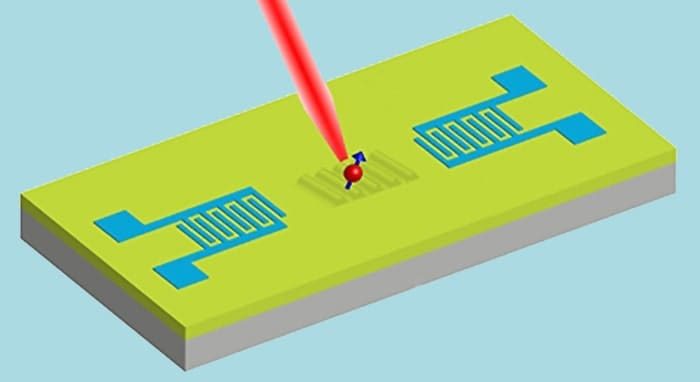
Harvard researchers extended the memory of a diamond-based quantum bit roughly threefold by surrounding it with a continuous stream of microscopic sound waves. The technique, published in Nature Physics, could let phonons both carry and protect quantum information in compact networks built on chips.

Qubits are extremely sensitive to disturbances from their surroundings, losing their stored state quickly. Standard protection uses microwave pulses, but those don't work inside phononic cavities, the structures that let sound shuttle information between qubits. The Harvard team instead dressed the qubit in a constant acoustic field, shielding it from low-frequency noise while keeping it coupled to the vibrations that carry data.

Why it matters

If this technique scales, quantum networks could fit on a single chip, moving quantum computing toward practical machines.

Questions about this story

Free account needed to ask — your question is kept and asked for you right after sign-up. Answers are public.

No questions yet — be the first to ask.

Key Indicators

3x
Coherence time extension
Silicon-vacancy spin coherence extended roughly threefold under continuous acoustic driving.
800 MHz
Fastest SiV spin rotation
Ultrafast spin rotations achieved, the fastest ever recorded for silicon-vacancy spins.
~100x
Speed gain over magnetic control
Mechanical driving rotates spins far faster than prior magnetic-field-based methods.

Voices

Curated perspectives — historical figures and your fellow readers.

Ever wondered what historical figures would say about today's headlines?

Sign up to generate historical perspectives on this story.

Play

Exploring all sides of a story is often best achieved with Play.

Most of these play right now — no account needed. Sign up to save scores, keep a streak, and unlock Debate and Predict. Log in Sign Up
Predict 3 ways this could play out. Back the one you believe — contrarian picks score more when a scenario has a resolution date. Log in to play

People Involved

Organizations Involved

Timeline

2024 September 2026

2 events Latest: Today
  1. Harvard team demonstrates all-mechanical coherence protection

    Today Experimental result

    Researchers at Harvard SEAS extend silicon-vacancy spin coherence threefold using continuous acoustic waves; paper published in Nature Physics.

  2. TUM theorists propose continuous spin rotation

    Theory

    Prof. Rabl and collaborators suggest driving spins with a strong external field so noise averages out while phonon coupling stays intact.

Scenarios

1

Phonon network links multiple qubits on one chip

Possible Resolves by End of 2027

Discussed by: Harvard SEAS team and Technical University of Munich theorists

Researchers demonstrate entanglement or coherent quantum state transfer between two or more silicon-vacancy spins on a single chip, mediated by phonons moving through the same mechanical cavities that provide protection. This would prove the dual role of phonons as carrier and shield.

2

Mechanical coherence protection spreads to other qubit platforms

Likely Resolves by Q2 2028

Discussed by: Prof. Rabl and colleagues at Technical University of Munich

Research groups apply the all-mechanical approach to other solid-state qubits, such as nitrogen-vacancy centers in diamond or superconducting circuits, showing the method generalizes beyond silicon-vacancy spins. Rabl has noted potential for small quantum processors and hybrid quantum devices.

3

Technique stays confined to silicon-vacancy spins

Possible Resolves by Q2 2028

Discussed by: Implicit in Rabl's caution that scaling to hundreds of qubits remains distant

No group extends the technique beyond the silicon-vacancy platform, and no practical multi-qubit network emerges in the next two years. The demonstration remains a proof-of-concept for a specialized research setting.

Historical Context

3 moments from history that rhyme with this story — and how they unfolded.

1950

Hahn spin echo (1950)

Physicist Erwin Hahn showed that two radio-frequency pulses could reverse the dephasing of nuclear spins, recovering a coherent signal that had all but vanished. The discovery underpins nuclear magnetic resonance and magnetic resonance imaging.

Then

Became a standard tool in nuclear magnetic resonance within a decade.

Now

Every coherence-protection scheme in quantum computing descends from this idea of refocusing noise.

Why this matters now

The Harvard technique pushes the same principle forward, replacing discrete refocusing pulses with a continuous mechanical field.

1995

Cirac-Zoller ion trap proposal (1995)

Ignacio Cirac and Peter Zoller published the first concrete blueprint for a quantum computer using trapped ions controlled by laser pulses. Experimentalists built working versions within a few years.

Then

Ion traps became a leading quantum computing platform.

Now

Showed that a clean physical mechanism can turn quantum theory into engineering practice.

Why this matters now

Phonon-based networks aim for a similar shift, using mechanical vibrations as the natural control and interconnect for solid-state qubits.

1998

Bang-bang dynamical decoupling (1998)

Lorenza Viola and Seth Lloyd proposed applying rapid, strong pulses to a quantum system to average away environmental coupling, systematically generalizing Hahn's echoes into a general-purpose error-suppression tool.

Then

Became a core technique in NMR quantum computing and trapped-ion systems.

Now

Pulse-based decoupling methods have steadily pushed coherence times upward across qubit platforms.

Why this matters now

The new work departs from pulse-based methods, using a continuous acoustic drive as a mechanical cousin of the same goal.

Sources

(10)