Anchor

Treasury sanctions Xinbi Guarantee, a massive scam marketplace
Money MovesThe $24 billion platform was designated a transnational criminal organization; $52.8 million in crypto was frozen
Yesterday: OFAC sanctions Xinbi; SCSF seizes infrastructureNew here? Follow stories to track developments over time. Create a free account to get updates when stories you care about change.
Overview
Updated 1 hour agoThe U.S. Treasury designated Xinbi Guarantee, a Chinese-language online marketplace, as a transnational criminal organization on September 9. The platform has processed more than $24 billion in digital assets since 2022, and the Justice Department seized its infrastructure the same day.
The action targets the financial plumbing behind Southeast Asia's scam centers, which steal billions from Americans each year. Xinbi's operators moved to USDD, a stablecoin with no freeze switch, after 52 wallets holding $52.8 million in tether were frozen.
Why it matters
Scam centers in Southeast Asia steal billions from Americans each year; this action targets the escrow platform that lets them operate.
Questions about this story
Free account needed to ask — your question is kept and asked for you right after sign-up. Answers are public.
No questions yet — be the first to ask.
Key Indicators
$24B
Total transactions processed since 2022
Xinbi Guarantee has processed over $24 billion in digital assets and fiat currency, primarily in Southeast Asia.
$52.8M
Crypto frozen in 52 wallets
The Secret Service froze 52 wallets holding $52.8 million in tether, based on intelligence from Elliptic.
2
Supporting entities sanctioned
SafeW Technology and Anwen Technology were designated for supporting Xinbi's operations.
$31B
Huione Guarantee's total before closing
The predecessor marketplace processed $31 billion over four years before closing in May 2025.
Related Media
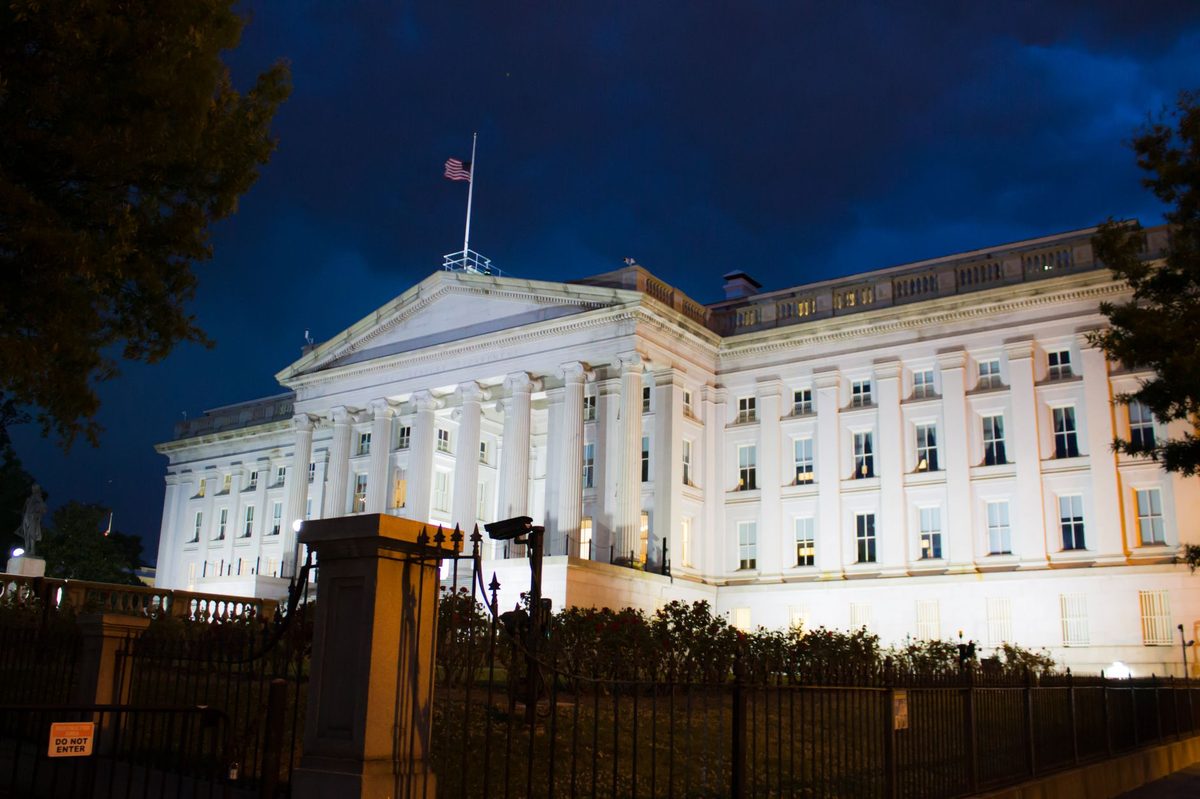
Stunning view of the U.S. Treasury Building illuminated against a twilight sky in Washington, DC.

26.0K views
13:25
'13 Chinese-run scam compounds': $52 million seized, DOJ ...
The Economic Times

11.7K views
33:27
DOJ Announces Actions Against Chinese-Run Scam Marketplace
NTD

163 views
30:43
DOJ seizes $50 million in crypto tied to scam network on ...
KVAL News
Images from Openverse under Creative Commons licenses. Videos from YouTube.
Voices
Curated perspectives — historical figures and your fellow readers.
Play
Exploring all sides of a story is often best achieved with Play.
Most of these play right now — no account needed. Sign up to save scores, keep a streak, and unlock Debate and Predict.
Log in
Sign Up
Higher or Lower
A number from this story, against one from elsewhere in the news — guess which is bigger, then keep the chain going. 5 rounds, 3 strikes; a miss costs a strike and resets your streak.
Example
Anchor
EU tariff revenue
$52B
Big for this kind of number
Mystery
Pentagon AI contract
?
Round 1
Streak: 0
Mystery
?
Keyboard: ↓/L lower · ↑/H higher
0 pts
Best streak: 0 · Rounds: 0
0 points — sign up to put that on the leaderboard.
Now try on this story
Timeline
Treasury sanctions Xinbi Guarantee, a massive scam marketplace
Order five events from this story, oldest at top. Each in the right slot scores 1 — neighbours within one slot count too. Your previous result — green ✓ for exact slots, yellow ~ for off by one. Cards now in true chronological order.
Loading puzzle…
Tap 💡 Free hint to lock the oldest into slot 1 — that leaves just four to order. Type pills are clues.
0/5
Exact slot
0/5
Within 1
Sign up to save your score and track a streak across stories.
Now try on this story
Connections
Sixteen names from the news. Find the four hidden groups of four. Four mistakes max.
Loading today's puzzle…
0/4 groups
Mistakes
Sign up to keep a daily streak — a new puzzle lands every day.
Now try on this story
Exit debate?
Your progress in this debate will be lost.
How it works
- 1 Two AI personas square off on this story.
- 2 You predict who'll win each round — correct picks earn XP.
- 3 One crossfire question is yours to fire. Pick it carefully.
Couldn't generate a topic
Select Your Champions
Choose one persona for each side of the debate
DEBATE TOPIC
Choose personas with different perspectives for a more dynamic debate.
SIDE A (PRO)
Select debater for this side:
No debate personas available right now.
SIDE B (CON)
Select debater for this side:
No debate personas available right now.
VS
Get ready to make your prediction...
Round of
Claim
Evidence
Stakes
Crossfire Answer
Closing Statement
Claim
Evidence
Stakes
Crossfire Answer
Closing Statement
Your Crossfire Question
Generating arguments...
Who's Got This Round?
Make your prediction before the referee scores
The referee scores both sides on
Correct predictions earn +20 XP
· Press 1 or 2 to pick
Evidence
40%
Logic
30%
Detail
20%
Style
10%
Round Results
Your Pick
Not this time
(%)
Overall Score
/10
Your Pick
Not this time
(%)
Overall Score
/10
Set the Crossfire
Pick the question both personas must answer in the final round
Crafting crossfire questions...
Choosing a question earns +10 XP crossfire bonus
🏆
Total XP Earned
Cred Change
Predictions
Debate Oracle! You called every round!
Sharp Instincts! You know your debaters!
The Coin Flip Strategist! Perfectly balanced!
The Contrarian! Bold predictions!
Inverse Genius! Try betting the opposite next time!
XP Breakdown
Base completion
+20 XP
Rounds played ( rounds x 5 XP)
+ XP
Correct predictions ( correct x 20 XP)
+ XP
Crossfire bonus
+10 XP
Accuracy
%
Prediction History
Round
You picked:
✓
✗
Now try on this story
Keep debating to level up your credibility and unlock achievements
People Involved
Organizations Involved
U.S. Treasury — Office of Foreign Assets Control (OFAC)
Federal Agency
Designated Xinbi Guarantee as a transnational criminal organization
The Treasury Department's sanctions enforcement arm.
Xinbi Guarantee
Criminal Organization
Sanctioned by OFAC; infrastructure seized
A Chinese-language illicit online marketplace connecting scam center operators with merchants.
Elliptic
Blockchain Analytics Firm
Provided intelligence that enabled the freeze
A blockchain analytics firm that tracked Xinbi's wallet infrastructure for years.
Scam Center Strike Force
DOJ Task Force
Seized Xinbi's infrastructure and wallets
A Justice Department task force targeting scam center operations.
ST
SafeW Technology Co., Ltd.
Technology Company
Sanctioned for supporting Xinbi
Singapore-based developer of the SafeW messaging app used by Xinbi.
AT
Anwen Technology Co., Ltd.
Technology Company
Sanctioned for supporting Xinbi
Cambodia-based developer of the XinbiPay wallet.
Timeline
January 2022 September 2026
7 events
Latest: Yesterday
Tap a bar to jump to that date
-
OFAC sanctions Xinbi; SCSF seizes infrastructure
Latest SanctionsTreasury designates Xinbi a transnational criminal organization. The DOJ's Scam Center Strike Force seizes its infrastructure and wallets.
-
Secret Service freezes 52 wallets
EnforcementWallets holding $52.8 million in tether are frozen based on Elliptic intelligence. Xinbi begins moving funds to USDD.
-
UK sanctions Xinbi Guarantee
SanctionsThe UK's Foreign, Commonwealth, and Development Office sanctions Xinbi, complementing later U.S. action.
-
Trump signs Executive Order 14390
PolicyThe order directs the U.S. government to combat cybercrime, fraud, and predatory schemes against Americans.
-
Xinbi migrates to new infrastructure
PivotXinbi moves to the SafeW messaging app and launches the XinbiPay wallet as scrutiny increases.
-
Huione Guarantee closes
Market ShiftThe largest such marketplace, which processed $31 billion, closes after FinCEN named Huione Pay a money laundering concern.
-
Xinbi Guarantee launches
LaunchThe Chinese-language escrow marketplace begins operations, connecting scam operators with merchants.
Historical Context
3 moments from history that rhyme with this story — and how they unfolded.
October 2013
Silk Road takedown (2013)
The FBI shut down Silk Road, the first major darknet marketplace, in October 2013. Founder Ross Ulbricht, operating as 'Dread Pirate Roberts,' was arrested and later sentenced to life in prison.
Then
The marketplace was taken offline and Ulbricht was convicted on multiple charges.
Now
Established the precedent that darknet marketplaces are not beyond the reach of U.S. law enforcement.
Why this matters now
Like Xinbi, Silk Road was a trust-based marketplace for illicit transactions. Its takedown showed that law enforcement can dismantle such platforms by targeting their operators and infrastructure.
May 2013
Liberty Reserve shutdown (2013)
U.S. authorities shut down Liberty Reserve, a digital currency used for money laundering, in May 2013. The platform processed an estimated $6 billion in illicit transactions before its founder Arthur Budovsky was arrested in Spain.
Then
Liberty Reserve was shut down and Budovsky was extradited and convicted.
Now
Demonstrated that U.S. law enforcement would pursue the financial infrastructure of cybercrime across borders.
Why this matters now
Like Xinbi, Liberty Reserve was a financial platform that enabled criminal transactions at scale. Its takedown shows the pattern of targeting the payment rails rather than individual criminals.
May 2025
Huione Guarantee closure (2025)
Huione Guarantee, the largest illicit guarantee marketplace, processed $31 billion over four years before closing in May 2025. FinCEN named its parent company Huione Pay a primary money laundering concern, and Elliptic's tracking put pressure on the platform.
Then
Huione closed, and cybercriminals migrated to Xinbi Guarantee, which offered substantially similar services to an overlapping customer base.
Now
Shows the whack-a-mole pattern: when one marketplace falls, another rises to take its place.
Why this matters now
Xinbi absorbed much of Huione's business after it closed. The question now is whether Xinbi's fate will mirror Huione's, or whether the pattern repeats with a new platform.
Sources
(10)Related Stories
International enforcement closes in on Southeast Asia's largest crypto fraud network
Rule Changes
Updated May 30
US Treasury targets Jalisco cartel's fuel-theft money
Money Moves
Updated Jul 1
ByteDance secures $29.6 billion loan for AI infrastructure push
Money Moves
Updated 5 days ago
EU extends Russia sanctions to offshore crypto platforms
Rule Changes
Updated Aug 26
US seizes China-linked hacking platforms QScan and QTRouter
Force in Play
Updated Aug 27
US tightens financial squeeze on Hizballah's cash pipeline
Money Moves
Updated Aug 21