


Pull to refresh
Logo
U.S. battery storage passes 200 gigawatt-hours

U.S. battery storage passes 200 gigawatt-hours

Built World

Cumulative capacity reaches 215.9 GWh as Texas, Arizona and California lead installations

Overview

Updated 1 hour ago

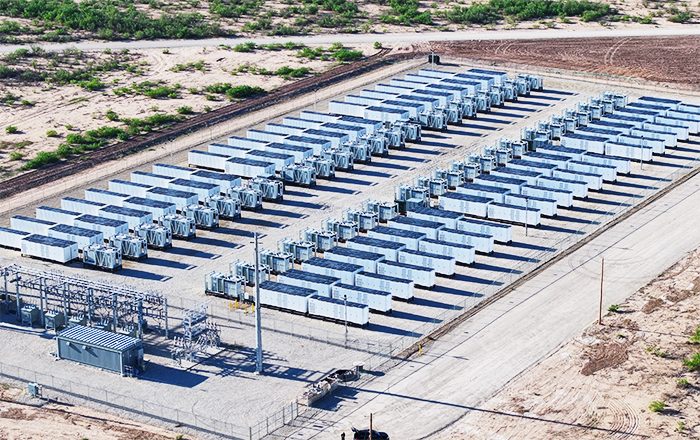
The United States had 215.9 gigawatt-hours of battery storage on its grid at the end of September, according to a quarterly report from the Solar Energy Industries Association (SEIA) and Benchmark Mineral Intelligence. A gigawatt-hour measures how much electricity a battery fleet can store. Third-quarter installations added 14.3 gigawatt-hours, and the groups expect 708 gigawatt-hours cumulatively by 2030.

Storage changes the economics of solar. Panels generate in the afternoon; batteries discharge in the evening, when demand peaks. SEIA says rapid solar and storage growth helped cut average wholesale power prices 42% in Texas and 51% in California between summer 2021 and summer 2026.

Why it matters

Batteries now shift enough solar power into evenings to change when electricity is available and what it costs.

Questions about this story

Free account needed to ask — your question is kept and asked for you right after sign-up. Answers are public.

No questions yet — be the first to ask.

Key Indicators

215.9 GWh
Installed U.S. storage capacity
Cumulative battery storage on the grid at the end of September 2026, per SEIA's summary.
14.3 GWh
Third-quarter 2026 additions
New storage installed in Q3, flat versus the prior quarter and up 23% year-over-year.
708 GWh
Forecast cumulative capacity by 2030
SEIA and Benchmark raised their 2030 forecast by 3.7% in the Q4 2026 outlook.
92.4 GWh
Domestic battery cell manufacturing capacity
New plants in Tennessee and Indiana brought total U.S. cell capacity to this level.
42%
Texas wholesale power price decline
SEIA's estimate of the drop from summer 2021 to summer 2026, attributed to solar and storage growth.
11
States setting annual storage records
States that surpassed their previous annual installation records by the end of Q3 2026.

Voices

Curated perspectives — historical figures and your fellow readers.

Sign up to generate historical perspectives on this story.

People Involved

Organizations Involved

Timeline

2025 November 2026

5 events Latest: Today
Tap a bar to jump to that date
  1. U.S. storage capacity passes 200 GWh

    Today Report

    SEIA and Benchmark put cumulative capacity at 215.9 GWh and raise the 2030 forecast to 708 GWh.

  2. Coalition projects 1 TWh by 2032

    Analysis

    U.S. Energy Storage Coalition estimates $250 billion in power system savings over a decade.

  3. Second quarter sets a record 20.2 GWh

    Deployment

    Q2 installations reach 20.2 GWh, bringing first-half 2026 totals to 30.8 GWh.

  4. 2025 record confirmed in quarterly report

    Report

    SEIA and Benchmark say 2025 installations grew 30% over the 2024 record.

  5. U.S. installs a record year of battery storage

    Deployment

    SEIA later reports 57.6 GWh installed in 2025, the largest single year on record.

Scenarios

1

Cumulative U.S. storage reaches 708 GWh by 2030

Likely Resolves by Q1 2031

Discussed by: SEIA and Benchmark Mineral Intelligence, Q4 2026 Energy Storage Market Outlook

The report's base case has annual installations exceeding 129 GWh by 2030 and cumulative capacity reaching 708 GWh. Hitting it depends on utilities signing capacity contracts, interconnection queues moving, and domestic cell supply continuing to expand. The forecast was raised 3.7% this quarter, which points to momentum rather than a ceiling.

2

Congress passes BAAJA and speeds storage permitting

Possible Resolves by End of 2027

Discussed by: SEIA, which organized a letter from more than 300 solar and storage companies

The Bipartisan American Affordability and Jobs Act would remove some permitting barriers for energy projects, including renewable installations. Democrats won control of Congress in the midterms and campaigned on lowering energy costs, which gives the bill a path. Passage would shorten timelines for projects now waiting on approvals; failure leaves the current queue in place.

3

Annual installations fall short of 129 GWh in 2030

Unlikely Resolves by Q1 2031

Discussed by: Benchmark Mineral Intelligence supply-chain analysts and EIA capacity forecasts

The 2030 forecast assumes factories keep opening and utilities keep contracting. A slowdown in data-center demand, tighter tax equity, or delays in interconnection could leave annual additions below the 129 GWh mark. Residential storage has already contracted, which shows the segments do not move together.

Historical Context

3 moments from history that rhyme with this story — and how they unfolded.

2008-2015

U.S. shale gas boom (2008-2015)

Horizontal drilling and hydraulic fracturing unlocked natural gas trapped in shale formations, and U.S. gas production rose sharply. Prices fell far enough that gas-fired plants began displacing coal generation across the power sector.

Then

Cheap gas changed which power plants ran and lowered wholesale electricity prices in many markets.

Now

The U.S. became a major exporter of liquefied natural gas, and gas became the largest source of American electricity.

Why this matters now

It shows how a supply-side cost decline can reorder an entire power market. Batteries are earlier on a similar curve, moving from niche to grid-scale.

2005-2015

Texas wind buildout (2005-2015)

Texas designated competitive renewable energy zones and built transmission lines to reach remote wind farms. Wind capacity grew quickly in a state with its own grid and competitive power market.

Then

Wind became a large share of Texas generation and pushed wholesale prices down during windy hours.

Now

Texas became the largest U.S. wind market, and its grid operator now manages large volumes of variable generation.

Why this matters now

Texas now leads the country in utility-scale storage additions, adding 12.3 GWh through Q3 2026. The same transmission-first approach is shaping where batteries get built.

2025

Record 2025 storage year

The U.S. installed 57.6 GWh of battery storage in 2025, according to SEIA and Benchmark, up 30% from the previous record. A later SEIA summary listed 58.8 GWh deployed that year.

Then

Storage became a routine part of utility resource plans rather than a pilot technology.

Now

The 2025 total set the base for the 200 GWh milestone reached in 2026.

Why this matters now

The 2026 milestone is the second year of a buildout that crossed from demonstration scale to utility procurement.

Sources

(9)