


Pull to refresh
Logo
Daily Brief
Following
Why Sign Up
United Kingdom enacts largest clinical trial reforms in 20 years

United Kingdom enacts largest clinical trial reforms in 20 years

Rule Changes
By Newzino Staff |

MHRA and HRA overhaul replaces 2004 framework with risk-proportionate, transparency-mandated regime

Today: UK clinical trial reforms take effect

Overview

For more than two decades, running a clinical trial in the United Kingdom meant navigating a framework written in 2004 for a different era of medicine. On 28 April 2026, that framework was retired. New regulations from the Medicines and Healthcare products Regulatory Agency (MHRA) and Health Research Authority (HRA) introduce a fast-track route for lower-risk studies, formalise a seven-day approval pathway for trial modifications, and make registration and publication of summary results a legal requirement for the first time.

Why it matters

Faster UK trial approvals can shave months off patient access to new cancer, rare-disease and gene therapies, and the transparency rules close a long-standing loophole that hid failed studies.

Key Indicators

169 → 122
Days for combined safety and ethics review
Average end-to-end review time has already fallen by 47 days under preparatory work before the reforms formally took effect.
7 days
Average Route B modification approval
During the 2025–2026 pilot, the new pathway approved substantial trial modifications in roughly a week, against a previous 35-day target.
20+ years
Since last major overhaul
The previous framework, the Medicines for Human Use (Clinical Trials) Regulations 2004, implemented an EU directive that critics blamed for slowing UK research.
Mandatory
Trial registration and results publication
For the first time in UK law, sponsors must register every trial and publish a summary of results, regardless of outcome.
Notifiable
New low-risk trial route
Studies of well-understood medicines used within their licensed indication can now proceed via a streamlined notification rather than full review.

Interactive

Exploring all sides of a story is often best achieved with Play.

Ever wondered what historical figures would say about today's headlines?

Sign up to generate historical perspectives on this story.

Sign Up

Debate Arena

Two rounds, two personas, one winner. You set the crossfire.

People Involved

Organizations Involved

Timeline

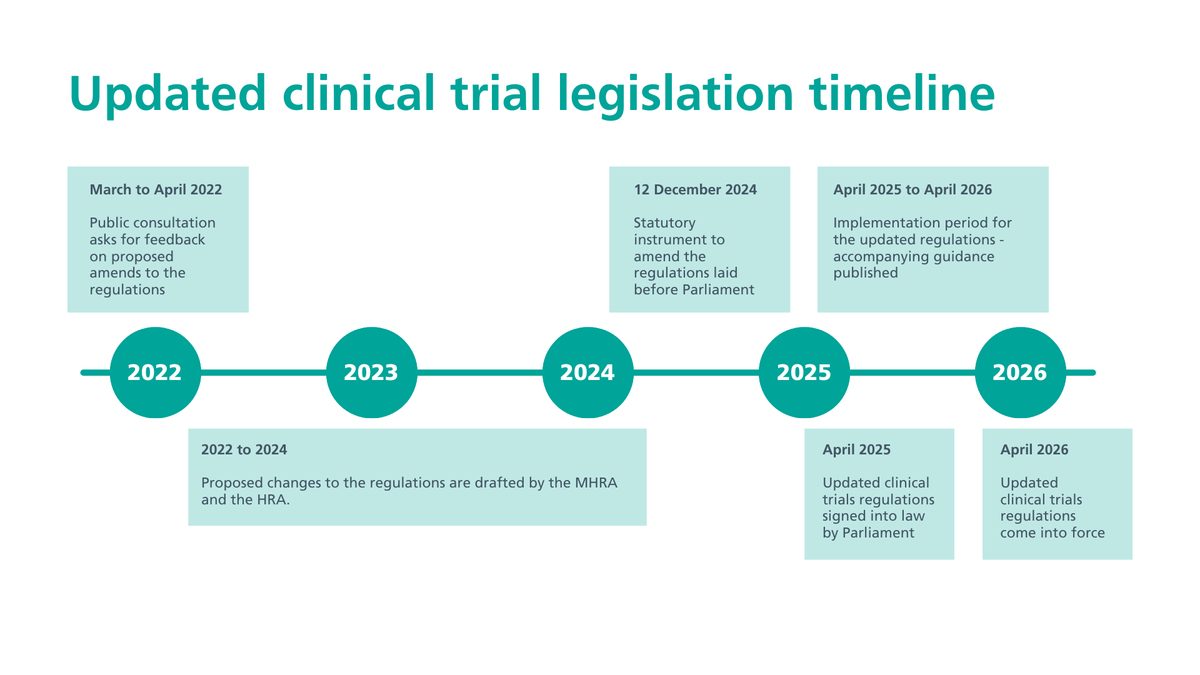
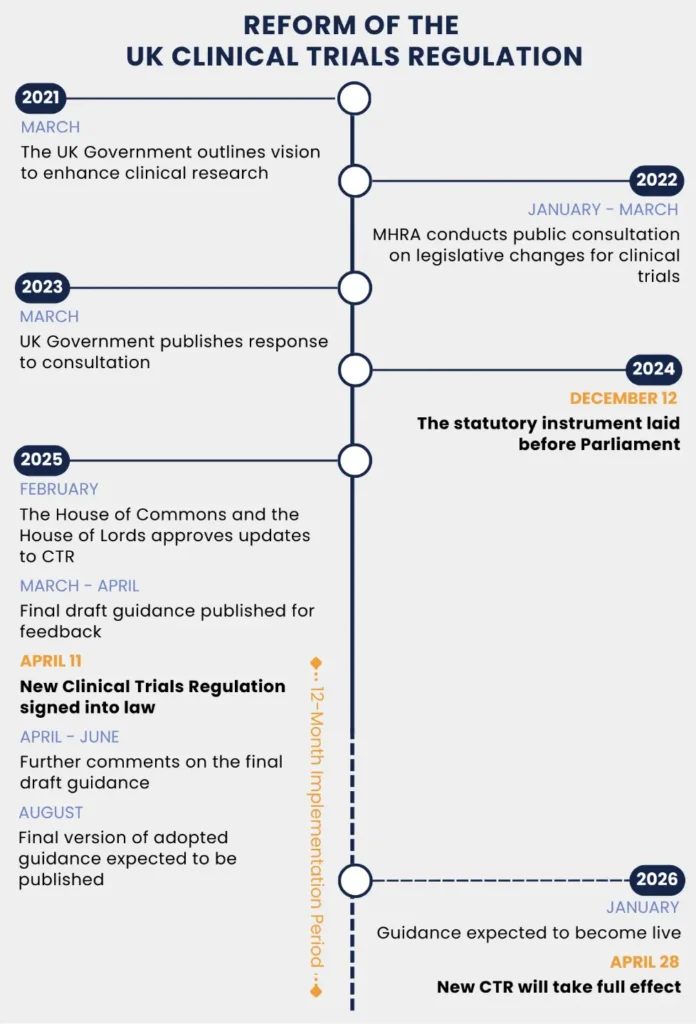
  1. UK clinical trial reforms take effect

    Regulation

    The most significant overhaul of UK trial rules in over two decades comes into force, with notifiable trials, formalised Route B, and mandatory registration and results publication now law.

  2. Route B pilot begins

    Pilot

    MHRA and HRA pilot a fast-track route for substantial trial modifications, achieving a seven-day average approval time against a previous 35-day target.

  3. Reform statutory instrument laid before Parliament

    Legislation

    The legal text of the reformed Clinical Trials Regulations is presented to Parliament, triggering a 28-day implementation countdown after approval.

  4. Government commits to risk-proportionate reform

    Policy

    MHRA publishes its response to the consultation, confirming plans for a notifiable trials route, integrated review, and transparency mandates.

  5. MHRA opens reform consultation

    Consultation

    The agency launches an eight-week public consultation on overhauling the 2004 framework, freed by Brexit from EU directive constraints.

  6. EU Clinical Trials Directive becomes UK law

    Regulation

    The Medicines for Human Use (Clinical Trials) Regulations 2004 implement an EU directive widely blamed for a sharp decline in UK academic and commercial trial activity over the following decade.

Scenarios

1

UK regains share of early-phase global trials

Discussed by: Association of the British Pharmaceutical Industry, MHRA leadership, sector analysts at companies including IQVIA

Multinational sponsors, attracted by the seven-day modification route and integrated review, increase their share of phase-one and complex adaptive trials placed in the UK. NHS sites benefit from earlier access to experimental treatments, and the UK begins to recover the trial volume it lost after 2004. This outcome depends on the reforms being matched by adequate NHS site capacity and recruitment performance, which remain bottlenecks the regulations alone cannot fix.

2

Faster approvals collide with NHS site capacity limits

Discussed by: Academic clinical trialists, NIHR commentators, House of Lords Science and Technology Committee witnesses

Approval timelines fall as designed, but the UK's persistent shortage of research-active NHS staff, recruitment infrastructure and trial pharmacy capacity means studies still take longer to complete than in competing jurisdictions. The reforms become a partial success—better than the 2004 regime, but not enough to materially shift sponsor behaviour without parallel investment in trial delivery.

3

Mandatory transparency exposes industry-wide reporting gaps

Discussed by: AllTrials campaign, BMJ editorial board, transparency researchers including Ben Goldacre's group

Once registration and summary results become legally compulsory, public dashboards reveal which sponsors—commercial and academic—are failing to report. Enforcement actions follow, and the UK's regime becomes a template that the European Medicines Agency and possibly the United States Food and Drug Administration cite when tightening their own transparency rules.

4

EU and US adopt comparable risk-proportionate routes

Discussed by: European Medicines Agency working groups, US Food and Drug Administration officials, regulatory affairs publications

Faced with sponsors openly comparing UK turnaround times to their own, the EU's Clinical Trials Information System and the FDA's IND framework adopt similar low-risk notification pathways. The UK's competitive advantage narrows, but global drug development as a whole speeds up—the reform's broader public-health goal.

Historical Context

EU Clinical Trials Directive implementation (2004)

May 2004

What Happened

The UK implemented EU Directive 2001/20/EC, applying a single rulebook to all interventional drug trials regardless of risk. Academic and investigator-led research collapsed as costs and bureaucracy multiplied; commercial sponsor activity in the UK fell sharply over the following decade.

Outcome

Short Term

Trial starts dropped, particularly for non-commercial cancer and paediatric studies. Insurance and sponsorship costs for university-led trials roughly doubled.

Long Term

The directive is widely cited as the reason European trial activity migrated to North America and Asia, and it shaped the political case for the post-Brexit reforms that took effect in April 2026.

Why It's Relevant Today

The 2026 reforms are an explicit attempt to fix what the 2004 regime broke—replacing one-size-fits-all review with risk-proportionate routes.

FDA Amendments Act trial registration mandate (2007)

September 2007

What Happened

The United States passed the FDA Amendments Act (FDAAA), requiring sponsors to register applicable trials on ClinicalTrials.gov and post summary results within a year. Compliance was patchy for years; enforcement actions began only in 2021.

Outcome

Short Term

ClinicalTrials.gov became the world's largest trial registry, but published-results compliance hovered around 40–60% for a decade.

Long Term

The FDAAA established the principle that trial transparency is a legal duty, not a courtesy. Subsequent FDA enforcement letters and civil penalties slowly raised compliance, and the rule served as the template UK reformers cited when drafting their own mandate.

Why It's Relevant Today

The UK's 2026 transparency requirements adopt the FDAAA model and apply it earlier in the pipeline, with the HRA—not a court—as primary enforcer.

EU Clinical Trial Regulation rollout (2022)

January 2022

What Happened

The EU replaced the 2004 directive with Regulation 536/2014, introducing the Clinical Trials Information System—a single portal for submissions across member states. Implementation was beset by IT problems and complaints about rigid timelines and transparency rules sponsors found onerous.

Outcome

Short Term

Submission volumes lagged forecasts as sponsors waited for the system to stabilise. Some moved early-phase studies outside the EU.

Long Term

The regulation set a baseline against which the UK's 2026 reforms are explicitly being measured by multinational sponsors choosing where to file.

Why It's Relevant Today

The UK reforms are designed to be faster and more flexible than the EU regulation while remaining compatible with it—the central trade-off shaping global sponsor decisions.

Sources

(4)